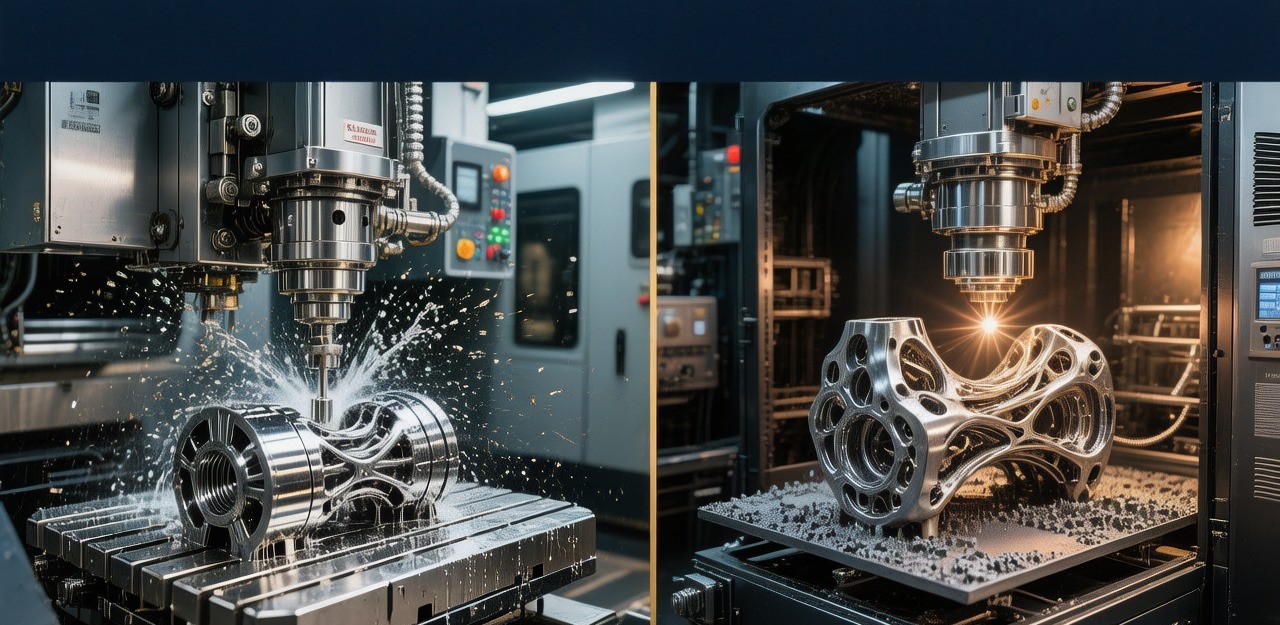
As additive manufacturing technology matures, procurement managers and design engineers increasingly face a critical decision: should you choose CNC machining or metal 3D printing for your next component? Both processes can produce functional, high-precision metal parts — but they serve fundamentally different production scenarios. Understanding their differences in cost, lead time, tolerances, material range, and scalability is essential before committing to either process.
This guide provides a practical, engineering-focused comparison to help you make an informed decision for your B2B manufacturing project.
1. Process Overview: How Each Technology Works
CNC Machining is a subtractive manufacturing process. A solid block of metal — called a billet or bar stock — is clamped onto a machine tool, and computer-controlled cutting tools systematically remove material to reveal the final part geometry. Multi-axis CNC centers (3-axis, 4-axis, 5-axis) can produce highly complex geometries in a single setup, cutting materials such as aluminum, stainless steel, titanium, brass, and engineering plastics with exceptional repeatability.
Metal 3D Printing (also called metal additive manufacturing or AM) builds parts layer-by-layer from powdered or wire feedstock. Common technologies include Selective Laser Melting (SLM), Direct Metal Laser Sintering (DMLS), and Electron Beam Melting (EBM). Unlike CNC, these processes can create complex internal geometries — lattice structures, conformal cooling channels, and organic shapes — that are impossible or impractical to machine.
Despite the excitement around additive manufacturing, CNC machining remains the dominant process for volume production of precision metal parts. According to most industry surveys, the majority of metal components in automotive, medical, aerospace, and industrial applications are still CNC-machined, due to the process's proven dimensional accuracy, wide material availability, and lower per-part cost at medium-to-high volumes.
To explore our CNC Machining service capabilities in detail, including our 3/4/5-axis machining centers and material options, visit our dedicated service page.
2. Dimensional Tolerances and Surface Quality
Tolerance capability is often the deciding factor for functional components used in assemblies, medical devices, or precision instruments. Here is how the two processes compare:
CNC Machining Tolerances: Standard CNC milling and turning operations routinely achieve tolerances of +/-0.01-0.05 mm (+/-0.0004-0.002 in). With precision grinding or finishing operations, tolerances as tight as +/-0.002-0.005 mm are achievable. Surface roughness after CNC machining typically ranges from Ra 0.8-3.2 um, and can be reduced to Ra 0.1-0.4 um with additional polishing or honing. This makes CNC the clear choice for tight-fit assemblies, bearing seats, thread features, and any application where dimensional consistency across hundreds or thousands of parts is required.
Metal 3D Printing Tolerances: As-built tolerances for most DMLS/SLM processes range from +/-0.1-0.2 mm for small features, worsening for larger parts due to thermal distortion and residual stress. As-built surface roughness is typically Ra 10-30 um — significantly rougher than machined surfaces — and usually requires post-process CNC machining, sandblasting, or electropolishing to meet functional requirements. Many metal AM parts require a post-machining step for critical surfaces, effectively combining both processes.
Verdict: CNC machining wins on dimensional accuracy and surface finish. Metal AM is acceptable for prototypes, low-stress structural components, and applications where surface quality can be post-processed. For components requiring tight tolerances, threading, or smooth mating surfaces, CNC machining is the reliable choice.
Learn more about our tolerance capabilities on our Metal Injection Molding and CNC Machining service pages, or review common engineering questions on our FAQ page.
3. Cost, Material Options, and Production Volume
Cost analysis requires examining both per-part cost and total project cost including tooling, post-processing, and qualification. Here is a structured comparison:
Tooling and Setup Cost: CNC machining requires no dedicated tooling for most parts — the same cutting tools are used across hundreds of different components, and setup costs are typically $50-$300 per part number. Metal 3D printing also has no dedicated tooling (no molds required), making setup costs comparable for prototypes. However, for production volumes above 50-100 units, CNC machining typically achieves a lower per-part cost because cycle times improve with optimized programming, and material waste (chips) can be recycled.
Per-Part Cost at Different Volumes:
- 1-10 units (prototyping): Metal AM can be cost-competitive, especially for geometrically complex parts that would require expensive 5-axis setups. CNC may require more programming time for organic shapes.
- 10-500 units (low-volume production): CNC machining typically offers lower per-part costs and better dimensional consistency. Unless the part geometry cannot be machined, CNC is preferred.
- 500+ units (medium-to-high volume): CNC machining is almost always more economical. For very high volumes of small, complex parts, Metal Injection Molding (MIM) may offer even lower per-part costs with near-net-shape capability.
Material Range: CNC machining supports virtually any machinable metal: aluminum alloys (6061, 7075), stainless steel (304, 316, 17-4 PH), titanium (Grade 2, Grade 5), copper, brass, carbon steel, tool steel, Inconel, and more. Metal 3D printing is limited to materials available in powder form for the specific machine technology — typically stainless steel, titanium alloys, aluminum alloys, cobalt-chrome, and Inconel 718. Exotic alloys, copper alloys, and most brass grades are not widely available in AM powder form.
Lead Time: CNC machining typically delivers parts in 5-15 business days for standard orders. Metal AM parts have similar lead times for printing, but post-processing (support removal, stress relief heat treatment, surface finishing, and inspection) often extends total lead time to 2-4 weeks for functional parts. For urgent prototype needs, both processes are competitive; for production deliveries, CNC is generally faster and more predictable.
Post-Processing Requirements: CNC parts typically require minimal post-processing — deburring, washing, and inspection are standard. Metal AM parts almost always require support structure removal, heat treatment for stress relief, and often secondary CNC machining of critical surfaces. These additional steps increase total cost and lead time, and must be factored into any cost comparison.
4. When to Choose CNC Machining vs Metal 3D Printing
Rather than declaring one process universally superior, experienced procurement managers use a decision framework based on part requirements:
Choose CNC Machining when:
- Tight tolerances (+/-0.01-0.05 mm) are required for assembly or function
- Production volume is 10 units or more
- The material is not available in AM powder form
- Surface finish requirements are Ra less than 3.2 um without extensive post-processing
- The part geometry can be achieved with standard 3/4/5-axis machining
- Cost per part is a primary driver at medium or high volumes
- Consistent part-to-part repeatability is critical for end-use production
Choose Metal 3D Printing when:
- The part has internal channels, lattice structures, or undercuts impossible to machine
- You need a single prototype or fewer than 5 units quickly
- Design iteration is ongoing and geometric changes are expected
- Weight reduction through topology optimization is a key design goal
- Part complexity would require expensive multi-setup CNC operations
For most B2B manufacturing scenarios — automotive brackets, medical device housings, industrial gear components, electronic enclosures — CNC machining delivers superior dimensional accuracy, broader material choice, lower per-unit cost, and better surface quality. Metal AM excels in aerospace topology-optimized structures, medical implants with complex lattice geometry, and early-stage prototypes where design flexibility outweighs unit cost.
If you are evaluating whether MIM, CNC, or another process is right for your part, our engineering team at Yujiaxin Tech offers free process selection consultations. With 27+ years of experience across six manufacturing processes, we help customers choose the most cost-effective and technically appropriate solution.
Need Precision Metal Parts for Your Project?
Yujiaxin Tech specializes in MIM, CNC Machining, Powder Metallurgy, Investment Casting, and Gear Hobbing. Get a free quote within 24 hours.