Last March a buyer called me on a Tuesday afternoon. His supplier had just moved the ship date on 8,000 aluminum 6061 brackets from day 20 to day 34, and his line was due to start consuming parts on day 50. He carried ten days of buffer stock. His question was blunt: what will it cost to fix this? The cheapest fix was not the expedite fee the supplier offered first. It was a 68 kilogram air shipment of 800 brackets that cost 390 dollars net, and his line never stopped.
To expedite a late order well, treat it as a money problem with four or five answers. Most buyers reach for the most expensive one before running any numbers. I have handled late shipments out of Chinese shops since 1998, and the order of operations matters more than the money. Here is that order.
In this guide
Find the real cause first
Ask the supplier one question before you approve any spend: what exactly slipped? The answer decides which tool works. A lost machine slot means the shop can recover by swapping CNC machining capacity, and no fee may be needed. A late aluminum mill delivery means the shop cannot start cutting at all. A failed lot means a rerun, with the same risk as the first.
I trust a supplier who names the exact operation that slipped. "The brackets are delayed" tells me nothing. "The 6061 plate came in late from the mill, material is in house now, machining starts Monday" gives me a date I can hold someone to.
On the bracket order the cause was a lost machining slot: a medical job with a hospital deadline pushed in ahead of us. Frustrating, but recoverable. Capacity problems respond to money or persuasion. Material problems respond only to time.
What expediting actually costs
Three cost buckets sit under every expediting decision. Price all three before approving anything.
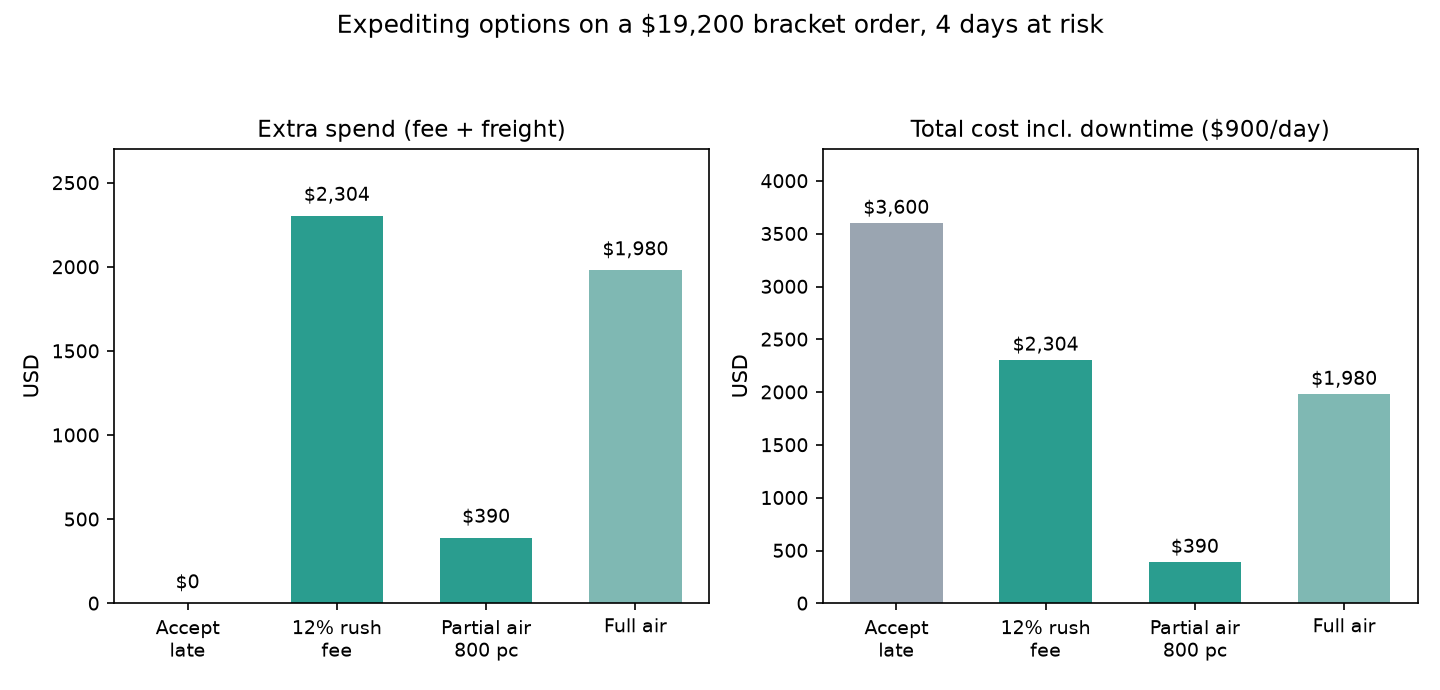
Rush fees run 10 to 25 percent of order value, sometimes a flat figure tied to overtime hours. The supplier on the bracket order asked 12 percent of the 19,200 dollar order value, so 2,304 dollars, to restore the day 24 ship date. Shops ask 18 percent when they know your line is down.
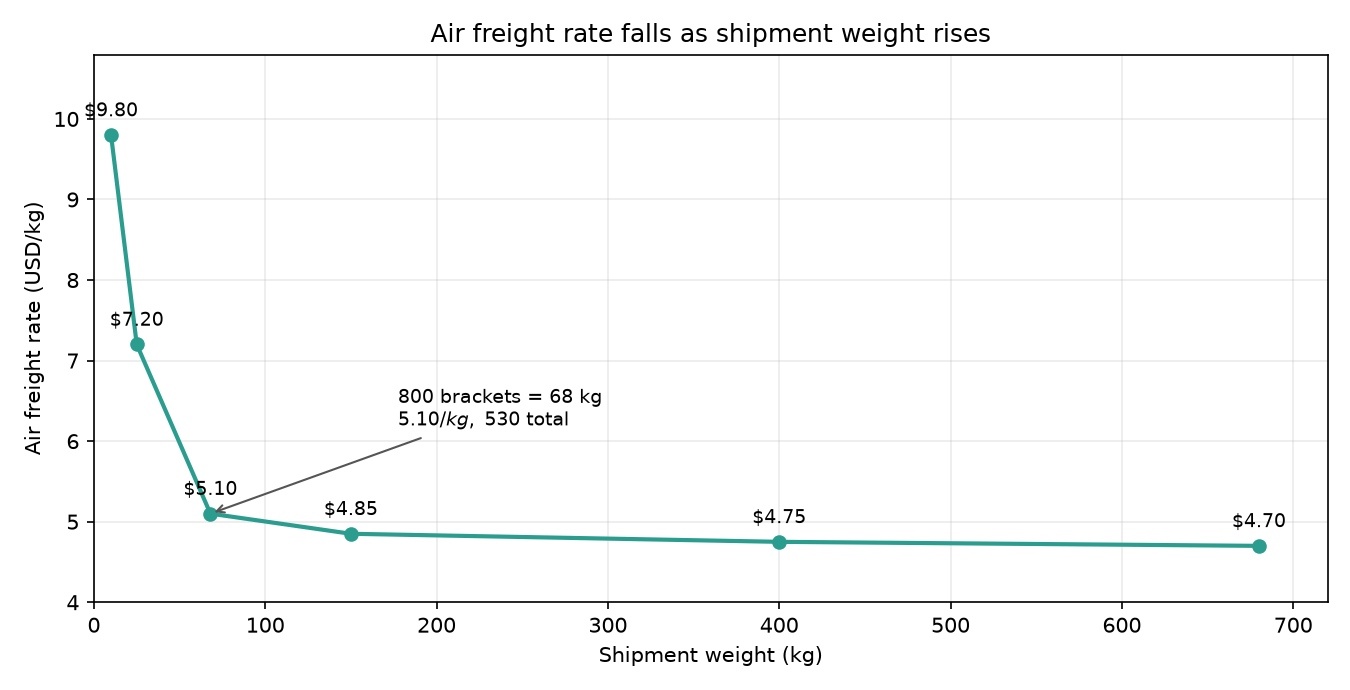
Air freight is priced per kilogram, and the rate falls as shipment weight rises. A 10 kilogram box pays about 9.80 dollars per kilogram. At 68 kilograms the rate drops near 5.10, and a 680 kilogram shipment pays around 4.70, plus 130 to 180 dollars of handling either way. Small metal parts barely register on a scale: 800 brackets at 85 grams each weigh 68 kilograms, so the air freight cost per part is about 66 cents, and it lands quietly in your landed cost.
Downtime is your own number, and it matters most. My buyer valued a stopped line at 900 dollars a day. The slipped arrival was day 64, his buffer ran out on day 60, so his exposure was four days, 3,600 dollars. The same figure sits anywhere from 300 dollars a day in a job shop to more than 3,000 in
Four moves that cost less than a rush fee
Move one is a partial air shipment, and on light parts it is usually the winner. Air 10 percent of the quantity and let the sea shipment carry the rest. On the bracket order, air freight for 800 pieces cost 530 dollars and the buyer already owed 140 dollars of sea freight on that share, so the net spend was 390. The air batch landed on day 40, ten days before the line started, and the sea shipment with the remaining 7,200 pieces followed on day 64. Buffer stock plus the air batch covered the four day gap. Exposure: 3,600 dollars. Spend: 390. I cover the freight side of this in detail in how to ship small volume machined parts without high freight.
Move two is finding the real bottleneck. Production often finished on time and the delay sits in a secondary operation. If finishing is the holdup, ask the supplier to ship parts raw and use a finisher near you, which works well for stainless grades like 316L where passivation queues are common. On cast parts the holdup is often the shell room, and no amount of overtime in machining helps.
Move three is offering something the supplier values more than cash. A written forecast for the next order, faster payment terms, or the next revision of the part can buy a capacity swap for free. I once settled at 10 percent instead of the 18 percent a vendor first asked because I put a 40,000 dollar annual forecast on the table in the same call.
Move four is negotiating the fee itself, and it starts with the cause. If the slip is on the supplier side, ask them to absorb part of the recovery cost, or at least ask for a credit even if it is small. If it traces back to a drawing revision you released late, pay the fee without complaint.
How to frame the request
How you ask shapes what you get. I keep three habits: call daily during the recovery week and keep each call under five minutes, get the revised ship date in writing with the operation that changed, and ask for the name of the person who owns the recovery plan.
A recovery plan without a name is a hope. "Production is being expedited" can mean a supervisor rescheduled a shift, or nobody has touched the job. When I hear a first name and a shift assignment, I relax a little. When I hear "we are doing everything we can," I start checking flights.
Ask the supplier to share the risk on the new date: if the recovery date slips again, the rush fee is refunded or credited against the next order. Suppliers resist this less than you would expect when the original slip was theirs. I ask for daily production counts during the recovery week too, because a count of zero on Wednesday is information you want on Wednesday.
When the rush fee is worth paying
Run one comparison: fee versus downtime. On the bracket order the fee was 2,304 dollars and the exposure was 3,600, so the fee wins before you count the softer costs: overtime at the customer plant and the goodwill you burn when a plant manager reshuffles a schedule around your parts.
The fee stops being worth it when your downtime number is small or the delay is tolerable. A job shop with two weeks of buffer should almost never pay one. Know your own calendar before you negotiate.
One more input: contract penalties. Some OEM agreements carry late delivery charges of 1 to 2 percent per week, capped near 5 percent. If your contract has one, that number is the floor for what a slip costs, and it gives you weight in the fee negotiation, since the supplier faces the same charges when the delay is contractually theirs. I have used it twice in twenty years; both times it moved the fee.
Clauses that prevent the next late order
Fixing one late order is fine. Preventing the next one is better, and that work happens on paper before the purchase order goes out.
Write partial shipment permission into the PO. Some suppliers will not split a shipment without written approval, and by the time you need one, the approval loop costs days. A single line, "supplier may ship in partial quantities upon buyer approval by email," is enough.
Pre-authorize air freight for light parts. Set a threshold: if the ship date slips more than 10 days, the supplier may air ship up to 100 kilograms and invoice the freight, with cost sharing agreed in advance. On small machined or MIM parts this turns a crisis into a routine PO line.
Define the ship date. Ex works and FOB are not the same promise, and a date that slides from "machining complete" to "goods on vessel" can hide a week inside a port queue. The terms behind that line are covered in which incoterms to use when importing parts from China.
Keep buffer stock on parts you consume fast. Ten days of coverage on a 2.40 dollar bracket put about 1,150 pieces on a shelf, roughly 2,760 dollars of inventory. That is less than one rush fee, it earns nothing but calm, and it turns most supplier slips from emergencies into scheduling notes.
Common questions
These are the questions buyers ask me most when a date slips. The full FAQ page covers the basics of ordering and quality too.
How much does a rush fee usually cost on a custom metal parts order?
Quotes I have seen run 10 to 25 percent of order value, sometimes a flat figure tied to overtime hours. On a 19,200 dollar order of machined aluminum brackets, the supplier asked 12 percent, or 2,304 dollars, to pull the ship date back ten days.
Is air freight worth it for small metal parts?
More often than buyers expect. 800 aluminum brackets at 85 grams each weigh 68 kilograms, about 530 dollars to fly, or roughly 66 cents of freight per part. The rate per kilogram falls from about 9.80 on a 10 kilogram box to around 4.70 on a 680 kilogram shipment. Weigh that against your line down cost per day and the answer is usually obvious.
Can I request a partial shipment when a production order runs late?
Yes, and you should. Air 10 percent of the quantity to bridge the gap and let the sea shipment carry the rest. Put partial shipment permission in the PO before problems exist, because some suppliers will not split quantities without written approval.
What downtime cost should I use when deciding whether to expedite?
Your own number, from your production planner. I have seen 300 dollars a day in a job shop and more than 3,000 in automotive final assembly. Multiply it by the days the recovery plan saves and compare that against the fee or the freight.
Does paying a rush fee guarantee the new ship date will hold?
No. A fee buys priority, not certainty. Ask for the recovery plan in writing with the operation, the date, and the name of the person who owns it, and ask that the fee be refunded or credited if the recovery date slips. Suppliers accept that clause more readily when the original slip was theirs.
The bracket order ended quietly. The air batch landed on day 40, the sea shipment cleared on day 64, and the line never stopped. Total expediting spend: 390 dollars, about 2 percent of order value, against a 3,600 dollar exposure. Diagnose the cause, price all three buckets, try the cheap moves first, and put the recovery plan in writing with a name attached; the same discipline shows up in how we work. The difference between a scheduling note and a fire drill is usually about 68 kilograms and one phone call made early.
Need Precision Metal Parts for Your Project?
Yujiaxin Tech specializes in MIM, CNC Machining, Powder Metallurgy, Investment Casting, and Gear Hobbing. Get a free quote within 24 hours.