I have priced machined parts for over twenty years, first at a contract shop in Suzhou and now with the team at Yujiaxin Tech. I have quoted tens of thousands of parts, and I can tell you which inquiries turn into fast, accurate prices. They are not the ones with the fanciest CAD work. They are the ones where the buyer told us everything in the first email.
About one inquiry in five arrives as a CAD file and nothing else. No drawing, no tolerance callouts, sometimes no material or quantity. I can still price those jobs, but every missing answer becomes an email, and every email adds a day. This article is the checklist I wish every buyer kept next to the send button: what a shop needs to quote, what belongs on the drawing, and the details that quietly add 40 percent to a price you have not seen.
Contents
- What a shop actually needs to quote your part
- The 2D drawing is still the contract
- Tolerances that cost money you did not mean to spend
- Surface finish and threads: say what matters
- Design details that stall a quote
- A pre-quote checklist that saves days
- What happens after you hit send
- Frequently asked questions
What a shop actually needs to quote your part
The short answer is a solid model plus a 2D PDF drawing. The model carries the geometry; the drawing carries the intent.
Send the model in STEP format, AP242 if your system offers it, or IGES if that is what you have. STEP is the safer choice. It keeps solid geometry, while a careless IGES export can arrive as loose surfaces we repair before any toolpath gets written. Native files help, but STEP is the language every shop speaks.
The 2D PDF does a different job. It is where you state the material, the general tolerances, the tight callouts, the threads, the surface finish, and anything the model cannot show on its own: which faces actually matter, which are cosmetic, which holes line up with the mating part. I have received beautiful models with no drawing and still had eleven questions before I could price.
Quantities matter just as much. A quote for ten parts and a quote for one thousand are different exercises. Give us the realistic tiers: prototype, pilot lot, and annual volume. Three quantities in one inquiry get one price curve instead of three quotes weeks apart.
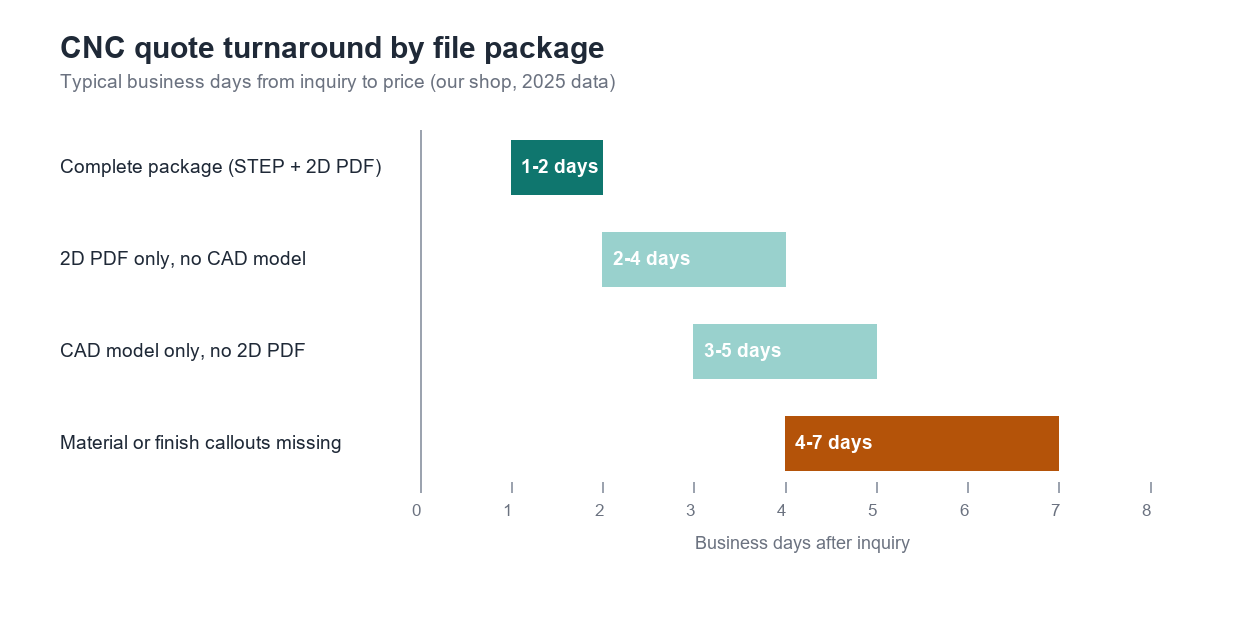
The 2D drawing is still the contract
Buyers ask why a drawing is still necessary when the model already contains every dimension. Here is why. The model does not carry intent. The drawing does.
Suppose the model shows a bore at 20.00 mm. Is that bore +/-0.1 mm because it clears a bolt, or +/-0.01 mm because a bearing sits in it? The model cannot answer. The drawing can, in one line. When we quote, every feature lands in a cost bucket, and the drawing says which.
Put a general tolerance note on the drawing as well. I recommend ISO 2768 medium as the default; it covers everything you did not call out and stops the shop from guessing. Add tight tolerances only where they earn their keep. A bearing bore might need +/-0.01 mm. The mounting holes next to it almost certainly do not.
State which document wins if the model and the drawing disagree. I quoted the same bracket twice last spring because revision C of the model carried a fillet that revision B of the PDF did not. A line reading "drawing governs" would have saved that week. When the two disagree, I stop and ask. That question costs a day. Guessing wrong costs weeks.
Thread callouts deserve their own sentence. "M6" is not a specification. "M6 x 1.0, through, 12 deep" is. The same goes for counterbores, spotfaces, and any hole beyond a plain drill and tap. On a recent bracket job for an automotive customer, the full thread spec from their fastener standard got us a quote with zero clarifications.
And name the material. "Aluminum" is not enough. 6061-T6 machines differently from 7075, and neither prices like cast A380. The alloy decides stock sizes, tool life, and fixturing. A bare "aluminum" adds a question and a day.
Tolerances that cost money you did not mean to spend
Tight tolerances are not free, and in my experience half of the tight ones I see are not needed. A buyer once sent me a simple mounting plate with +/-0.01 mm on every hole. Every hole. No bearing bores, no seals, nothing that justified it. That callout added finishing and extra inspection to every feature, and the quote came back at nearly triple the price of the plate with a sane plan.
The price curve on a typical 3-axis job looks like this. Holding +/-0.1 mm is the baseline. +/-0.05 mm raises the quote about 20 percent. +/-0.025 mm puts you near 60 percent over. +/-0.01 mm roughly doubles the machined price, and below that you are into grinding territory at three to four times baseline. None of these numbers is a scare tactic. They are what the extra setups, tool wear checks, and temperature-controlled inspection actually cost.
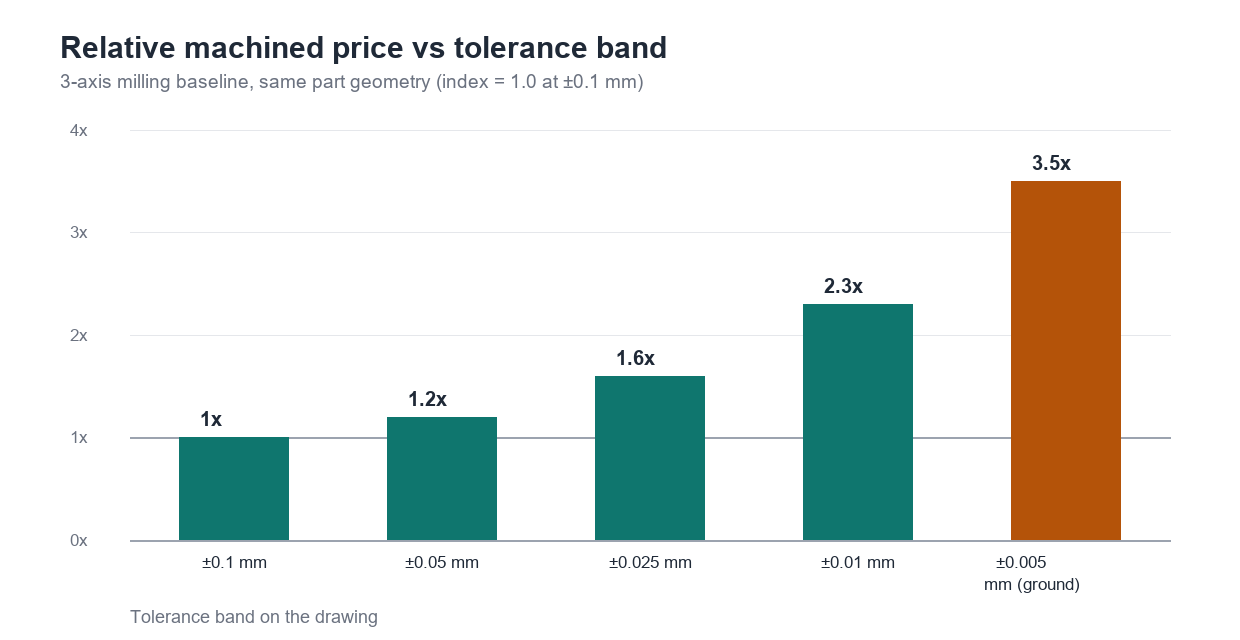
The habit I would leave you with: call tight tolerance on the functional faces only. Bearing seats, seal grooves, locating surfaces. Let everything else ride on the general note. If you are not sure which faces qualify, send the drawing with your best guess and ask. A shop that answers before quoting is a shop you can work with. Our guide to CNC machining tolerances walks through the callouts in detail.
Surface finish and threads: say what matters
Surface finish is the callout I see missing most. Left blank, we assume as-machined, roughly Ra 3.2. That is fine for brackets and housings, not for a seal face or a sliding contact. If you wanted Ra 0.8 and did not write it, the quote you received is not the part you wanted.
A short ladder covers most machined parts. Ra 3.2 as-machined for general faces, Ra 1.6 for surfaces that mate, Ra 0.8 for seals and precision fits, Ra 0.4 only where it genuinely matters. Each step down adds an operation. My guide to specifying surface roughness on a drawing covers the sampling-length detail most drawings get wrong.
Second operations follow the same rule. Anodize, plating, passivation, and painting all add cost, and the type changes the number. A 316L part that needs passivation quotes differently from one left bare, so tell us the environment it will live in and we will suggest the finish. Masking matters too: mask the threads or not, but say so on the drawing.
Design details that stall a quote
Some features do not kill a quote. They slow it down, and slow quotes are how launch dates slip:
- Internal corners sharper than the smallest standard tool radius. Every sharp corner needs EDM or a secondary operation; add a corner radius and the feature becomes one end-mill pass.
- Cavities deeper than four times the tool diameter. Below that ratio the tool deflects and the price follows.
- Walls under 0.5 mm in aluminum. They chatter, distort under clamping, and scrap easily.
- Features that need compound angles. Those push the part to a 5-axis machine or multiple setups. My article on reducing features that force 5-axis machining shows how small geometry changes pull parts back to 3-axis prices.
None of this means you must redesign the part. It means the quote will come back with questions, and questions cost days. Above a few thousand units a year, the same geometry might price better outside machining. Metal injection molding handles small complex parts at high volume, investment casting suits larger complex shapes, and powder metallurgy wins on simple cross-sections in very high volume. Send the drawing anyway. Part of our quote process is telling you when your first choice of process is not the cheapest one for your volume, because that decision outweighs the hourly rate.
A pre-quote checklist that saves days
Before you send, run through this list. Five minutes, and it removes most of the back and forth:
- STEP (AP242) or IGES solid model, attached to the email, not a link that expires.
- 2D PDF drawing with material, tolerance note, tight callouts, threads, and finish.
- A line stating that the drawing governs over the model.
- Quantities per release: prototype, pilot, and annual volume.
- Certificates you require: EN 10204 3.1 material certs, dimensional report, PPAP Level 3.
- Delivery terms and destination, so the quote lands FOB or DDP the way you compare.
- Your target price, if you have one. It does not weaken your position; it tells us whether to quote at all.
That last item divides buyers. Some fear that naming a target invites a padded number. My experience is the opposite. When the target is inside reach, we shape the process to hit it. When it is not, I would rather tell you in the first email than after two weeks of engineering. Either way you lose nothing.
What happens after you hit send
With the package above, a quote for a typical machined part leaves our desk in one to two business days. Castings and molded parts take longer because the process itself needs costing: mold or pattern amortization, cycle time, secondary operations. The geometry review happens before the price does, and that is why the drawing matters.
Expect questions, and treat them as a good sign. If a hole callout looks like it needs a reamer we will ask whether the function requires it. A shop that asks nothing will invoice you for its assumptions.
When the quote arrives, read it the way the estimator wrote it. My guide to reading a CNC quote without missing hidden fees covers the line items buyers miss: setup amortization, material surcharges, finish minimums, freight terms. If anything seems off, ask. Questions before the PO are free. The ones after it are not.
The whole trick fits in one line: send the STEP file and the PDF together, state the material and quantities, and let the drawing carry the intent. Do that and the price you get back will be closer to the part you need. If anything here is unclear, our FAQ page covers the rest.
Frequently asked questions
What file format should I send for a CNC machining quote?
Send a STEP file (AP242 preferred) plus a 2D PDF drawing. STEP keeps solid geometry that every CAM system reads. Native CAD files help but are optional; the PDF carries tolerances, material, and finish.
Do I need a 2D drawing if I already have a CAD model?
Yes. The model shows geometry, not intent. Tolerances, material, threads, finish, and functional faces live on the drawing. Without them we quote assumptions, and assumptions come back as change orders.
How long does a CNC machining quote take?
A complete package prices in one to two business days. A model without a drawing stretches to three to five days of email. Missing material or finish callouts push it to four to seven.
What tolerances should I put on my drawing?
Use ISO 2768 medium as the general note, then call tight tolerance only on functional faces such as bearing seats and seal grooves. Every extra decimal adds setups and inspection, roughly doubling the price at +/-0.01 mm.
Why is my CNC quote higher than expected?
Usually one of three: tighter tolerance than the function needs, a finish or coating absent from the original inquiry, or geometry that forces extra setups. Send the drawing with a target price and we will tell you which.
Need Precision Metal Parts for Your Project?
Yujiaxin Tech specializes in MIM, CNC Machining, Powder Metallurgy, Investment Casting, and Gear Hobbing. Get a free quote within 24 hours.