Tooling is the number that stops most MIM conversations. A buyer sees $18,000 for a mold on a part that costs $0.90 to make, and the project stalls. I have sat on both sides of that conversation, and I think the reaction is fair. It is usually aimed at the wrong number though. The mold is not the problem. The problem is that nobody ran the amortization out loud, so the buyer ends up comparing a one-time invoice against a piece price that already has everything folded inside it.
Metal injection molding makes economic sense at volume and makes very little sense below it. That is not a flaw in the process. It is what happens when you move cost out of machine time and into a physical tool. This guide covers what you pay for when you buy a MIM tool, how that cost shows up in your unit price, where the break-even against CNC sits, and which tooling terms are worth arguing over. I am writing it for engineers and buyers who have to defend the number internally.
On this page
- What you pay for when you buy a MIM tool
- How amortization lands in your unit price
- Where MIM breaks even against CNC
- Tool life, and who owns the mold
- Design changes are what actually break your amortization
- Terms worth arguing over
- What I would do with a new MIM program
- Frequently asked questions about MIM tooling cost
- Related reading on process selection
What you pay for when you buy a MIM tool
A MIM mold is quoted as one line item, but it is not one thing. The biggest chunk is the cavity and core inserts, cut from hardened tool steel and finished by wire EDM and sinker EDM. For a small stainless component I would expect inserts in something like SKD11 or 8407 hardened to 58 to 62 HRC, with the cavity detail burned in rather than milled. The corner radii on a MIM part are usually too small for a cutter to reach.
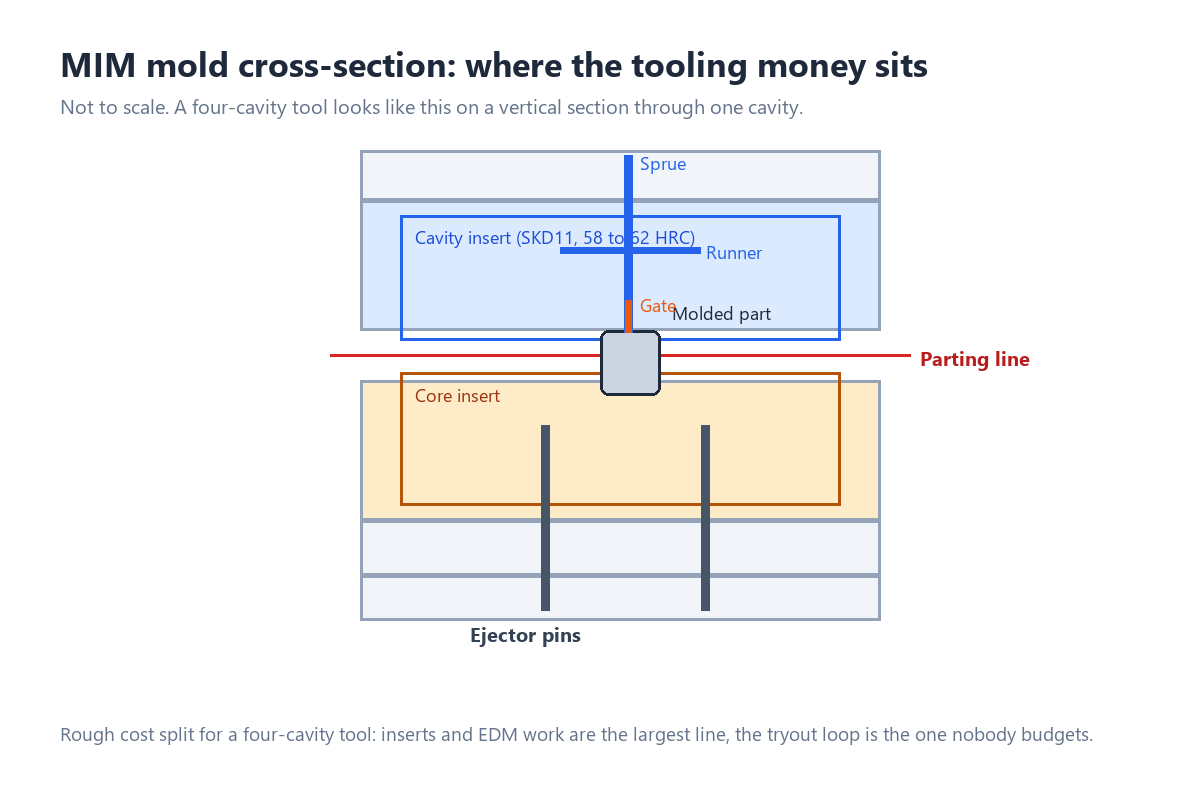
Around that you have the mold base, the runner and gate system, the ejector layout, and any side action the geometry needs. Slides and unscrewing cores are what push a tool from $15,000 to $35,000. If your part has an undercut that cannot be formed with a straight pull, tell the toolmaker before the quote goes out, not after.
Then there is the part nobody budgets for: the tryout loop. MIM feedstock shrinks about 15 to 20 percent in linear terms during sintering, so the cavity is deliberately cut oversize by that factor. The first guess at the shrink factor is an educated one, based on the alloy and the powder loading, but it is still a guess. The first shots come out of the furnace, go on a CMM, and the cavity gets corrected. Most tools need one correction loop. Difficult geometry needs two, and each one is roughly two to three weeks.
Rough ranges from quotes I have reviewed: a single cavity tool for a simple small part runs $6,000 to $9,000. Four cavities for the same part is $12,000 to $16,000. Eight cavities takes it to $20,000 to $26,000. Those numbers assume a competent shop cutting a standard tool steel and geometry that needs no side actions.
Tooling ownership questions come up often enough that they are covered in the FAQ, and the standard sequence from quote through first article approval is described on the how we work page.
How amortization lands in your unit price
Amortization is the tooling cost divided by the number of parts you expect to buy. That is the whole formula, and nearly every argument about MIM pricing comes down to what goes in the denominator. When a buyer asks me for MIM tooling cost per part, this division is the whole answer. You do not need a MIM tooling amortization calculator for it, though a two column spreadsheet helps when you want to run several volumes at once.
Take a $16,000 four cavity tool. If your program is 20,000 parts a year for three years, that is 60,000 parts and the tooling adds $0.27 to every piece. If the program is 10,000 parts total, the same tool adds $1.60 and MIM stops looking clever. Same mold, same steel, same part geometry. The only thing that moved was the volume you committed to.
Suppliers present this two ways. The first is a separate upfront tooling invoice with a clean piece price. The second folds tooling into the piece price and quotes no tooling at all. I have a preference and it is not a neutral one. I want separate billing on the first program and amortized pricing only after the part has been in production for a year.
The reason is that amortized pricing looks cheaper and quietly transfers risk to you. You pay for the tool across every unit whether or not you ever order those units. If the program gets cancelled at 30 percent of forecast, you have paid for a third of a mold you cannot use. A separate invoice hurts more to sign, which is exactly why it forces the volume conversation to happen before any steel gets cut.
Watch for the version where tooling is amortized and the supplier keeps ownership. You have paid for the mold, you do not own it, and you cannot move the work. I treat that clause as a reason to keep looking.
Where MIM breaks even against CNC
CNC machining has no tooling cost worth arguing about. You program the part, you hold it in a fixture or a vise, and you cut it. That is the whole appeal at low volume, and it is why I send prototypes to a machining center without thinking twice.
The break-even sits where accumulated machining hours cost more than the mold plus the molded piece price. For a small stainless part with a lot of geometry, that crossover lands between 3,000 and 10,000 pieces. For a simple prismatic part a 3-axis mill can knock out in 90 seconds, it can be 25,000 pieces or never.
Here is a comparison I keep coming back to. A 17-4PH latch body, roughly 12 grams, with two cross holes and a slot. Machined from bar on a 3-axis vertical, it ran about 6 minutes of cycle time including a flip. At an $85 an hour shop rate that is $8.50 of machine time, plus $1.90 of bar stock, and the shop was throwing away roughly 60 percent of that bar as chips. Call it $11 a part. The MIM version needed a $19,000 eight cavity tool, and the molded piece price before amortization was $1.85. At 40,000 units the amortization was $0.48, so the landed MIM cost came to $2.33. The saving was large and it was not a close call.
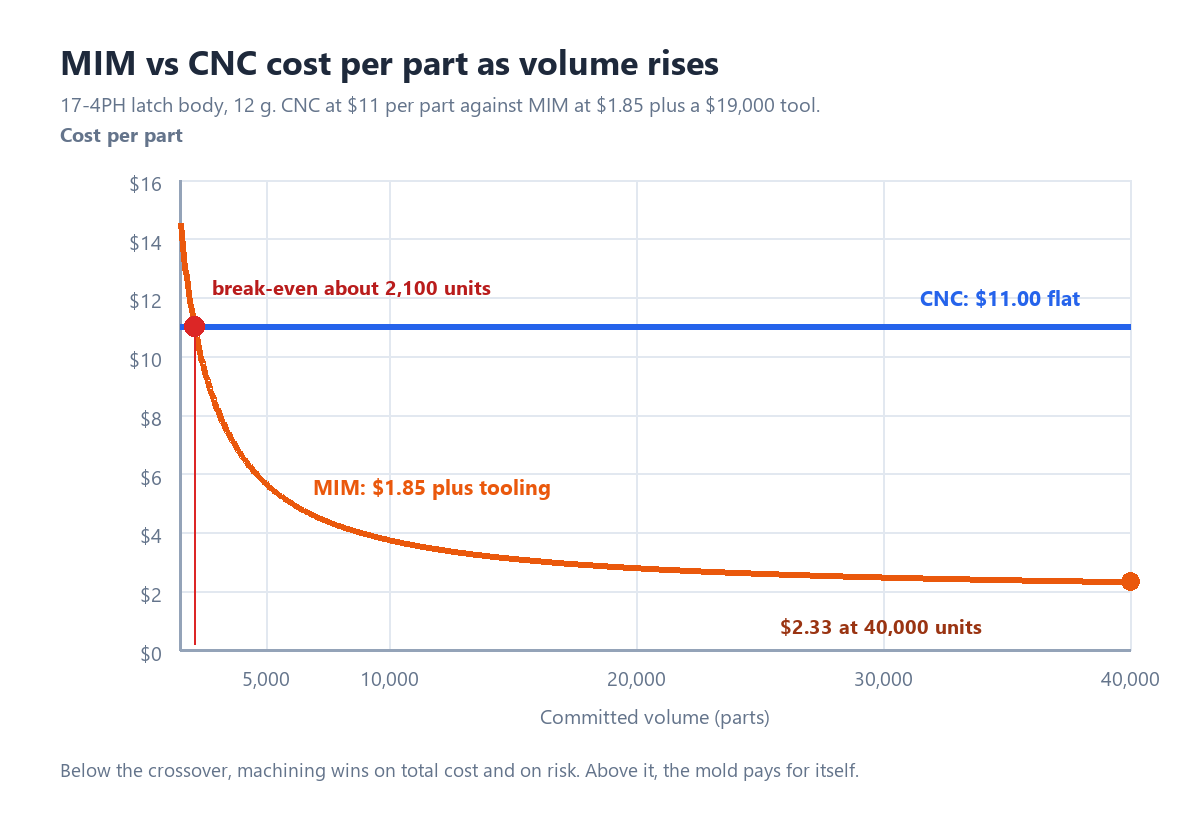
At 4,000 units the amortization would have been $4.75 and MIM would have cost $6.60 against $11. Still cheaper, but now you are taking on an eight week tool build, a shrink risk, and a frozen design to save $4.40 a part on $44,000 of total spend. I would take the machined parts at that volume. The arithmetic favors MIM and the risk does not.
If the geometry is simple and the material is a standard grade, powder metallurgy is worth pricing alongside both. Compaction dies cost less than injection molds because the tool is simpler, though shape freedom is tighter and you give up fine detail. For larger parts where ±0.1 mm is acceptable, investment casting tooling runs for a fraction of a MIM mold.
Tool life, and who owns the mold
MIM mold life expectancy gets quoted as a single number, and that number is only as good as the assumptions behind it. A MIM tool wears. The feedstock is abrasive and the cavity sees injection pressure on every shot. With a standard tool steel and a feedstock like 316L stainless, I would plan for 300,000 to 500,000 shots before the cavity needs refurbishing. Harder inserts or a wear resistant coating can push that toward a million. Specify a highly abrasive material and expect less.
Refurbishing is cheaper than a new tool, typically $2,000 to $5,000, and it is a normal cost of a long program rather than a failure. The question to settle early is who pays. If the supplier quoted a piece price on the assumption of 400,000 shots and your program runs 900,000, the refurbishment cost should have been in the quote somewhere. Ask where.
Ownership is the clause that matters most. Get it in writing. The mold should transfer to you on final payment, or at minimum you should hold a written right to have it transferred and released to another molder. I have watched a buyer discover two years into a program that the supplier owned the tool, and then take a 40 percent price increase because moving the work meant paying for the mold twice. That was avoidable, and it was avoided by one sentence in a purchase order.
Design changes are what actually break your amortization
Volume risk gets most of the attention, but in my experience design instability costs more. A machined part absorbs a drawing change overnight. A molded part cannot, because the cavity is physical geometry cut for a specific shrinkage factor.
If you change a wall from 1.2 mm to 1.5 mm, the toolmaker does not edit a program. The insert gets re-cut or replaced, the shrink factor shifts with the section thickness, and you go through another tryout loop. A small correction that only needs polishing and a re-shot might be $800. A new insert set is $4,000 to $8,000. A change that moves the parting line can mean a new tool.
This is why I push customers to run machined or printed prototypes through functional testing before any steel is ordered. The prototype is not about proving MIM works. It is about freezing geometry while changes are still free. Programs in medical devices understand this better than most, because the validation burden already forces the design to stop moving. Automotive programs are similar once PPAP starts.
Material choice locks in early too. If you think you may move from 316L to a higher strength alloy later, decide before tooling, because both the shrink factor and the sintering profile change. The same applies if you are weighing Ti-6Al-4V, which behaves differently in the furnace and needs its own dimensional compensation. Details on how these are documented are on the quality page.
Terms worth arguing over
Four things are negotiable on almost every MIM tooling quote and most buyers ask about none of them.
Payment schedule. Fifty percent at order and fifty percent at first article approval is standard and reasonable. Paying 100 percent upfront gives away your only real pressure at exactly the point where you need it, which is when the first shots come back out of tolerance.
Ownership and transfer, as above. Put the release condition in writing.
Refurbishment responsibility. Ask what a cavity refurbishment costs and how many shots the quoted tool is rated for. A supplier who cannot answer either number has not thought about your program length.
Price reduction at the end of amortization. If tooling is folded into the piece price, the piece price should drop once the tool is paid off. Ask for the unit count at which that happens and get it in the contract. I have seen amortization continue quietly for two years past the pay-off point because nobody wrote the number down.
Ask for the tooling breakdown as well. A quote that says only "tooling: $18,000" tells you nothing. A quote that separates insert steel, cavity count, side actions, and tryout shots lets you see where the money goes. Dropping from eight cavities to four usually saves 30 to 40 percent of tooling and raises the piece price by 15 to 20 percent. That trade is worth making when your forecast is soft.
What I would do with a new MIM program
Below roughly 5,000 pieces a year with a design that is still moving, machine it. Above 20,000 a year with stable geometry, tool it, and pay for the tool separately so the volume commitment is explicit. In between, price it both ways and be honest about how much you trust your forecast.
Get the ownership clause into the purchase order before you sign. Get the cavity count and the tool steel grade into the quote so you know what you are buying. Then hold the design frozen from the day the steel is ordered. That last one is the only item on this list that costs nothing, and it is the one that saves the most money.
Frequently asked questions about MIM tooling cost
How much does a typical MIM tool cost?
A single cavity tool for a simple small part runs $6,000 to $9,000. Four cavities is $12,000 to $16,000, and eight cavities $20,000 to $26,000. Geometry that needs slides or unscrewing cores pushes the number past $35,000. The tool steel grade, the cavity count, and whether the part needs side action drive most of the variation.
Is MIM tooling refundable?
No. Tooling is a one-time manufacturing cost rather than a deposit, and no molder can refund a cavity that has already been cut. What you can negotiate is who owns the tool, the conditions under which it transfers, and a piece price reduction once amortization ends. Treat the tooling invoice as sunk the day the steel is ordered.
Who owns the MIM mold after payment?
It depends on the contract, which is exactly why you should read it. Ideally the tool transfers to you on final payment, or you hold a written right to have it released to another molder. If the supplier keeps ownership, you have paid for a mold you cannot move, and that leaves you exposed to the next price increase.
What is a realistic MIM mold life expectancy?
With a standard tool steel and a feedstock like 316L, plan for 300,000 to 500,000 shots before the cavity needs refurbishing. Harder inserts or a wear resistant coating can push that toward a million. Abrasive alloys shorten it, so ask for the rating with your material in mind.
How do I work out MIM tooling cost per part?
Divide the tooling cost by the total volume you expect to buy over the program. A $16,000 tool across 60,000 parts adds $0.27 per piece. Across 10,000 parts it adds $1.60. If the forecast is soft, run the number again at 50 percent of plan before you commit to steel.
Related reading on process selection
If you are still deciding whether MIM is the right process, these notes cover the adjacent questions. The first walks through the volume crossover in detail, the second covers geometry and feature limits, and the third explains where the 15 to 20 percent shrinkage figure comes from and how it gets dialed in. The last one sets MIM and CNC side by side: When MIM beats CNC for small parts. How to tell whether a part suits MIM. Shrinkage control in MIM parts. MIM versus CNC machining.
Need Precision Metal Parts for Your Project?
Yujiaxin Tech specializes in MIM, CNC Machining, Powder Metallurgy, Investment Casting, and Gear Hobbing. Get a free quote within 24 hours.