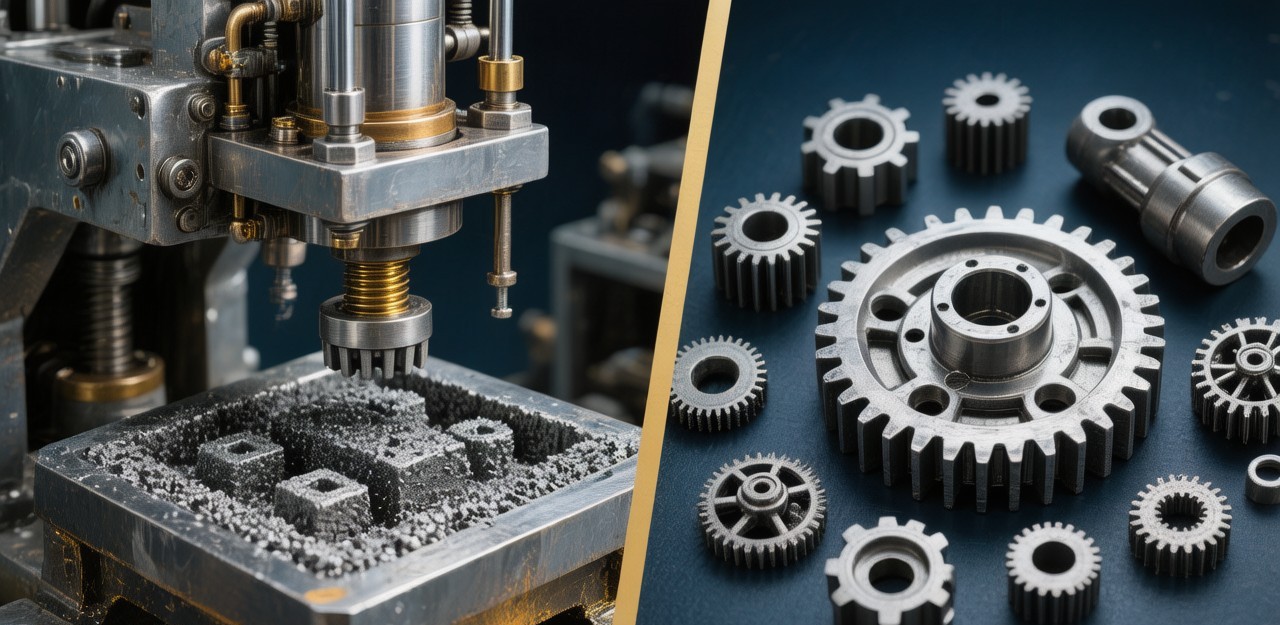
Powder metallurgy (PM) and metal injection molding (MIM) share a common foundation: both use metal powders and sintering to produce finished parts. Yet for engineers and procurement managers evaluating manufacturing options, the two processes are remarkably different in their capabilities, design constraints, and cost profiles.
At YuJiaxin Tech, we have operated both PM pressing and MIM production lines since 1998. With ISO 9001 and GJB9001C certifications and over 500 clients across 50+ countries, we have guided hundreds of engineering teams through this exact decision.
What Is Powder Metallurgy (PM Pressing)?
Powder metallurgy, in the context of structural parts manufacturing, typically refers to die compaction and sintering. The process begins by blending metal powders with lubricants, then compacting under high uniaxial pressure (300–800 MPa) to form a green compact. The compact is sintered in a controlled-atmosphere furnace below the melting point, allowing particle bonding to develop mechanical strength.
PM pressing is highly productive — short cycle times, durable tooling, and full automation. It excels for high-volume production of relatively simple geometries: gears, bearings, bushings, cams, and structural brackets. Dimensional tolerances are typically ±0.05–0.1 mm. PM parts achieve 85–98% of theoretical density.
Visit our Powder Metallurgy Pressing service page for materials, tolerances, and capabilities.
What Is Metal Injection Molding (MIM)?
Metal injection molding combines the shape freedom of plastic injection molding with the material properties of sintered metal. Fine metal powder (<22 μm) is mixed with a binder and injection-molded into a mold cavity. After debinding, the part is sintered — shrinking 15–22% linearly as powders fuse. The result is a dense metal part with properties comparable to wrought equivalents.
MIM's key advantage is three-dimensional complexity: undercuts, cross-holes, internal passages, threads, and fine surface textures can all be molded directly. MIM parts range 0.1–100 g, with tolerances of ±0.3–0.5% of nominal dimension. MIM achieves 95–99% of theoretical density — superior to conventional PM.
Explore our Metal Injection Molding (MIM) capabilities — stainless steels, tool steels, nickel alloys, titanium.
Head-to-Head Comparison: PM vs MIM
Part Geometry: PM pressing is uniaxial — geometry must eject vertically; no undercuts. MIM has no such constraint, producing arbitrary 3D complexity impossible in PM without secondary machining.
Materials: PM is primarily iron-based alloys (iron-copper, 316L, bronze). MIM supports stainless steels (316L, 17-4PH, 420, 440C), tool steels (M2, H13), nickel superalloys (Inconel 625/718), titanium Ti-6Al-4V, and cobalt-chrome for medical.
Density & Strength: MIM achieves 95–99% theoretical density vs. PM's 85–95%. Higher density = better tensile strength, fatigue resistance, and impact toughness for demanding applications.
Volume Economics: PM tooling ($3,000–$15,000) suits volumes of 5,000 to millions/year. MIM tooling ($8,000–$40,000) is optimized for 5,000–500,000 parts/year. For complex parts at moderate volumes, MIM's total cost (including elimination of machining steps) is often lower.
For a detailed explanation of our process steps and quality controls, see our How We Work page.
Process Selection Decision Framework
1. Does the part have undercuts, cross-holes, or 3D features that cannot be ejected axially? → MIM required.
2. Is the material a high-alloy steel, nickel superalloy, titanium, or cobalt-chrome? → MIM. Standard iron-copper or 316L at moderate spec → PM viable.
3. Annual production volume? Below 2,000 pcs → CNC machining. 2,000–500,000 pcs → MIM optimal for complex parts. Above 500,000 pcs (simple geometry) → PM pressing wins on cost.
4. Density requirement ≥95%? High stress/fatigue/impact conditions → MIM. Moderate-load structural → PM at 90–94% may suffice.
5. Part weight >100 g? → PM pressing or investment casting more practical economically.
Real-World Application Examples
PM Applications: automotive connecting rod caps, VVT sprockets, timing gears, oil pump rotors; industrial spur/helical gears, cams; self-lubricating PM bushings.
MIM Applications: medical orthodontic brackets, laparoscopic instrument tips; firearms trigger components, hammer bodies; consumer electronics hinge mechanisms; aerospace fuel injector components, sensor housings; automotive turbocharger vanes.
YuJiaxin Tech has produced both MIM and PM parts across all these industries. See our case studies for technical documentation of process selection rationale and results.
Need Precision Metal Parts for Your Project?
Yujiaxin Tech specializes in MIM, CNC Machining, Powder Metallurgy, Investment Casting, and Gear Hobbing. Get a free quote within 24 hours.