I have quoted 17-4PH parts for well over a decade, and the same gap shows up on drawings again and again. The print says "17-4PH" and nothing else. No condition, no hardness band, no test location. Three suppliers will quote three different heat treatments from that one line. This article explains what the H numbers mean, how the conditions trade strength against toughness, and the callout that gets you the part you designed.
Contents
- What the H numbers actually mean
- The strength and hardness ladder
- How the conditions trade strength against toughness and corrosion
- Heat treating 17-4PH made by MIM or casting
- How to put the condition on the drawing
- Machining before or after aging
- 17-4PH drawing mistakes I see
- Frequently asked questions
What the H numbers actually mean
17-4PH is a precipitation hardening stainless steel, UNS S17400, also sold as alloy 630. The PH in the name is the whole story: the steel reaches its final properties through an aging step, not through quenching alone. The part is first solution treated, heated to about 1,900 \u00b0F (1,040 \u00b0C) and cooled fast, which leaves it soft and uniform. It then ages at a lower temperature so fine copper-rich precipitates form inside the grains. Those precipitates are what push the strength up.
The H number is the aging temperature in Fahrenheit. H900 means the part was aged at 900 \u00b0F (482 \u00b0C). H1150 means 1,150 \u00b0F (620 \u00b0C). Same alloy, same solution treatment, different aging temperature, very different part at the end. That is why "17-4PH" alone does not define anything you can inspect.
The strength and hardness ladder
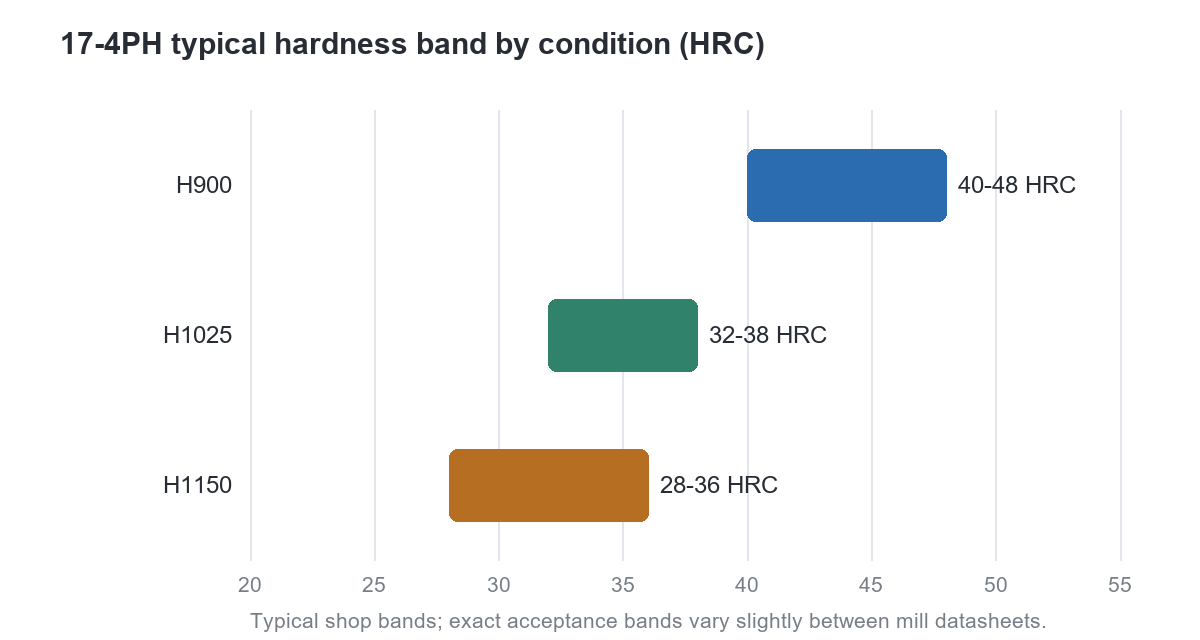
The ladder is simple: the lower the aging temperature, the higher the strength and hardness. ASTM A564 lists a minimum tensile strength of 190 ksi for H900, 155 ksi for H1025, and 135 ksi for H1150. Hardness runs the same direction. Typical shop bands are 40 to 48 HRC for H900, 32 to 38 HRC for H1025, and 28 to 36 HRC for H1150, though the exact acceptance band shifts a little between mill datasheets, so lock yours into the purchase order.
One more note on those numbers: a tensile bar tests the lot, but hardness is what you can check on the finished part. Put the test location on the print. A reading taken on a thin section can sit a point or two off a reading from the body, and without a stated location you get the same part argued over two numbers. The location line costs nothing and removes the argument.
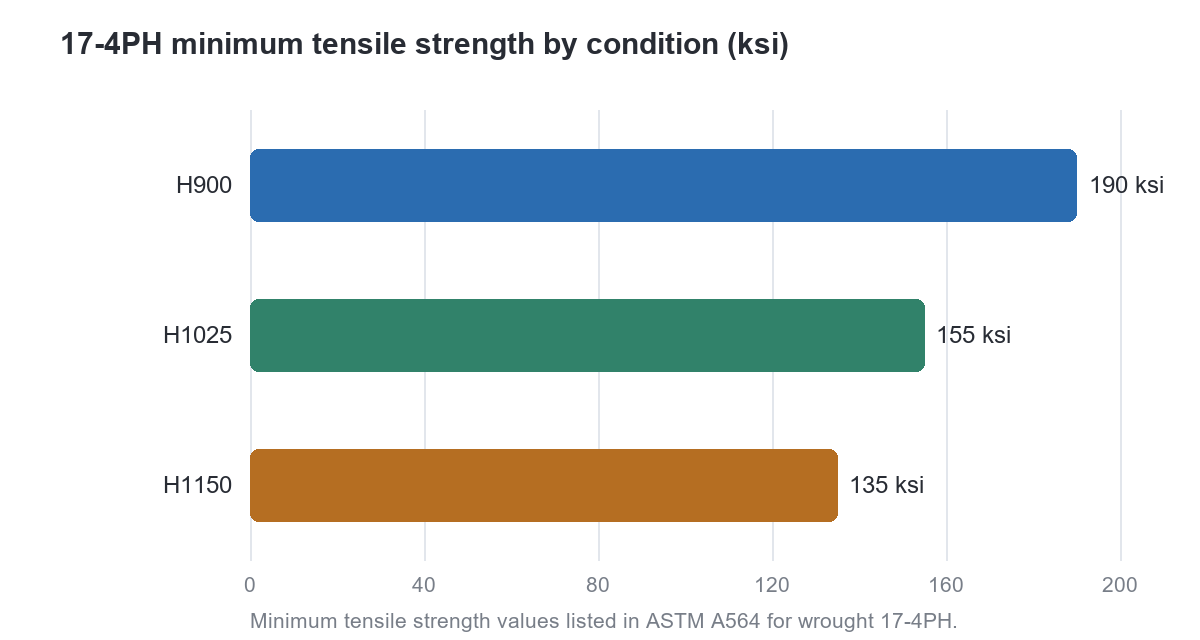
Yield strength follows the same slope, and so does the rest of the picture: elongation, toughness, and corrosion resistance all improve as you move down the ladder. There is no best condition. There is only the right condition for the load, the environment, and the risk you are willing to carry.
How the conditions trade strength against toughness and corrosion
If the part sees high static stress in a wet or salty environment, H900 deserves a hard look before you commit. The peak-aged condition is the one most likely to crack under sustained stress in a corrosive media. It shows up most in pins, springs, and fittings exposed to chlorides. Moving to H1025 or H1150 buys back toughness and stress corrosion resistance at a cost of 35 to 55 ksi of tensile strength, which is usually the better trade.
I watched that trade go wrong once, in one direction. A hinge pin went out at H900 because the drawing said so and nobody asked why. Two years in coastal air, and one pin cracked at the root. The fix was a re-release at H1150 with a slightly fatter pin to make up the strength. The steel was never the problem; the condition was. That is the conversation worth having before the PO, not after.
For general corrosion, 17-4PH sits near 304 stainless: fine in many atmospheres, weaker than 316L in chlorides. If your part lives in salt water, read our 316L vs 304 comparison before you settle on 17-4PH at all; the marine answer is usually no.
Heat treating 17-4PH made by MIM or casting
Wrought bar is not the only form. metal injection molding runs 17-4PH as one of its workhorse alloys, and investment casting pours it as CB7Cu-1. Both routes need the full thermal cycle after forming: sinter or cast, then solution treatment, then the age. A casting that skips solution treatment ages unevenly, and the hardness survey will prove it.
MIM 17-4PH sinters to 96 to 99 percent density and runs a little lower in ductility than wrought bar at the same condition. Aging itself moves dimensions by only a few hundredths of a percent. The step that warps parts is solution treatment, so thin walls get fixtured, or the part keeps grind stock on the tight-tolerance faces for a final pass after aging. If you are still weighing whether MIM suits the part at all, our post on how to know if a part is a good fit for metal injection molding walks through that decision.
How to put the condition on the drawing
Here is the callout I want to see on a print: "17-4PH per ASTM A564, condition H1025. Hardness 32 to 38 HRC at the section marked. Heat treat after rough machining." Three lines, and every quote that comes back is for the same part. If the part carries a customer spec, add the processing standard: AMS 2759/3 is the usual one for wrought aerospace work, and it nails the solution temperature, aging time, and atmosphere down to numbers an auditor can check.
If you genuinely have no preference, say so and ask for a recommendation during DFM. Our how we work page describes where that conversation happens in our quoting flow. What you should not do is leave the field blank; a blank is not neutrality, it is a gamble on whichever condition the shop finds convenient that week. And when the certificate arrives, check it against the callout. Our material certificate walkthrough shows what to trace, even though it uses 316L as the example.
Machining before or after aging
Most shops machine 17-4PH in Condition A, the soft state right after solution treatment, then age it. Machining at H900 means cutting 44 HRC steel, which burns inserts and makes tight tolerances expensive. If final dimensions are tight and distortion matters, the sequence is rough machine, age, finish machine. Any CNC machining shop will quote the aging as a separate operation, so put it in the RFQ up front. Note the soak too: conditions at 1,050 \u00b0F and above age for four hours rather than one, which is why an H1150 cycle adds about a day to the schedule.
H1150 is the exception. At 28 to 36 HRC it machines well enough after aging, which helps when the aging step would distort a thin feature beyond tolerance. The trade is buying the softer condition first.
17-4PH drawing mistakes I see
The first mistake is the blank condition, and I have covered it enough. The second is calling out H900 for every high strength part by habit. I ask what the load actually is; half the time H1025 meets it with margin and carries better toughness. H900 is a tool for specific jobs, not a default.
The third is specifying a hardness that contradicts the condition. A print that demands H1150 and 40 HRC minimum is asking for two different parts; the band tops out around 36. If the hardness number came from an old drawing revision, chase down which requirement is real before the RFQ goes out. And if you are unsure how callouts interact with the rest of the print, our surface roughness callout guide applies the same discipline to finish.
17-4PH rewards a buyer who decides. Pick the condition for the load and the environment, write it on the print with a hardness band and a test location, and every quote and every certificate will line up against the same target. That decision costs ten minutes and prevents the most expensive kind of surprise, the kind that passes inspection at both ends and fails in service. Shorter questions about documents and tolerances are answered in our FAQ.
Frequently asked questions
What does H900 mean on a 17-4PH drawing?
The part was aged at 900 °F (482 °C) after solution treatment. The H numbers are the aging temperature in Fahrenheit: H1025 means 1,025 °F, H1150 means 1,150 °F. A lower aging temperature gives higher strength and hardness.
Which 17-4PH condition has the best corrosion resistance?
H1150. Aging at 1,150 °F trades about 55 ksi of tensile strength for the best toughness and stress corrosion resistance of the common conditions. H900 is the most susceptible to stress corrosion cracking in chloride environments.
What hardness is 17-4PH H1025?
Typically 32 to 38 HRC, with about 155 ksi minimum tensile strength per ASTM A564. The exact acceptance band varies slightly between mill datasheets, so state yours in the purchase order.
Can 17-4PH be machined before aging?
Yes, and that is the normal route. Machine in Condition A or after H1150, then age. Machining at H900, around 44 HRC, is slow and hard on tooling. For tight dimensions, rough machine, age, then finish machine.
Does heat treatment change 17-4PH dimensions?
Aging moves dimensions by only a few hundredths of a percent. The riskier step is solution treatment, which can warp thin sections. Fixture thin walls or leave grind stock for a final pass after aging.
Need Precision Metal Parts for Your Project?
Yujiaxin Tech specializes in MIM, CNC Machining, Powder Metallurgy, Investment Casting, and Gear Hobbing. Get a free quote within 24 hours.