I have spent the better part of two decades quoting aluminum enclosures for buyers in automotive, electronics, and industrial sectors. The question that comes up most often is not which alloy to use or what wall thickness to specify. It is whether to invest in die casting tooling or stay with investment casting. The answer is almost always a number, and that number is annual volume.
Below is a breakdown of when die casting wins for aluminum enclosures, when it does not, and what I look for on a drawing before I recommend one process over the other.
The cost crossover point
Die casting tooling for an aluminum enclosure runs between $30,000 and $80,000 for a single-cavity H13 steel mold. Investment casting tooling for the same part is typically $2,000 to $5,000. The gap is large, but the per-part cost story flips quickly.
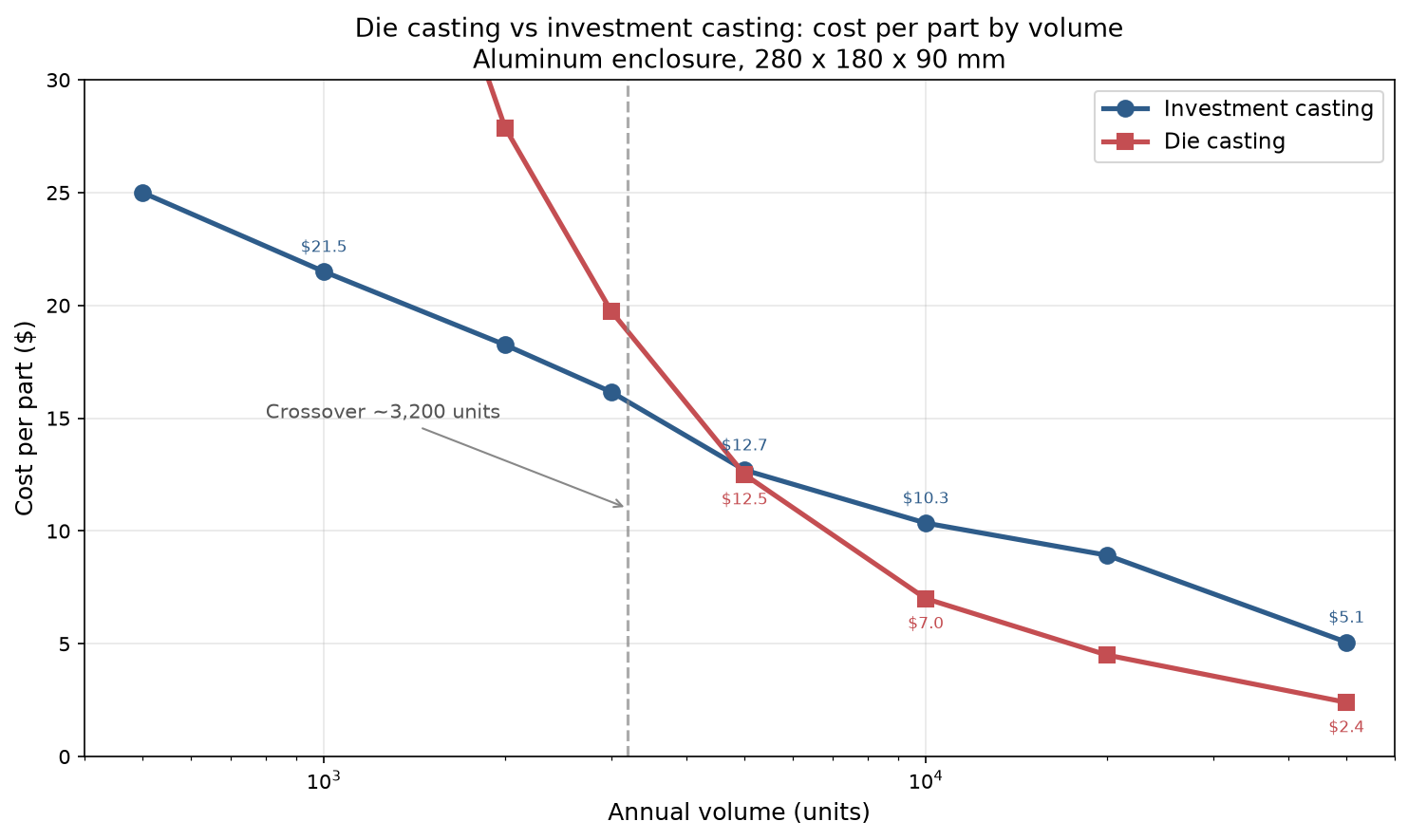
At 1,000 units per year, investment casting is almost always cheaper. The total job cost stays low because the tooling is a small line item and the per-part price, while higher than die casting, does not have enough volume to amortize the mold investment. At 5,000 units, the two processes are often within 10 percent of each other. By 10,000 units, die casting is usually 40 to 60 percent cheaper on a per-part basis. At 50,000 units, the gap widens to 2.5 times or more.
I ran a real quote last year for an aluminum junction box, 280 mm by 180 mm by 90 mm, with four internal mounting bosses and a gasket groove. The numbers came back as follows:
- Investment casting: $3,500 tooling, $18 per part at 1,000 units, $12 per part at 5,000 units
- Die casting: $45,000 tooling, $6 per part at 1,000 units, $3.50 per part at 5,000 units
The crossover sat at roughly 3,200 units. Below that, investment casting won. Above it, die casting won decisively. That is the arithmetic I walk buyers through in the first ten minutes of a call.
One detail buyers miss: die casting cycle times are measured in seconds. A typical high-pressure die casting cell produces 100 to 300 shots per hour. Investment casting produces 10 to 50 parts per day. That speed difference drives the per-part cost down at volume and makes die casting the default choice for automotive and consumer electronics enclosures.
Tolerance and surface finish
Die casting holds tighter tolerances on most geometries. For the first 25 mm of a dimension, die casting typically achieves ±0.05 mm. Investment casting achieves ±0.1 mm for the same span. On larger enclosures, that gap narrows slightly, but die casting still holds the edge on repeatability.
Surface finish is where the two processes trade places. Die casting produces Ra 0.8 to 3.2 µm as-cast, smooth enough for anodizing without secondary machining. Investment casting produces Ra 3.2 to 6.3 µm as-cast, which often needs bead blasting before cosmetic finishing.
For an electronics enclosure that will be anodized black and sit on a retail shelf, die casting saves a finishing step. For an industrial housing that will be painted anyway, the investment casting surface is acceptable. I have seen buyers specify die casting solely to avoid a $0.40 per part blast operation. At 20,000 units, that is $8,000 saved.
Draft angles are another consideration. Die casting requires 1 to 3 degrees on all vertical surfaces so the part can eject from the steel die. Investment casting requires zero draft. If your enclosure has deep vertical walls with internal features that must be straight, investment casting may be the only option.
Wall thickness and lightweighting
Die casting wins on thin walls. Aluminum die cast walls can run as thin as 0.8 mm with proper gating and venting. Zinc die cast walls go down to 0.5 mm. Investment casting walls are typically 1.5 mm minimum, and 2.0 mm is safer for large aluminum parts.
For handheld electronics enclosures where every gram matters, that 0.7 mm difference is the deciding factor. I worked on a wearable device housing where the industrial designer specified 1.0 mm walls with ribbed internal structure. Die casting was the only process that could hit the wall thickness without warping. Investment casting would have needed 1.5 mm walls and added 12 grams to a 45-gram part. That is a 27 percent weight penalty the client could not accept.
Uniform wall thickness matters more in die casting. Thick sections create shrinkage porosity and hot spots. Investment casting handles variable wall thickness better because the ceramic shell insulates more evenly and risers feed isolated thick sections. If your enclosure has heavy mounting bosses on thin walls, investment casting may be the safer choice.
Porosity and pressure containment
This is the single biggest technical risk in die casting, and it is the reason I still specify investment casting for certain aluminum enclosures even at high volume.
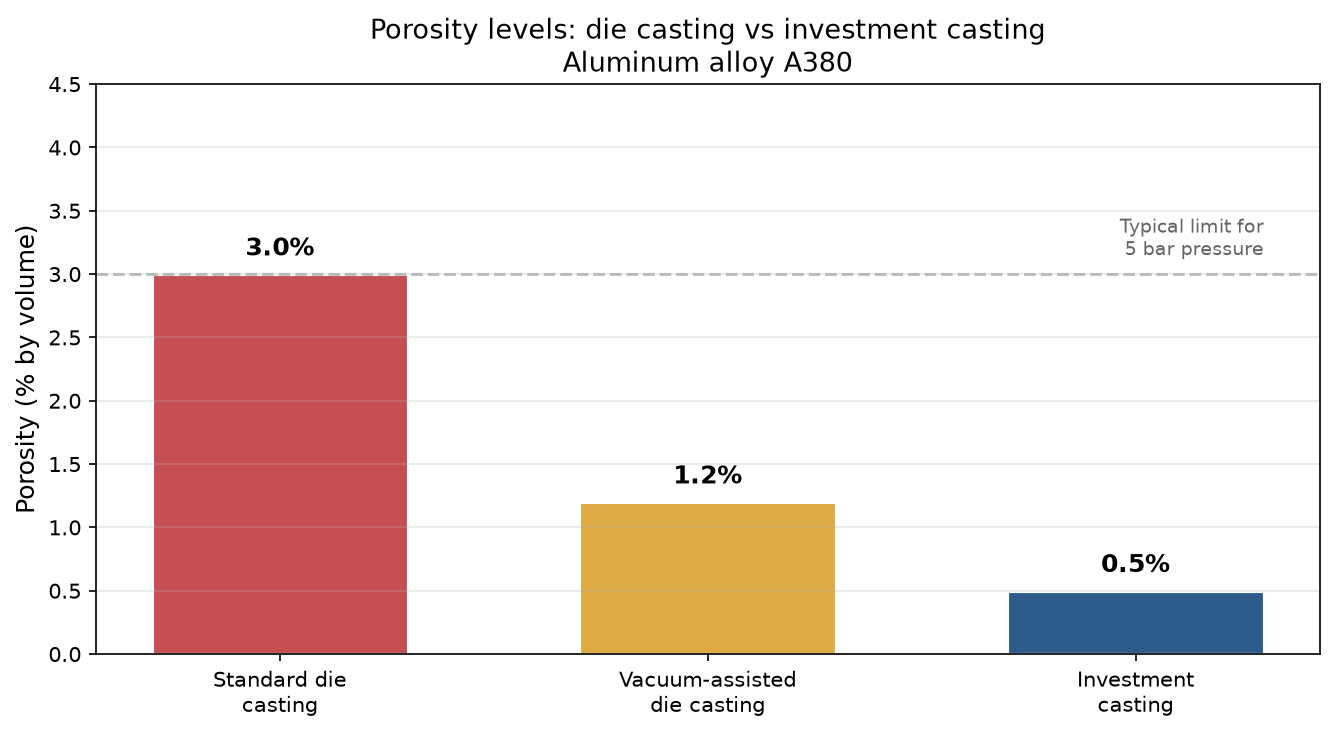
High-pressure die casting injects molten aluminum into a steel cavity at 50 to 150 MPa. That speed traps air. The air pockets create porosity, typically 1 to 5 percent by volume in standard die castings. The porosity is not visible on the surface, but it is there, and it limits what the part can do.
Porosity means die cast aluminum cannot be reliably welded. The trapped gas expands under welding heat and creates blisters. It also means die cast parts cannot be heat treated to T6 or T7 temper. If your enclosure needs welding or heat treatment, die casting is off the table unless you move to vacuum-assisted die casting, which adds 20 to 40 percent to part cost.
Pressure containment is another issue. A die cast housing with 3 percent internal porosity may weep under 5 bar pressure. An investment cast housing with controlled shell process can hold 10 bar or more. For sensor housings or valve bodies, I default to investment casting unless the buyer accepts vacuum-assisted die casting or squeeze casting.
I lost a job in 2022 because I recommended die casting for an aluminum pump housing at 8,000 units per year. The buyer accepted the quote, built prototypes, and then discovered the parts failed a 6-bar pressure test. We switched to investment casting, absorbed a 15 percent per-part cost increase, and passed the test. The lesson: volume is not the only variable. Function matters more.
Tooling cost and lead time
Die casting tooling is expensive because the mold is machined from H13 or 8407 tool steel, heat treated to 48 to 52 HRC, and fitted with cooling channels and ejector pins. Lead time is 8 to 16 weeks for a new mold. A four-slide mold with internal cores can run 20 weeks.
Investment casting tooling is simpler. The master pattern is machined from aluminum or steel, and the wax injection mold is typically aluminum. Lead time is 2 to 4 weeks. If the part changes, the pattern can be modified for a few hundred dollars. A die casting mold modification starts at $2,000 and can run to $10,000 if the change affects core slides or cooling.
For products with short lifecycles or uncertain demand, that tooling flexibility matters. I have seen buyers commit to die casting for a product that was canceled 18 months later, leaving a $50,000 mold with no home. Investment casting would have cost them $3,500 in tooling and allowed them to walk away clean.
Tooling life is the flip side. A well-maintained die casting mold produces 100,000 to 300,000 shots before major refurbishment. Investment casting patterns wear faster, especially on fine details, and may need replacement after 10,000 to 50,000 wax shots. At very high volume, die casting tooling amortizes to pennies per part. Investment casting tooling becomes a recurring cost.
When investment casting still wins
Die casting is not universal. There are clear cases where investment casting is the better choice for aluminum enclosures, even at volumes where die casting looks cheaper on paper.
First, complex internal geometry. Investment casting uses soluble wax cores to create internal passages and undercuts that die casting cannot touch. A die casting die ejects in one direction. Anything that traps steel requires a slide, and slides add cost. For enclosures with internal cooling channels, investment casting is often the only option.
Second, zero draft. Die casting needs 1 to 3 degrees draft. Investment casting needs none. If your enclosure mates with a flat panel and walls must be perpendicular, investment casting is the answer.
Third, material flexibility. Die casting is limited to aluminum, zinc, and magnesium. If your program might switch to stainless steel later, investment casting handles the change. Die casting cannot cast steel. The melting point would destroy the mold.
Fourth, low volume. At 500 units, die casting tooling is a $60 per part burden before metal is poured. Investment casting spreads the same tooling over 500 units at $6 per part. The casting cost is higher, but the total job cost is lower.
If you are unsure which process fits, our investment casting and CNC machining teams can review your CAD model and recommend the lowest total cost path.
A buyer decision checklist
Here is the checklist I use when a buyer sends me an aluminum enclosure drawing:
- Volume above 5,000 units? Die casting is probably cheaper.
- Wall thickness below 1.2 mm? Die casting.
- Internal pressure above 3 bar? Investment casting.
- Welding or heat treatment required? Investment casting only.
- Zero draft walls? Investment casting.
- Surface finish Ra below 1.6 µm? Die casting wins.
- Tooling budget under $10,000? Investment casting.
- Product lifecycle under 3 years? Investment casting.
- Material may change to steel later? Investment casting.
If six or more answers point to die casting, I quote die casting. If four or fewer, I quote investment casting. The gray zone in between is where I run both quotes and let the buyer decide based on lead time and risk tolerance.
Related reading
If you are evaluating manufacturing processes for metal enclosures, these articles may help:
- Investment casting design guidelines
- How to choose a metal parts manufacturing process
- Metal parts surface finish options guide
- CNC machining tolerances complete guide
For material selection, see our aluminum 6061 and stainless steel 316L pages. Our how we work page explains quoting and sample workflow.
Frequently asked questions
At what volume does die casting become cheaper than investment casting for aluminum parts?
The crossover typically occurs between 3,000 and 5,000 units per year. Below 3,000 units, investment casting is usually more economical. Above 5,000 units, die casting offers 40 to 60 percent lower per-part costs.
Can die cast aluminum parts be welded or heat treated?
Standard high-pressure die castings cannot be reliably welded or solution heat treated because internal porosity causes blistering. Vacuum-assisted die casting reduces porosity enough for limited welding, but adds 20 to 40 percent to part cost.
What is the minimum wall thickness for die casting vs investment casting?
Die casting achieves 0.8 mm walls in aluminum and 0.5 mm in zinc. Investment casting typically requires 1.5 mm minimum for aluminum, with 2.0 mm recommended for large parts.
How long does die casting tooling last compared to investment casting patterns?
A die casting mold produces 100,000 to 300,000 shots before major refurbishment. Investment casting wax patterns last 10,000 to 50,000 shots. At very high volume, die casting tooling amortizes to pennies per part.
Is die casting tooling refundable if the project is canceled?
Die casting tooling is almost never refundable. The mold is custom-machined to your part geometry and has no resale value. Investment casting patterns are also custom, but the lower upfront cost reduces exposure if demand does not materialize.
Need Precision Metal Parts for Your Project?
Yujiaxin Tech specializes in MIM, CNC Machining, Powder Metallurgy, Investment Casting, and Gear Hobbing. Get a free quote within 24 hours.