I have written first article inspection reports on the supplier side and torn them apart on the customer side. Sitting in both chairs changed how I buy parts. A purchase order can spell out material, tolerances, and finish, and still say nothing about the process behind them. First article inspection is the one document that tests the process, not the parts alone.
Contents
What a first article inspection actually is
A first article inspection is a full verification of parts made on production tooling, run at production settings, measured against the production drawing. Usually one to five pieces, with three as the common count. The point is narrow: prove the process can hold the print before you release a full order against it.
The words "production tooling" carry most of the weight there. A sample milled on a universal machine proves the machine. It says nothing about the mold or fixture that will make your next 50,000 pieces. If the first article comes off a prototype path, it is not a first article. I once watched a buyer accept a hand-finished sample as an FAI, then act surprised when the molded parts did not match it. That surprise was avoidable.
FAI also differs from the first-piece check a shop runs on every order. The first-piece check confirms today's setup. The FAI confirms the whole process chain, tooling included, was built correctly the first time. You want both.
What a proper FAI report contains
A report worth approving has six elements:
- A ballooned drawing with every dimension assigned a number
- A results table: balloon number, nominal, tolerance, actual, pass or fail
- A material certificate, EN 10204 3.1 as the standard, with a heat number matching the parts
- Hardness results wherever the drawing calls for them
- An appearance result judged against a stated visual standard
- Measuring equipment listed with calibration dates
The material line deserves a pause. If the parts are 316L stainless steel, the mill certificate should trace a specific heat number to the bar or powder lot, and that heat number should appear on the parts or their packaging. A report with "stainless steel" typed into the material row proves nothing. We went through that document line by line in how to read a material certificate for stainless steel 316L.
My fastest filter on a report from a new supplier: if every actual value matches its nominal exactly, the report was retyped, not measured. A real process drifts a little in every direction. A 10.00 plus or minus 0.05 dimension reading 10.00 ten times in a row is fiction. I reject such reports on sight.
One more element separates a serious report from a formality: the process settings behind the article parts. Sinter temperature for MIM, pour temperature for castings, speeds and feeds for machining. If a dimension fails six months later, those numbers tell you where to look first.
What FAI costs and what skipping it costs
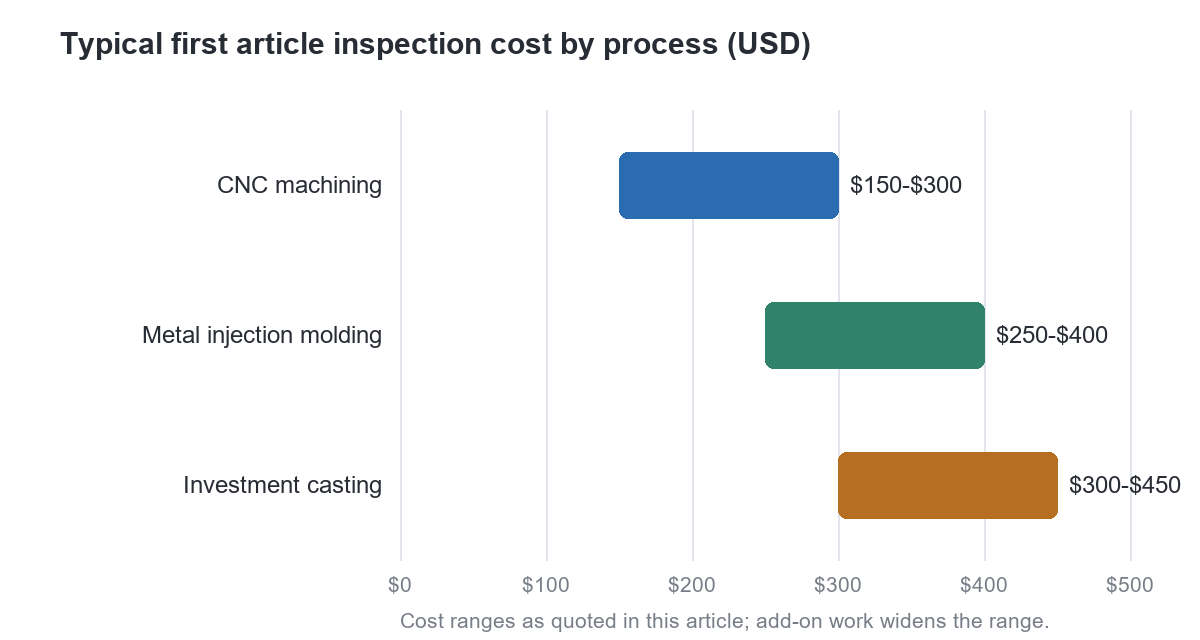
First article inspection is not free, and buyers deserve honest numbers. A simple part off a CNC machining line: plan on $150 to $300. Parts from metal injection molding run $250 to $400, because the report has to cover cavity-specific dimensions and the shrinkage behavior of the tool. Castings from investment casting usually land between $300 and $450 once hardness and porosity checks join the dimensional work.
Those prices buy more than paper. Put them next to what the same drawing error costs when it survives the FAI stage. Caught at first article, the fix costs about $250: adjust the process, remake a few samples, measure again. Caught at incoming inspection on a 5,000 piece batch, you are into sorting, rework, and freight, about $6,000. Caught after your customer has assembled the parts, the number stops being about parts. One buyer I worked with dropped the FAI line from the PO to save a week on the schedule. The error surfaced at their assembly plant, and the containment, line-down time, and claims came to about $40,000. The report they declined cost $250.
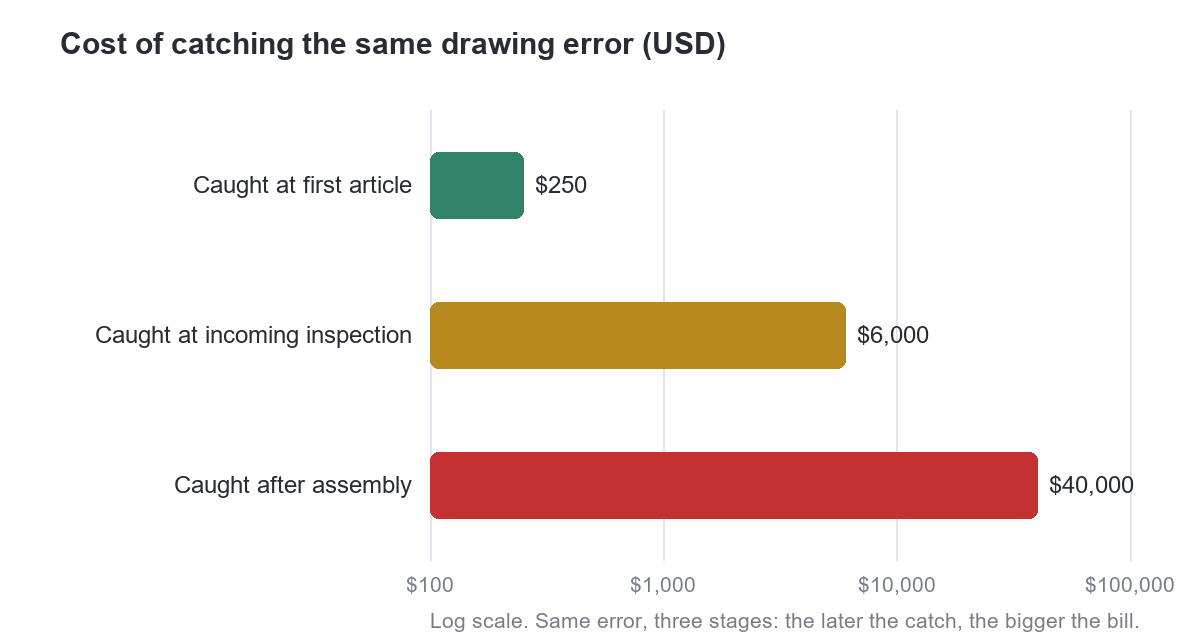
I run that comparison for every team that calls FAI overhead. It is the cheapest quality gate you will ever buy, and the price is public the moment you ask for it in the quote.
FAI lead time and how to keep it short
The usual question after price is time. How long does a first article inspection take? Machined parts: 2 to 5 working days after first-off production. MIM and cast parts: 5 to 10 working days, because tooling trials, sinter or pour cycles, and heat treatment sit in front of the measuring table. Neither figure includes shipping.
You control more of that lead time than you might think. Send the inspection standard with the RFQ and mark the dimensions that matter most, so the shop does not guess. Agree the report format before the order exists, not after. Ask the supplier to measure on a calibrated CMM and send the report the same week. Those habits have saved me one to two weeks more than once.
What stretches an FAI into a month is rarely the measurement. It is a drawing revision found mid-report, a missing callout, or a tolerance the supplier cannot measure in-house. Catch those during DFM and the report goes fast.
First article inspection vs PPAP
Buyers in the automotive world ask about first article inspection vs PPAP as if the two were rivals. They are not. FAI is one report: dimensional results, material proof, and appearance, on a sample set. PPAP is an 18-element evidence package, adding PFMEA, control plans, capability studies, and measurement system analysis. In a Level 3 submission, the FAI results are one element inside the package.
Which do you need? If your customer base is automotive and the contract invokes IATF 16949, you need PPAP, and the FAI rides inside it. Everywhere else, an FAI plus a material certificate plus a process sign-off covers most of the risk a buyer faces. A full PPAP package adds roughly $300 to $800 in documentation and 2 to 4 weeks of schedule beyond the FAI itself. Pay that when a contract demands it, not as a habit. Our PPAP submission checklist for buyers walks through the full package element by element.
When a full FAI is overkill
Honesty cuts both ways. A full FAI on a simple bracket with plus or minus 0.25 mm tolerances, running on a process that has shipped thousands of parts without a field issue, is spending money on paper. For plain reorders with no tooling change, a heat number check and a spot measurement of five dimensions is a reasonable floor. I would rather see that budget go to a full layout once or twice a year than to a ceremonial report on every order.
Certain events reset the clock: a new or transferred tool, a change of material source, a move to a different machine or plant, production restarting after 12 months idle. When any of those happen, the reorder argument is gone, because the process itself has changed. Our how we work page shows where first article inspection sits in our order flow, and our FAQ answers the document questions buyers raise most often.
FAI mistakes I see buyers make
The first is approving a report nobody can audit later. A PDF of numbers with no ballooned drawing cannot be traced back to the print, and a dispute without balloon numbers becomes two people pointing at different rows. Ask for the balloon drawing every time. It costs the supplier minutes and saves you days.
The second is accepting FAI parts made anywhere but the production path, the mistake with the highest price tag. A beautiful sample from a prototype route is a nice part and a meaningless approval.
The third is treating the FAI as a one-time event. Processes drift: tools wear, operators rotate, powder lots change. If you cannot say when the process was last re-validated, assume it has quietly moved. If you doubt the supplier's measurement ability in the first place, no report will fix that; the questions to ask before the order are in how to vet a Chinese metal parts manufacturer before ordering, and what is CMM inspection and when do you actually need it explains when a report deserves a second opinion.
None of this takes a quality department or a certification audit. It takes one disciplined step between "the samples look good" and "release the order". That step is the first article inspection, and it remains the least expensive insurance in the procurement stack.
Frequently asked questions
How much does a first article inspection cost?
CNC machined parts: $150 to $300. Metal injection molded parts: $250 to $400 because of cavity-specific dimensions. Investment castings: $300 to $450 with hardness and porosity checks. Drawings with more than 100 dimensions sit at the top of each range.
How long does a first article inspection take?
Machined parts: 2 to 5 working days after first-off production. MIM and cast parts: 5 to 10 working days, since tooling trials and heat treatment come first. Clear drawings keep it at the low end.
What is included in a first article inspection report?
A ballooned drawing, a dimensional results table with nominal, tolerance, and actual values, a traceable material certificate (EN 10204 3.1), hardness where specified, an appearance result, and measuring equipment with calibration dates.
Is first article inspection the same as PPAP?
No. FAI is a single report on one sample set. PPAP is an 18-element package used in automotive, with the FAI results inside it. A Level 3 PPAP adds roughly $300 to $800 and 2 to 4 weeks beyond the FAI.
When do I need a new FAI on an existing part?
Any process change: a new or transferred tool, a new material source, a different machine or plant, or a restart after 12 months idle. Plain reorders need only a heat number check and a spot measurement.
Need Precision Metal Parts for Your Project?
Yujiaxin Tech specializes in MIM, CNC Machining, Powder Metallurgy, Investment Casting, and Gear Hobbing. Get a free quote within 24 hours.