Ultrasonic Scalpel Blade Tip
Medical Device Components
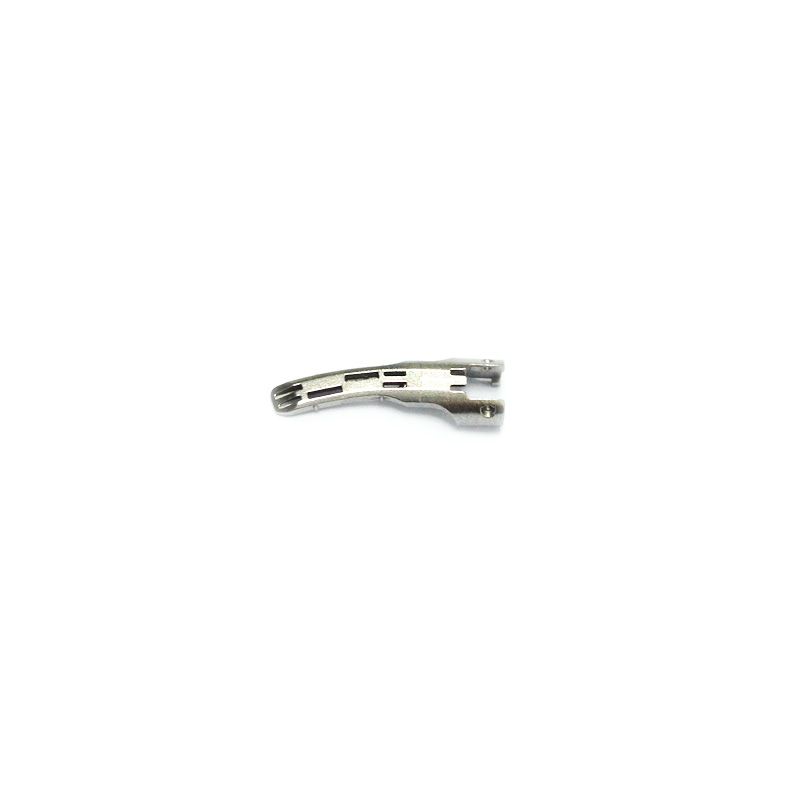
Titanium ultrasonic scalpel blade tips built to drawing for surgical handpiece OEMs, with controlled edge geometry, mass balance and resonance for dissection and coagulation.
| Category | Medical Device Components |
| Materials | Ti-6Al-4V ELI, 316L Stainless Steel |
| Industries | Medical, Surgical Instruments |
Send your drawing or 3D model — engineering review and quotation within 24 hours.
Yujiaxin Tech produces custom ultrasonic scalpel blade tips for surgical instrument OEMs and handpiece builders. Every blade is made to the customer drawing, with edge geometry, mass balance and surface finish controlled so the tip stays on resonance inside the assembled handpiece.
What this part does
An ultrasonic scalpel, also sold as a harmonic scalpel, drives its blade at roughly 55 kHz, so tissue is separated by high frequency mechanical motion instead of a heated edge. The blade tip is the part that contacts tissue, which makes its profile, edge sharpness and balance the deciding factors in cut quality and thermal spread.
Typical blade geometries
Ultrasonic surgical blades are profiled around the anatomy they have to reach, so a single handpiece may carry several tip shapes across one procedure.
- Curved blade for dissection along tissue planes
- Hook and ball tips for blunt separation
- Thin straight blade for fine cutting in confined anatomy
- Threaded or bayonet shank matched to the handpiece interface
Materials
Titanium alloy is the usual choice when low mass and fatigue strength matter across millions of vibration cycles. Medical grade stainless steel suits single use tips that need a harder edge at a lower unit cost.
| Material | Why it is chosen |
|---|---|
| Ti-6Al-4V ELI (Grade 23) | Low density, high fatigue resistance and good biocompatibility for reusable blades |
| 316L stainless steel | Harder, keener edge for single use tips with good corrosion resistance |
Typical specifications
| Parameter | Typical range |
|---|---|
| Blade length | 35 to 60 mm, custom per drawing |
| Thickness at the cutting edge | 0.10 to 0.30 mm |
| Edge radius | 5 to 15 microns |
| Tolerance on functional features | +/- 0.02 mm |
| Surface roughness at tissue contact | Ra 0.2 microns or finer |
| Resonance target | Matched to handpiece frequency, commonly 55.5 kHz |
| Surface finish | Passivation or bead blast, agreed at quotation |
The table describes common requirements rather than fixed limits. Final tolerances are confirmed against your drawing and the acceptance criteria of the handpiece it fits.
Applications for ultrasonic dissection blades
- Laparoscopic and endoscopic dissection and coagulation
- General surgery harmonic handpieces
- ENT and head and neck instrument sets
- Vessel sealing devices and minimally invasive procedure kits
What to send for a quotation
- 2D drawing or 3D model of the blade tip, with the cutting edge and shank features marked as critical
- Material grade, or the handpiece specification if the alloy is still open
- Target frequency and the interface the tip must mate with
- Surface finish, packaging and documentation requirements
- Estimated annual volume, and whether the tip is reusable or single use
Quality and documentation
Yujiaxin Tech operates to ISO 9001 and GJB 9001C-2017 quality systems, with dimensional inspection recorded per batch. Shipments can include material certificates, dimensional reports and first article inspection data. These tips are supplied as components for your own device assembly and approval, not as finished medical devices.
FAQ
Can the blade tip be produced to our own drawing?
Yes. Most of the custom ultrasonic scalpel blade tips we supply are built to customer drawings. Send the drawing or 3D model and we confirm material, tolerance and inspection method before quoting.
Can you match the resonance of an existing handpiece?
Resonance depends on mass distribution and stiffness, so the drawing has to define both. If you can supply a reference sample together with the target frequency, we work to those acceptance criteria.
What is the minimum order quantity?
Blade tips are quoted per project rather than from a fixed catalogue. Prototype and pilot batches are available, and unit price decreases as annual volume grows.
How is the cutting edge protected in transit?
Each tip ships in its own cavity or with an edge guard. The packaging format is agreed at quotation so the tip arrives without edge damage.
Related pages
Browse the full medical device components range, review the materials we work with, or send us your drawing for a custom ultrasonic scalpel blade tip quotation.