Ceramic injection molding and alumina pressing get quoted against each other more often than most process pairs, and the comparison usually starts in the wrong place. Buyers ask which route gives the better part. The real question is which route fits the shape you have.
I have quoted technical ceramic parts for a little over eighteen years, and I have watched ceramic powder injection molding and dry pressing mixed up in the same sentence more times than I can count. Here is the short version. If your alumina component has a cross hole, an internal thread, a boss off the parting line, or a wall under about 1.5 mm, dry pressing will not run it. If your part is a simple disc or a wear plate, pressing will usually beat ceramic injection molding on price.
How the two routes shape the part
Uniaxial dry pressing fills a hardened die cavity with spray dried alumina granules and squeezes them along one axis, usually between 80 and 200 MPa. The powder does not flow sideways in any useful way, so the press can only make a shape that ejects straight out of the cavity. Cold isostatic pressing widens that geometry range because it compacts from all sides, but it still cannot form a cross hole.
Ceramic injection molding starts from a feedstock of ceramic powder mixed with 35 to 45 percent by volume of a thermoplastic binder. The feedstock is heated until it flows and injected into a steel mold the way a plastic part is molded. The binder holds the shape, the part is debound, and the green body is sintered at 1,500 to 1,750 degrees Celsius for alumina. Shrinkage runs 15 to 20 percent linear, which the mold compensates for from the first cavity sketch.
That flowing step is the whole story. Because the feedstock flows, ceramic injection molding can produce the internal channels, side holes, threads, and thin walls a press cannot form. The trade is density and cost. Pressed parts reach 99.5 percent of theoretical density with a uniform microstructure, while sintered injection molded ceramic lands between 97 and 99 percent with more porosity variation. Pressed alumina is also anisotropic, so properties along the pressing axis differ from properties across it, and for a wear plate under a dominant load direction that grain orientation is worth designing around. The same shape logic shows up in metal work, and how to choose a metal parts manufacturing process covers the equivalent trade on that side.
Cost per part and the break-even point
Numbers settle this argument faster than geometry. Take a 12 mm alumina insulator with one cross hole. Ceramic injection molding tooling for a two cavity mold runs about 9,000 USD in tool steel, and the molded and sintered part lands near 1.10 USD in volume. A pressing die for a comparable outer envelope costs roughly 2,500 USD, but the as-pressed blank needs diamond grinding and a drilled cross hole, which pushes the finished part to about 2.25 USD.
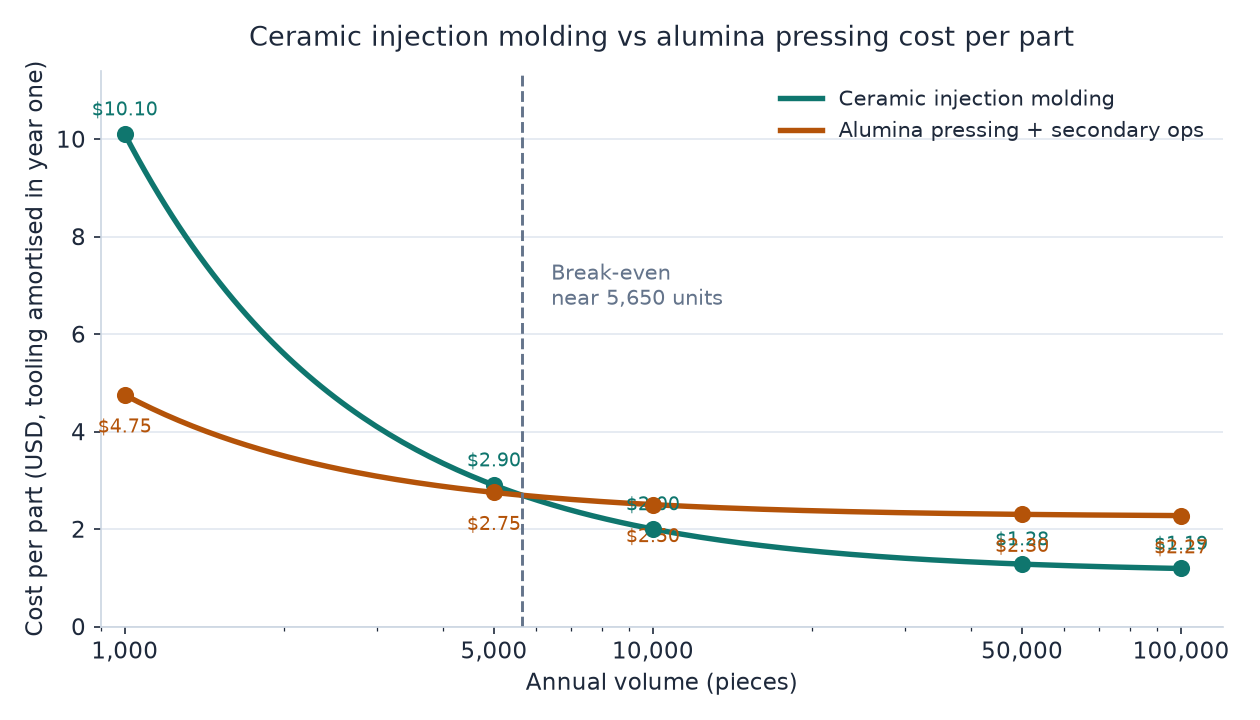
Run the arithmetic. At 1,000 pieces a year the injection molded part costs 10.10 USD and the pressed part costs 4.75 USD, so pressing wins by a wide margin. At 5,000 pieces the gap is down to 15 cents. Break-even sits near 5,650 units. By 100,000 pieces the molded part is 1.19 USD against 2.27 USD, and the verdict has reversed. That break-even volume moves with two variables. Tooling cost is the first, since a four cavity mold at 16,000 USD instead of 9,000 USD pushes break-even past 11,000 units. Secondary operation count is the second, because every grinding pass added to the pressed blank pulls break-even down.
The figure to watch over a program is cost per part, not the quoted piece price. Tooling amortisation distorts early comparisons, and a supplier who quotes a low piece price while hiding a large tooling line has not done you a favour. The same trap exists on the metal side, and metal injection molding programs run into it constantly. The MIM tooling cost amortization guide walks through those mechanics line by line. Part size matters at the extremes too, and a thin walled surgical component behaves nothing like a 40 mm bushing blank, a point our medical industry page illustrates.
Tolerances and wall thickness limits
This is where the two routes separate hard, and where most bad specifications come from.
As-sintered dry pressed alumina holds roughly plus or minus 1.5 percent of nominal across the pressing direction, closer to plus or minus 2 percent for cold isostatic pressing. On a 10 mm dimension that is 0.15 mm, which is generous. Ceramic injection molding holds about plus or minus 0.4 percent of nominal as sintered, and critical features can reach plus or minus 0.1 mm with a light diamond grind after sintering. Neither process approaches machined metal tolerance, and a drawing carrying plus or minus 0.025 mm on an as-sintered ceramic feature is asking for a grinding operation nobody priced. Tolerance bands work the same way for any material, which is the subject of our guide to CNC machining tolerances.
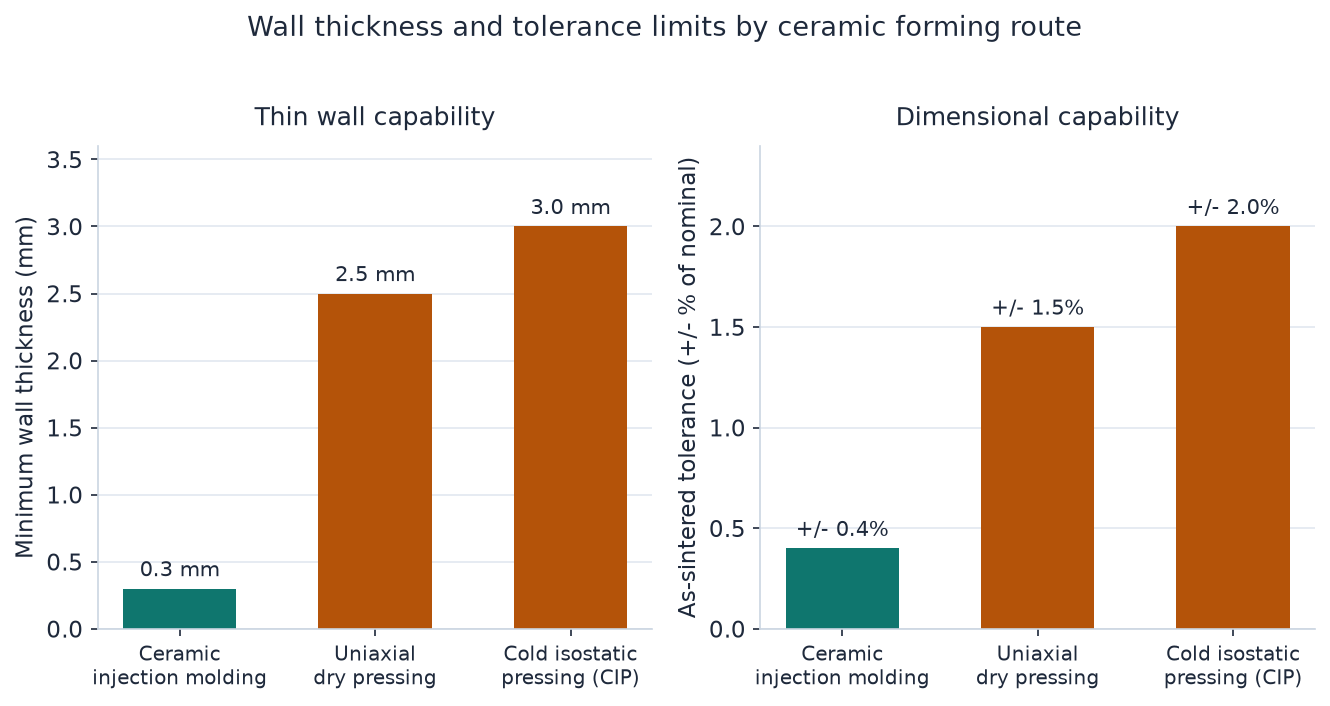
Wall thickness tells a similar story. Dry pressing needs at least 2.5 mm of wall for reliable powder transfer, and 3 mm for cold isostatic pressing at the low end of the size range. Below that, the powder does not fill evenly and the part sinters with a density gradient that shows up as a crack after the first thermal cycle in service. Ceramic injection molding reaches 0.3 mm walls because the binder carries powder into thin sections.
Draft angles run 1 to 2 degrees on a pressed part, and zero on an injection molded one, and that single difference decides a lot of designs. I have redesigned more than one small alumina insulator away from pressing because the customer needed a straight wall with a 0.8 mm section and a cross hole, and no draft angle or added grind step was going to rescue it. A pressed die leaves a matte finish that usually needs a lap on a seal face, and that callout logic is covered in our guide to specifying surface roughness on a drawing.
Material choices that differ
Both routes start from alumina, and 96 percent and 99.5 percent purity grades are available in either. Pressed grades lean on dry blending, so heavily loaded compositions with a single additive press cleanly, while injection molding needs enough powder sphericity to fill a thin cavity without separation. Zirconia toughened alumina is the clearest example. It runs beautifully in a press, but in an injection molded feedstock the zirconia must be dispersed well or the sintered part develops local transformation zones that crack under load. For porous parts such as filters and diffusers, pressing also wins on control, since pore structure is set by powder packing and the sacrificial pore former, and pressed parts can be engineered to 25 to 45 percent porosity with predictable pore size. If corrosion resistance matters more than hardness, a sintered component can look a lot like a stainless one on paper, and that trade is covered on our stainless steel 316L page.
Tooling cost and mold life
Tooling is the number buyers ask about first and understand least. A single cavity ceramic injection mold in hardened tool steel runs 6,000 to 9,000 USD. A four cavity mold runs 12,000 to 16,000 USD, and an eight cavity mold lands between 20,000 and 26,000 USD. Cavities are cut in steel that has to survive abrasive feedstock, typically 48 to 52 HRC.
Mold life expectancy is usually quoted at 300,000 to 500,000 shots before a cavity needs refurbishment, and refurbishment costs 2,000 to 5,000 USD. For an eight cavity mold at 300,000 shots, that is 2.4 million parts before the first rebuild, or roughly two and a half years of single shift running.
Two decisions move the tooling number. Cavity count is the first. Going from eight cavities to four saves 30 to 40 percent of tooling cost and raises the piece price only slightly at moderate volume, and for programs under 20,000 pieces a year that trade is usually worth taking. Feature complexity is the second. Side actions for cross holes add 2,000 to 4,000 USD and a maintenance line item that outlives the purchase order, which is why I push buyers toward a post-sinter drilled hole whenever the tolerance permits it.
Where each route earns its place
Alumina pressing earns its place on simple rotational shapes at any volume, on very high volume programs where piece price dominates everything else, and on porous parts where pore structure is the product. Piston plungers, seal rings, wear tiles, nozzle liners, and bushing blanks belong here. Pressing also wins whenever the part is thick, because a 6 mm wall is free in a press and a problem in a mold.
Ceramic injection molding earns its place when the geometry carries the value. Threaded ceramic insulators, fiber optic ferrules, implantable component bodies, and sensor housings with internal channels all fall on this side of the line. I will say plainly that I dislike watching buyers force an injection molded design onto a part that is really a pressed disc. I have quoted those jobs, and I have also told customers to take them elsewhere. The reverse is worse, since a pressed blank with four secondary operations costs more than a properly tooled injection molded part above 10,000 pieces.
Prototypes complicate the picture, since neither process prototypes cheaply. When a customer needs functional ceramic samples before committing to a route, the usual answer is to machine the first articles from a sintered blank.
Questions buyers send me most
Is ceramic injection molding or alumina pressing cheaper at 3,000 pieces a year?
Pressing, and not narrowly. At 3,000 units the pressed piece price runs about 3.08 USD finished against 4.10 USD for the molded part once tooling is amortised. The margin disappears around 5,650 units, where the two curves cross.
Can pressed alumina hold a plus or minus 0.05 mm tolerance?
Not as pressed. As-sintered dry pressing holds about plus or minus 1.5 percent of nominal, so a 10 mm dimension carries a band near 0.15 mm either way. Reaching plus or minus 0.05 mm takes diamond grinding after sintering, which adds 0.40 to 1.20 USD per part.
How much does a ceramic injection molding tool cost?
A single cavity mold runs 6,000 to 9,000 USD, four cavities run 12,000 to 16,000 USD, and eight cavities run 20,000 to 26,000 USD. Cavities are cut in steel at 48 to 52 HRC. Expect 300,000 to 500,000 shots before refurbishment, which costs another 2,000 to 5,000 USD.
Can one supplier run both ceramic routes?
Usually not. Pressing and injection molding need different equipment, feedstock preparation, and sintering profiles, and most ceramic shops are strong in one. A part family with simple discs and threaded insulators means two qualification packages, and how we work outlines what that package contains on our side.
Paperwork is the last detail worth planning. When a drawing package mixes ceramic and metal parts, the CNC machining and powder metallurgy routes cover the metal half, and our quality page lists the inspection documentation we issue by default. Measuring a 0.3 mm sintered wall with hand tools produces numbers nobody should sign, which is why ceramic parts get the same coordinate measuring machine treatment as machined metal, and our FAQ page lists what we publish by default.
Need Precision Metal Parts for Your Project?
Yujiaxin Tech specializes in MIM, CNC Machining, Powder Metallurgy, Investment Casting, and Gear Hobbing. Get a free quote within 24 hours.