I have walked through investment casting shops in Guangdong for more than fifteen years. The parts that fail first article inspection are rarely the ones with obvious defects. They look fine. The surface is clean. The dimensions check out on three points. Then you lay the part on a granite plate and see a 0.4 mm bow across a 120 mm wall. That is warping, and in thin wall investment castings it is the failure mode I respect most, because it hides until the last minute.
This guide covers what I have learned about keeping thin wall castings flat. The rules are not theoretical. They come from programs that passed and programs that did not.
Table of contents
How thin is too thin for investment casting
The question buyers ask most often is whether their 0.5 mm wall can be cast. The honest answer is sometimes, but not in the way they imagine. Investment casting can produce walls down to 0.4 mm in small areas, but a continuous 0.5 mm wall across a 100 mm span is a different problem. The issue is not filling the cavity. The issue is keeping the shape after the metal solidifies and cools.
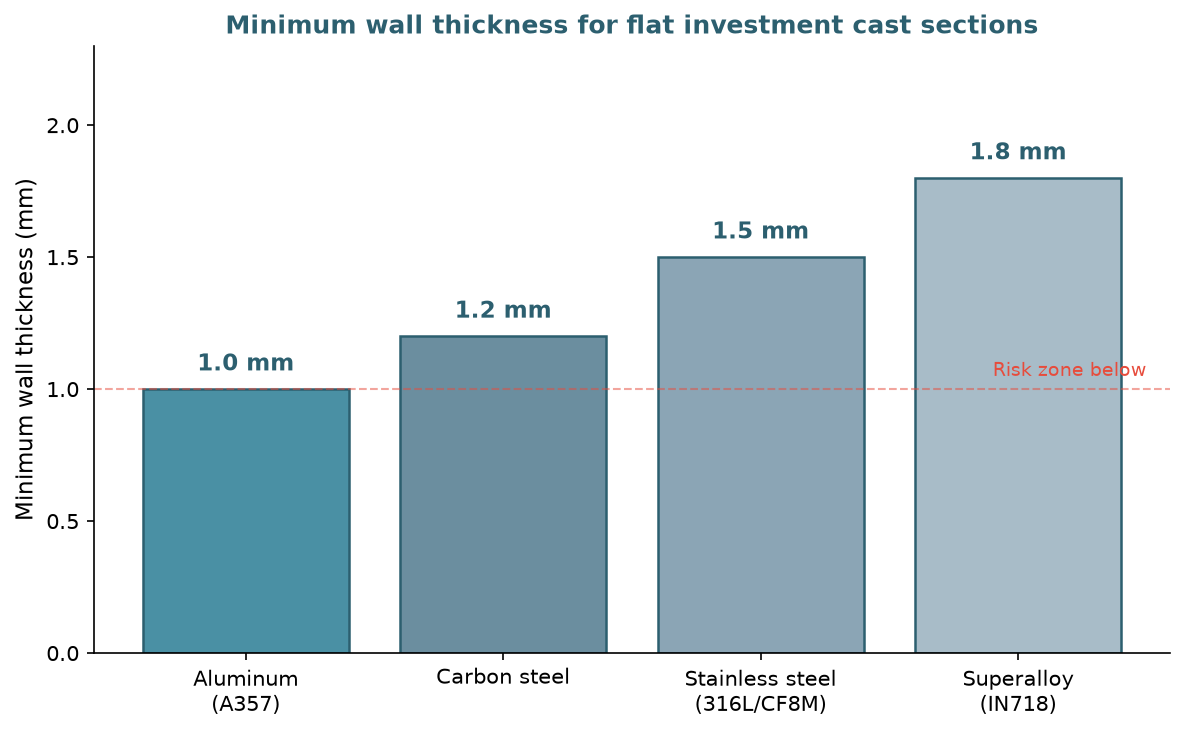
My rule of thumb for flat, thin sections is 1.0 mm minimum for aluminum, 1.2 mm for carbon and low alloy steel, and 1.5 mm for stainless steel and superalloys. These numbers assume the wall is supported by ribs or thicker sections nearby. A free-standing 0.8 mm stainless wall 80 mm long will warp. I have seen it happen.
The ratio matters as much as the absolute number. A wall that is ten times longer than it is thick is already risky. At twenty times, warping is probable unless you take specific measures. I treat a 1.0 mm wall 50 mm long as normal. A 1.0 mm wall 150 mm long gets extra attention in the shell build and cooling stages.
Buyers searching for investment casting wall thickness limits often find theoretical minimums online. Those minimums are for small, stiff geometries. For large flat panels, double them.
Alloy choice and its effect on distortion
Not all alloys warp equally. The two factors that matter are thermal contraction and strength at high temperature. Aluminum alloys like A356 contract about 1.3% from liquid to room temperature. Stainless steel 316L contracts about 2.0%. That extra 0.7% sounds small, but across a 200 mm dimension it is 1.4 mm of total shrinkage that has to go somewhere.
The stronger the alloy is while it is cooling through 800 to 500 degrees C, the better it resists distortion. Carbon steels are weak in that range. They sag under their own weight if the shell is removed too early. Nickel-based superalloys like IN718 hold stiffness better, but they also shrink more and are harder to straighten afterward.
I had a job in 2019 for a 316L sensor housing with 1.2 mm walls. The first articles warped 0.3 mm. We switched to CF8M, the cast equivalent of 316, and the warping dropped to 0.08 mm. The chemistry is nearly identical. The difference was that CF8M is specified for cast microstructure, with slightly higher ferrite content that adds stiffness during cooling. For buyers who need stainless steel 316L properties in a cast part, this is worth discussing with your foundry.
For aluminum, A356 is common but A357 has better castability and less tendency to hot tear in thin sections. The mechanical properties are close enough that most buyers do not notice the difference. I recommend A357 for walls under 1.5 mm.
Gating design for even cooling
Warping starts with uneven cooling. If one end of a thin wall solidifies while the other end is still liquid, the solid end contracts and pulls the soft end with it. The result is a permanent bend.
The standard fix is multiple gates. A single gate at one end of a long thin wall is almost guaranteed to cause distortion. I prefer two or more gates spaced along the length, so the wall fills from multiple points and the temperature stays more uniform. For a 150 mm wall, I want gates at 40 mm and 110 mm, not one gate at the end.
The gate cross-section also matters. Thin walls need small gates to avoid overfeeding, but gates that are too small freeze off before feeding is complete and cause shrinkage porosity instead of warping. I use a gate thickness of 1.5 to 2.0 times the wall thickness for aluminum, and 2.0 to 2.5 times for steel. A 1.0 mm steel wall gets a 2.0 mm gate. That is thick enough to feed, thin enough to freeze at the right time.
Riser placement is the mirror image of gate placement. Risers draw heat away. If you put a large riser at one end of a thin wall, that end cools slower and the wall bows toward the riser. I keep risers off thin sections when possible, or I use small, distributed risers rather than one large one. For CNC machined prototypes that will later move to casting, this is a detail that prototype designers often miss.
Shell building and ceramic control
The ceramic shell is the mold that holds the metal. Its thickness and uniformity control how fast heat leaves the casting. A thick shell in one area and a thin shell in another creates the same problem as uneven gating: one area cools faster and pulls the part out of shape.
I have watched shell builders dip clusters by hand. The slurry thickness varies. The stucco particle size varies. The drain angle varies. All of these show up in the casting. For thin wall parts, I specify a minimum shell thickness of 6 mm for small parts under 100 mm, and 8 mm for larger parts. More important than the absolute thickness is uniformity. I ask for shell thickness variation under 1 mm across the part surface.
The shell material also affects cooling. Fused silica shells have lower thermal conductivity than alumina shells. They cool the metal slower and more evenly. For thin wall steel castings, I prefer fused silica for the primary coats and alumina only for the backup coats where strength matters more. The difference in cooling rate can be 20 to 30%, which directly translates to less distortion.
Dewaxing is another source of variation. If the autoclave cycle is too aggressive, the shell cracks. Small cracks fill with metal and create local hot spots that cool differently. I specify a gradual preheat to 150 degrees C before steam entry, and a steam pressure ramp rather than a step. Most foundries know this, but the ones that rush dewaxing to save cycle time create problems downstream.
Cooling rate and fixturing after cast
The moment the casting leaves the furnace, it is still hot and weak. How you handle it in the first hour determines whether it stays flat.
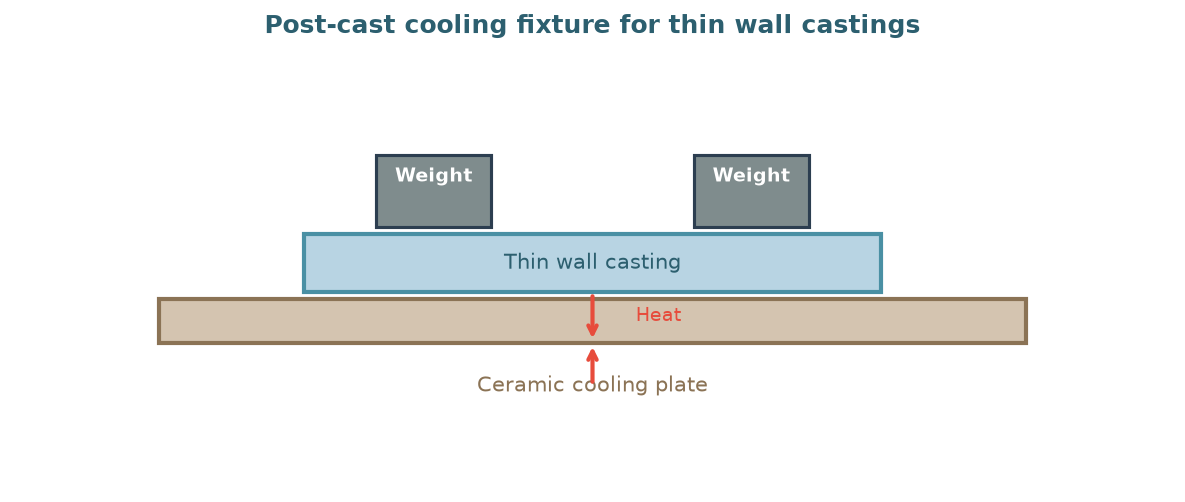
For thin wall parts, I never let the casting cool in free air on a bench. The bottom surface cools against the bench while the top surface cools to air. The temperature difference across a 1.0 mm wall is enough to cause 0.1 to 0.2 mm of bow. Instead, I specify cooling on a flat ceramic plate with the part weighted down. The plate acts as a heat sink on both sides, and the weight resists the early distortion while the metal is still plastic.
The cooling rate itself is a trade-off. Fast cooling through the transformation range produces finer grain and better mechanical properties, but it also increases thermal gradients and distortion. Slow cooling reduces gradients but can produce coarse grain or precipitate phases that hurt properties. For 316L, I cool in still air to 400 degrees C, then move to the plate. For aluminum, I go straight to the plate because the transformation happens so fast that air cooling is already slow enough.
Some buyers ask about straightening after casting. It is possible for mild distortion under 0.5 mm, but I do not recommend it for thin walls. The straightening process introduces stress that can cause delayed distortion during machining or in service. I have seen a 0.3 mm bend corrected by pressing, then return three weeks later after a stress relief cycle. For aerospace parts where dimensional stability matters, this is unacceptable.
How to measure warping correctly
You cannot fix what you do not measure correctly. For thin wall castings, I use a granite surface plate and a dial indicator with 0.01 mm resolution. The part sits on three support points defined by the drawing datum scheme. The indicator scans the surface in a grid pattern. I record the maximum deviation from the plate.
The support points matter. If the drawing does not define datums, I use the minimum-rocker method: three points that minimize the maximum deviation. This gives the flattest possible reading, which is fair to the supplier but may not represent how the part mounts in the assembly. I prefer datums defined by the buyer.
For production, I move to a CMM once the process is stable. The CMM gives a full surface map rather than a single number. I can see whether the distortion is a simple bow, a twist, or a complex saddle shape. Each pattern points to a different root cause. A bow suggests uneven cooling across the length. A twist suggests asymmetric shell thickness. A saddle shape suggests the part was constrained during cooling in a way that fought natural shrinkage.
I also measure after stress relief. Some alloys move 0.05 to 0.10 mm during the 1,050 degree C stress relief cycle for stainless steel. If the part is within tolerance before stress relief and out after, the buyer needs to know before they machine. I always mark first article dimensions as "before stress relief" or "after" so there is no confusion.
Related reading
See our investment casting design guidelines, what drives precision cast component pricing, or how to choose a manufacturing process. Our process engineering team reviews drawings before quoting.
Common questions about thin wall investment casting warping
What is the thinnest wall investment casting can hold without warping?
For flat, unsupported sections, 1.0 mm for aluminum, 1.2 mm for carbon steel, and 1.5 mm for stainless steel. Smaller localized features can go to 0.4 mm, but long thin walls need more mass.
Can warped investment castings be straightened?
Mild distortion under 0.5 mm can be pressed flat, but the residual stress often returns during machining or heat treatment. For precision applications, fix the process rather than straighten the part.
How much does wall thickness affect investment casting cost per part?
Thin walls increase cost by 15 to 40% because they require slower shell builds, more careful gating, and higher scrap rates. The break-even point where a thicker wall with machining is cheaper depends on volume and geometry.
Which alloy warps least in thin wall investment casting?
Aluminum alloys like A357 warp less than steels because they contract less and solidify at lower temperatures. Among steels, cast grades like CF8M distort less than wrought equivalents because their microstructure is optimized for casting.
How do I specify flatness tolerance on a thin wall casting drawing?
Use GD&T flatness control with a datum reference frame. A typical value is 0.15 mm for a 100 mm feature. Tighter than 0.10 mm usually requires post-cast machining or grinding, which should be noted on the drawing.
Need Precision Metal Parts for Your Project?
Yujiaxin Tech specializes in MIM, CNC Machining, Powder Metallurgy, Investment Casting, and Gear Hobbing. Get a free quote within 24 hours.