I have quoted precision cast components for buyers in automotive, aerospace, and medical device supply chains for more than fifteen years. The first thing I tell them is that the unit price on the quote is not a single number. It is the visible tip of several cost drivers that sit underneath the part geometry. If you understand those drivers, you can read a precision casting quote the same way a foundry engineer does.
This article breaks down what drives the unit price of precision cast components. I will focus on investment casting, because that is where most of our customers land when they need complex metal shapes without paying for a die-casting die. The same logic applies to other precision casting routes, but the numbers change.
Table of contents
Pattern and tooling amortization
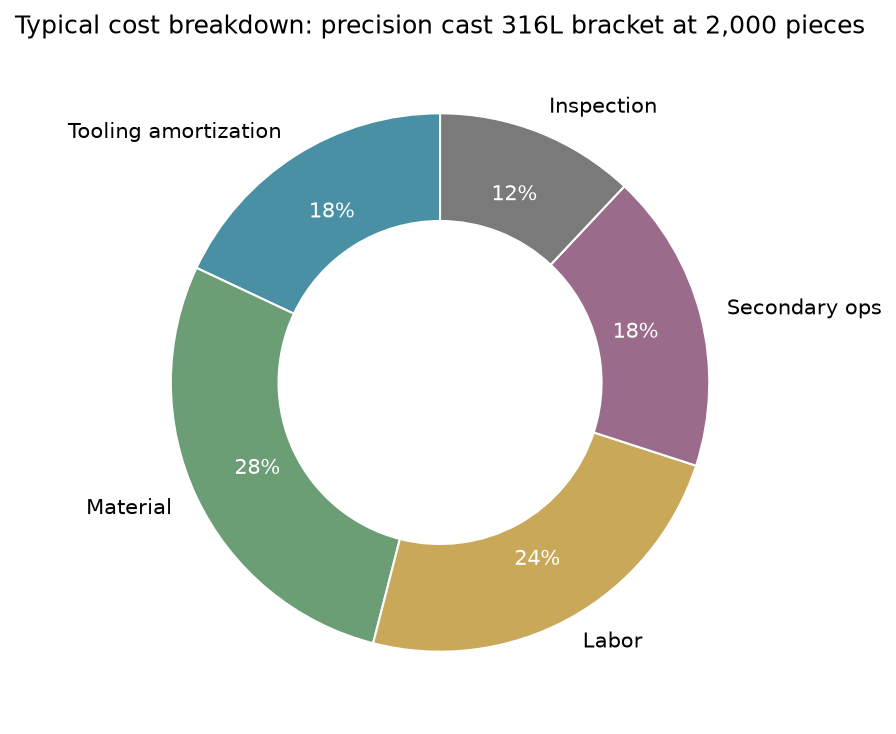
The biggest shock for new buyers is the tooling line. A set of aluminum or brass injection dies for the wax pattern typically runs $2,000 to $8,000 for a small to medium stainless steel part. Larger parts, multi-cavity tooling, or parts with internal cores can push that figure past $15,000. The ceramic shell itself is consumed every pour, so it is not part of the capital cost, but the wax pattern die is.
That die cost has to be recovered across the order volume. If the tooling is $5,000 and the program calls for 1,000 pieces, the tool adds $5.00 to every part. If the program calls for 10,000 pieces, it adds $0.50. This is why investment casting design guidelines matter so much: a small change that lets the foundry use a simpler die can cut the tooling line by 30% or more.
Some buyers ask whether the tooling cost is refundable. In my experience, it almost never is. The die is specific to your part geometry. Once it is cut, the foundry cannot use it for another customer. The only time I see tooling credits is when a customer commits to a multi-year agreement with guaranteed volumes, and even then the credit is spread across future releases.
Die life expectancy is rarely the limiting factor. A well-maintained aluminum wax injection die can last 50,000 to 100,000 shots before it needs refurbishment. For most programs, the tool wears out slowly enough that the amortization is already complete long before rework is needed.
Alloy and feedstock cost
After tooling, the metal itself is the next largest variable. A kilogram of 316L stainless steel feedstock currently costs roughly $4 to $6, depending on the form and certification level. Carbon and low-alloy steels are cheaper. Cobalt chrome and titanium alloys can run 5 to 10 times higher. Aluminum is inexpensive by the kilogram, but it has a lower density, so a part that looks small can still consume more metal than you expect.
The quoted material cost is almost never just the finished part weight. Foundries buy feedstock by the pour, and the gating system, risers, and shell fill paths add metal that is later recycled but still has to be counted. A typical casting yield, meaning the finished part weight divided by the poured weight, ranges from 40% to 65% for complex geometries. The rest comes back as remelt, but the energy and labor to melt it are already spent.
Certification also moves the number. A heat of 316L stainless steel with full EN 10204 3.1 traceability costs more than the same alloy bought without certificates. For aerospace or medical work, that documentation is not optional, so the material line reflects it.
Wall thickness and casting yield
Thin walls look efficient on paper because they use less metal. In a foundry, they are often more expensive. A wall below 1.5 mm is difficult to fill in investment casting and may need a higher pouring temperature, a thinner shell coat, or extra inspection. Walls below 0.8 mm are possible in some alloys, but the scrap rate climbs fast and the quoted price climbs with it.
Thick walls are not free either. Heavy sections create shrinkage porosity and slow solidification, which increases the chance of X-ray or cut-up rejection. The sweet spot for most stainless steel investment castings is 2 mm to 6 mm. When a buyer asks me to reduce a 5 mm wall to 1 mm to save material, I usually warn them that the unit price may go up, not down, once the yield loss is included.
Radii and fillets also matter. Sharp internal corners act as stress concentrators and can cause hot tearing. A generous radius reduces scrap and reduces the need for weld repair. The design pages on CNC machining and metal injection molding cover similar rules, but in casting the penalty for ignoring them is porosity rather than tool wear.
Tolerance bands and secondary operations
Investment casting can hold linear tolerances of roughly ±0.5% of nominal dimension, or ±0.1 mm on small features, whichever is larger. That is good enough for many assemblies. When a drawing calls for ±0.05 mm or tighter, the as-cast part will not meet it without secondary machining.
Secondary operations are where the quote grows quickly. A machining hour in China runs roughly $15 to $40 depending on the equipment and certification. A hole that needs reaming, a face that needs milling, or a thread that needs chasing can each add a setup. I have seen parts where the casting itself was inexpensive and the machining to finish it cost more than the casting.
The cheapest way to control this is to relax tolerances that do not matter. If a cosmetic surface can live with Ra 6.3 µm instead of Ra 1.6 µm, say so. If a hole can be cast instead of machined, leave it cast. The CNC machining tolerances guide explains how tolerance bands translate to machine time, and the same math applies when casting needs a machining assist.
Order quantity and setup spread
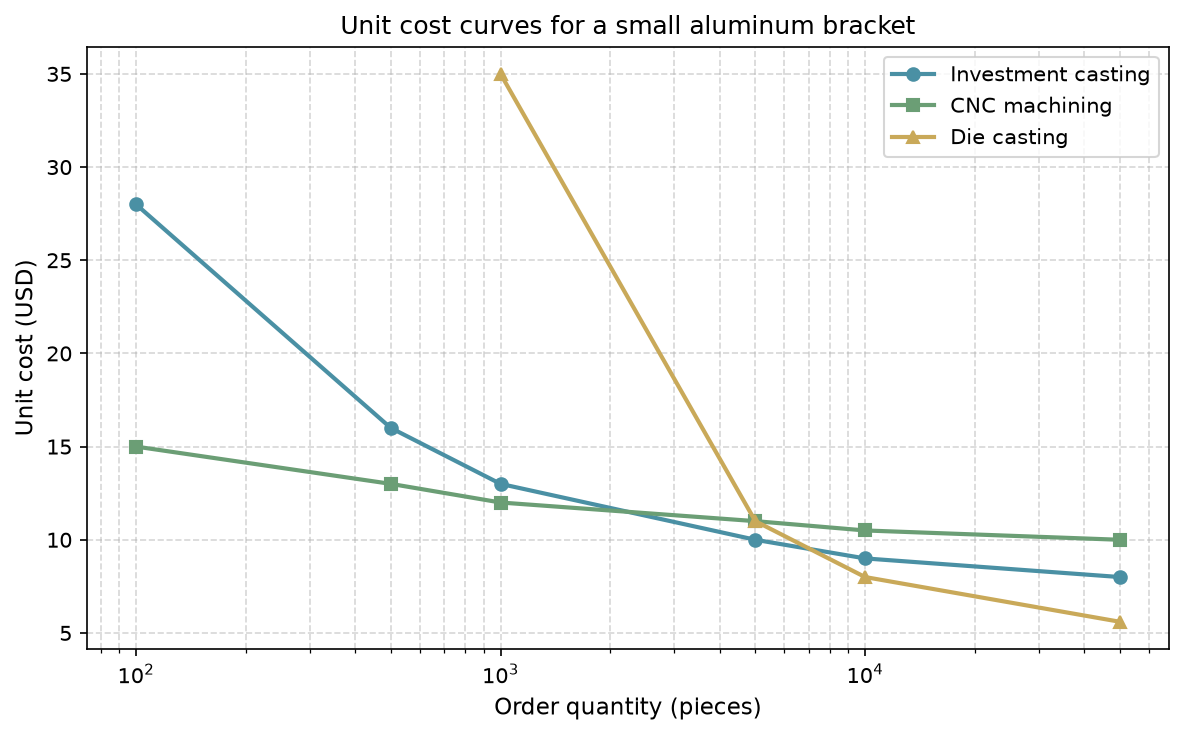
Setup cost is the fixed labor to prepare the furnace, build the shells, assemble the tree, and pour the heat. A small batch of 50 pieces carries almost the same setup as a batch of 500. This is why the unit price drops sharply between 100 and 1,000 pieces, then flattens out.
In my quotes, the break-even volume for precision casting versus CNC machining usually lands between 200 and 500 pieces for a complex stainless steel part. Below that, machining is often cheaper because there is no tooling to amortize. Against die casting, the break-even is much higher, typically 5,000 to 15,000 pieces, because the die-casting die is expensive but the cycle time is fast. I covered that crossover in more detail in the article on when die casting beats investment casting for aluminum enclosures.
Annual volume also affects scheduling. A foundry will quote a lower piece price for a firm forecast of 10,000 pieces per year than for a one-time lot of 1,000, because the tooling risk and furnace loading are easier to plan.
Surface finish and inspection level
As-cast surface finish depends on the ceramic shell grain size and the alloy. A fine shell gives a smoother surface but costs more and is more fragile. Typical as-cast finishes range from Ra 3.2 µm to Ra 6.3 µm for stainless steel. Specifying Ra 0.8 µm as-cast is unrealistic without machining or polishing.
Inspection is the last major lever. A visual and dimensional check is cheap. X-ray, dye penetrant, or computed tomography adds cost fast. For a aerospace casting, NDT can add 15% to 30% to the part price. For an automotive bracket, a simple dimensional report is usually enough.
I always ask buyers to separate critical features from nice-to-have features. If only two holes need tight true-position tolerance, call those out and leave the rest at general tolerances. The quote will come back lower, and the supplier will have fewer reasons to add inspection that you did not really need.
For buyers who need the lowest possible casting unit price, the fastest lever is usually order quantity. The second fastest is tolerances. The slowest but most durable lever is design for manufacturability. Changes made before the die is cut cost nothing to implement and pay back across every release.
Frequently asked questions
How much does investment casting tooling cost?
For small to medium stainless steel parts, expect $2,000 to $8,000 for the wax pattern die. Larger parts, multi-cavity tooling, or internal cores can push the figure above $15,000.
What is a typical break-even volume for precision cast parts?
Compared with CNC machining, the break-even volume is usually 200 to 500 pieces for a complex stainless steel part. Compared with die casting, it is typically 5,000 to 15,000 pieces.
Does a thinner wall always lower the casting cost per part?
No. Walls below 1.5 mm increase scrap and may need special pouring control. The result can be a higher unit price even though the part uses less material.
How do as-cast tolerances affect unit price?
As-cast tolerances of ±0.5% or ±0.1 mm are standard. Tighter tolerances require machining, which can add $15 to $40 per hour of machine time and often dominates the quote.
Which alloy adds the most to precision casting cost?
Titanium and cobalt chrome alloys can cost 5 to 10 times more per kilogram than 316L stainless steel. Carbon steels and aluminum are at the lower end of the range.
If you want a deeper look at how process choice shapes total cost, read the guide on choosing a metal parts manufacturing process. For surface finish trade-offs, the surface finish options guide has more detail. Our FAQ and how we work pages cover quoting and sample flows.
Need Precision Metal Parts for Your Project?
Yujiaxin Tech specializes in MIM, CNC Machining, Powder Metallurgy, Investment Casting, and Gear Hobbing. Get a free quote within 24 hours.