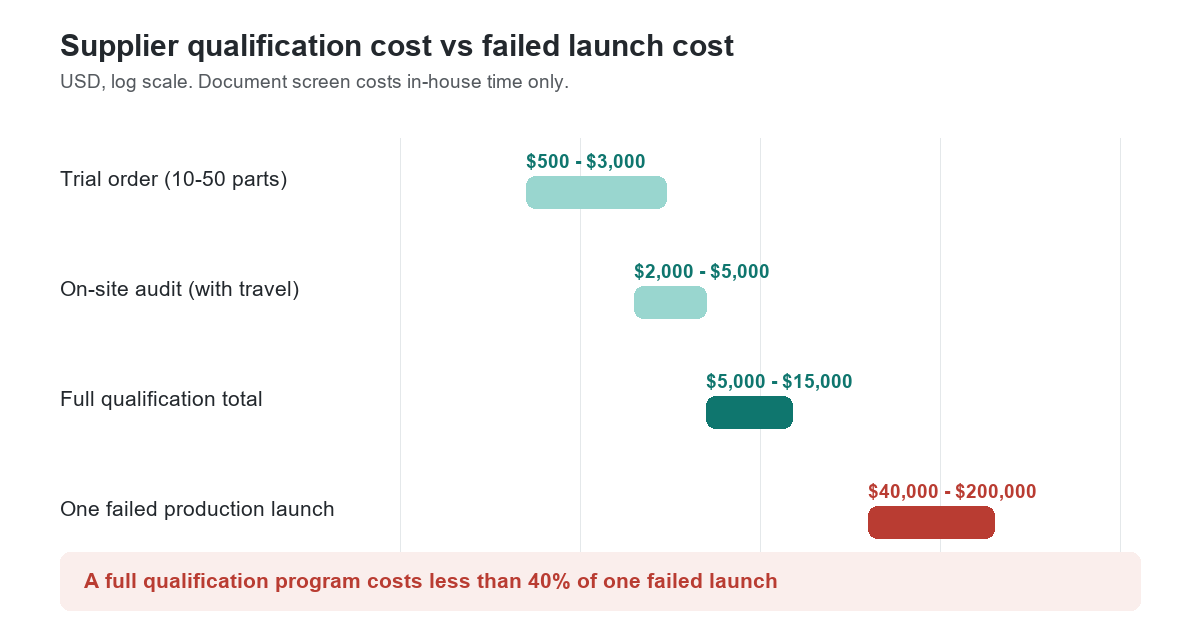
Every year I watch the same film play out. A buyer finds a new metal parts supplier, sends a drawing, likes the price, and wires tooling money within three weeks. Four months later a shipment lands with 12 percent rejects, and nobody at the supplier can explain what changed. Almost all of those failures were visible in the first conversations, if anyone had looked with intent. A qualification process is that look, done on purpose, written down. In this article I give you the six steps I use to qualify a new metal parts supplier, what each step costs, and where it usually goes wrong. The whole effort runs eight to fourteen weeks and roughly $5,000 to $15,000 with travel. Against one failed launch, which has cost my clients between $40,000 and $200,000, it is the cheapest insurance we buy.
Contents
- What a qualification process actually protects
- Step 1: define the part before you define the supplier
- Step 2: screen candidates with documents, not brochures
- Step 3: audit the floor, not the lobby
- Step 4: run a trial order that mirrors production
- Step 5: judge the first articles against the drawing
- Step 6: agree on documents and ongoing controls
- Warning signs that end the conversation
- Frequently asked questions
What a qualification process actually protects
A supplier qualification process protects your production schedule and your cash. A certificate on the wall says a factory passed an audit once. Your qualification says you checked that this factory, for your part, with your tolerances, can hold them in a busy month when the owner is traveling. Those are different claims, and I only trust the second one.
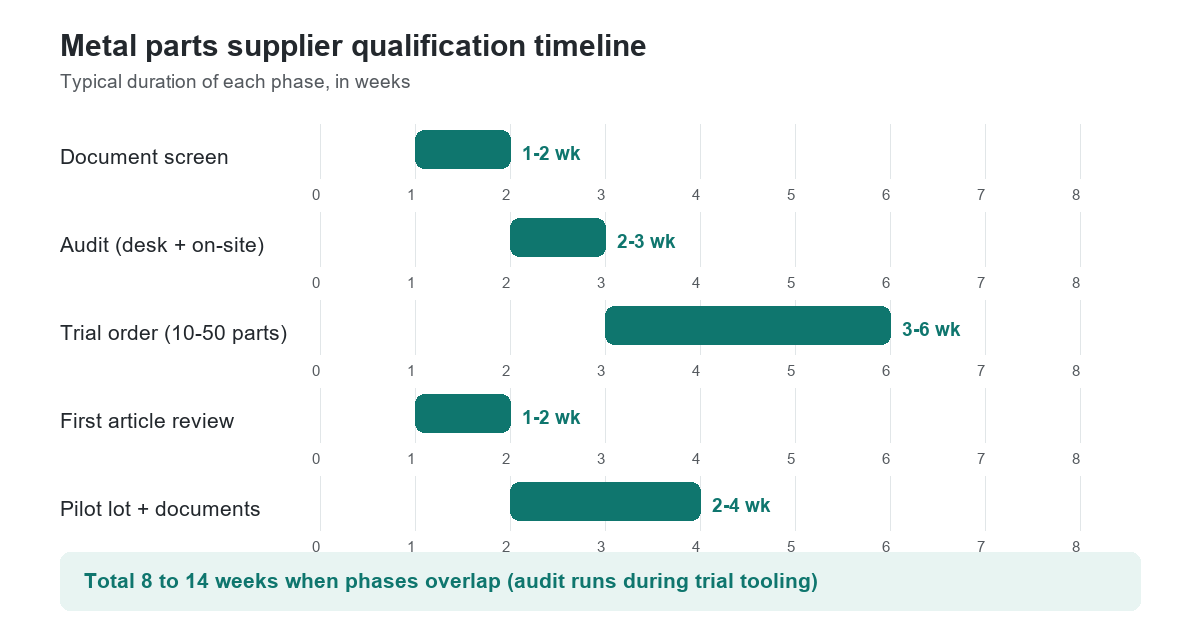
I run the work in six steps: define, screen, audit, trial, inspect, control. Run them back to back and the calendar reads nine to seventeen weeks. Overlap the audit with trial tooling, which I usually do, and you land inside eight to fourteen weeks. Skipping steps does not save time; it moves the delay to your production launch, where it costs more and where you have fewer options left.
Step 1: define the part before you define the supplier
I turn incomplete prints away from quoting, and it is not to be difficult. A drawing without tolerances, volumes, and material callouts produces quotes nobody can compare. Before you contact anyone, write down five things: the material and grade, the tightest tolerances (I start worrying below the 0.025 mm range), annual volume for the first three years, finish and coating, and the industry requirements attached to the program. Automotive programs bring PPAP with them, and parts for the medical industry add ISO 13485 language to the conversation. Volume picks the process: 15,000 units a year of a 12 gram 17-4PH clip points toward metal injection molding, while 200 units a year stays on a CNC machining center. A 316L stainless part headed for marine service disqualifies half of your candidate list before you send anything.
Step 2: screen candidates with documents, not brochures
Screening costs nothing but two or three hours, and it removes more bad suppliers than any other step. I ask every candidate for the same five documents:
- ISO 9001 certificate, including the scope page
- a sample material certificate from a recent lot
- a first article report with its balloon drawing
- a calibration list for their measuring equipment
- two customer references in my industry
Then I read the scope page. A certificate issued to a different company name than the quotation letterhead, or scoped to trading and assembly only, is a finding. I stop there until it is explained. Material certificates deserve the same suspicion; I once traced a 316L cert to a melt lot that could not have produced the heat number printed on it. I go deeper on both in how to vet a Chinese metal parts manufacturer before ordering and how to read a material certificate for stainless steel 316L.
Step 3: audit the floor, not the lobby
References and certificates describe the factory a supplier wants you to see. The floor shows you the one that will actually make your parts. I audit in person when the program justifies travel, and by scheduled video walk when it does not. On the floor I look at incoming material segregation, the calibration sticker on the CMM, whether the SPC charts carry data points from this month, tooling ownership records, and the scrap bins. Bins tell the truth about yield faster than any slide deck. A one day on-site audit with travel runs $2,000 to $5,000 for a Chinese supplier from most Western cities, and it is the best money in this whole process. If travel is off the table, a third party inspection agency charges about $250 to $400 per man-day to walk the same checklist. Our how we work page explains how we pair that audit with a DFM review before any quote goes out.
Step 4: run a trial order that mirrors production
A trial order proves the supplier can make your part, not a showroom version of it. I specify ten to fifty pieces, on production material, through the production process, at the production inspection level. Budget $500 to $3,000 for a machined or cast trial. The mistake I keep seeing: buyers accept samples cut from bar stock when production will be cast or molded. The sample passes, tooling gets cut, and the cast version moves differently on the dimensions that matter. If production is investment casting, the trial goes through wax and shell like real parts. If the drawing calls for titanium Ti-6Al-4V, the trial runs that alloy from the mill source the supplier intends to buy from. Heat treatment follows the same rule: H1025 on the print means the trial goes through that age cycle, not a shortcut.
Step 5: judge the first articles against the drawing
When first articles arrive, I judge them the way I would judge a submission to an automotive customer. Every print dimension gets ballooned and measured, with actual values recorded next to nominal, never a pass or fail tick. CMM reports cover the tight tolerances, and I want capability numbers beside the raw results. A shop that holds tolerances near 0.025 mm around a Cpk of 1.33 has a process. A shop that measures three parts with a caliper has a story. For the 200 piece pilot lot I sample to AQL 1.0 at Level II, and our quality page lists the certificates behind that practice. Any dimension beyond print sends the lot back with a corrective action request, and the way a supplier responds to that rejection teaches me more than the FAI report itself. I explain the logic further in why first article inspection matters for procurement and what is CMM inspection and when do you actually need it.
Step 6: agree on documents and ongoing controls
Qualification ends with paperwork that keeps working after the first shipment. For programs in the automotive industry, PPAP Level 3 is the standard package and I have written a buyer checklist for it in metal parts PPAP submission checklist for buyers. Whatever the industry, I want four clauses in writing before the first production order: material traceability to heat number, a change notification clause covering process and sub-tier moves, a defined escape response with quarantine inside 24 hours, and a requalification trigger such as a line relocation. Add 100 percent inspection on tight dimensions for the first three lots, then review the whole relationship at the 90 day mark. None of this is adversarial. Good suppliers sign these clauses every week, because they already work this way for their automotive customers.
Warning signs that end the conversation
Some findings end the conversation whatever the price looks like. A certificate dated before the company was founded. A first article where every measurement ends in the same decimal. A refusal to name the equipment that would measure my parts. A quote 40 percent below the others on the same print. And the sentence I trust least: we can do that, offered instantly to every special request. Any one of them sometimes has an innocent explanation. I have heard all five, and I have paid for those explanations. The chart below puts the arithmetic in one place: a full qualification costs less than 40 percent of one failed launch, before you count the customer you lose.
Frequently asked questions
These are the questions buyers ask me most often about qualifying a new supplier. Our FAQ page answers more of the everyday ones.
How long does supplier qualification take for metal parts?
Plan on eight to fourteen weeks with phases run in parallel. A single simple part can compress to six weeks. A multi part program with new tooling can stretch past twenty.
How much does it cost to qualify a new metal parts supplier?
Typical total: $5,000 to $15,000. The on-site audit with travel runs $2,000 to $5,000, the trial order $500 to $3,000, and the document screen costs internal time only.
How many samples should I request before approving a supplier?
A first article set of three to five pieces, plus a trial lot of ten to fifty. Three pieces prove a machine ran well once. The trial lot shows the process holds across a week.
Is an ISO 9001 certificate enough to qualify a supplier?
No. The certificate tells you a management system exists. The scope page, the floor audit, and the first article results tell you whether that system actually covers your part.
Can I qualify an overseas supplier without visiting the factory?
Yes, with a scheduled video audit on your own checklist and a third party inspection at $250 to $400 per man-day. I still prefer to visit before the first production order.
Need Precision Metal Parts for Your Project?
Yujiaxin Tech specializes in MIM, CNC Machining, Powder Metallurgy, Investment Casting, and Gear Hobbing. Get a free quote within 24 hours.