Most MIM inquiries I quote start well and then stall on one line in the quotation: the minimum order quantity. A buyer wants 300 sensor bosses a month, sees that metal injection molding fits the geometry, and then runs into a first-order requirement of several thousand pieces. The usual assumption is that the supplier is padding the deal. I have quoted MIM programs for well over a decade, and the minimum is not a sales tactic. It is arithmetic.
This guide covers where the MOQ for MIM tooling comes from, what numbers are realistic, how the minimum shapes your tooling cost per part, and four ways to lower it when your volume cannot carry a standard production tool.
What this guide covers:
Why MIM tooling forces a minimum order
A MIM mold is built for one part and one customer. Nobody resells a used cavity. That fact alone explains most of the minimum order quantity, because the tooling investment has to come back through the parts it produces. A single-cavity production tool in hardened steel costs $6,000 to $9,000 for a small part, and a four-cavity version runs $12,000 to $16,000. That money pays for design work, steel, EDM, polishing, and trial shots, all of it spent before the first production part ships.
The second force is the sintering furnace. MIM parts shrink 15 to 20 percent during sintering and only reach final density in a full furnace load. A batch of small parts holds thousands of pieces, and a half-empty load costs the same in energy, atmosphere gas, and cycle time as a full one. Thin loads also make the thermal profile harder to hold, which is where distortion and carbon control problems begin. Put the tool and the furnace together and the conclusion writes itself: a supplier who accepts a 500-piece first order on a fresh production tool is losing money, and a supplier who loses money on the first order will look for it back on the second. I have watched that movie more than once.
This is also why I push buyers to settle the process question before tooling design starts. If the part could go either way, work through the screening questions first; our guide on whether a part is a good fit for metal injection molding covers them in detail. Deciding in week nine is expensive. Deciding in week one is free.
What a typical MIM minimum looks like
Numbers vary from shop to shop, but these ranges are honest for small parts in the 5 to 30 gram range:
- Bridge tooling in aluminum or soft steel: 500 to 1,000 pieces for a first order. The tool costs less, the unit price runs higher, and tool life is measured in tens of thousands of shots instead of hundreds of thousands.
- Single-cavity production tool in hardened steel: 3,000 to 5,000 pieces for the first order. This is the number most buyers mean when they ask about MIM MOQ.
- Multi-cavity production tool: 5,000 to 10,000 pieces, because a bigger tool needs a bigger run to pay for itself.
These are first-order minimums, not lifetime obligations. What a supplier actually watches is annual volume, because that is what pays back the tool. A buyer who needs 3,000 pieces every quarter fits a 3,000-piece first order and a simple release schedule. A buyer who needs 3,000 pieces once, ever, is a harder conversation, and the answer is usually bridge tooling or machined parts.
Take a 316L stainless steel sensor boss of about 8 grams, a part we mold for electronics customers. 316L feedstock is not cheap, and the sealing face needs consistent shrinkage control to hold tolerance. Modest part price plus real process risk is the classic profile of a component sitting right at the MOQ boundary.
How MOQ connects to cost per part
Amortization is the whole story. Spread the tool cost across the first order and you get the tooling cost per part:
- 1,000 pieces: $8.00 of tooling per part, $8.85 all in
- 2,500 pieces: $3.20 of tooling, $4.05 all in
- 5,000 pieces: $1.60 of tooling, $2.45 all in
- 10,000 pieces: $0.80 of tooling, $1.65 all in
- 25,000 pieces: $0.32 of tooling, $1.17 all in
The figures assume an $8,000 single-cavity tool and a $0.85 molding cost per part, which is realistic for a part this size in 316L. Machining the same boss from bar stock runs about $3.80 per piece at low volume. Chart both options and the break-even volume lands near 2,700 units.
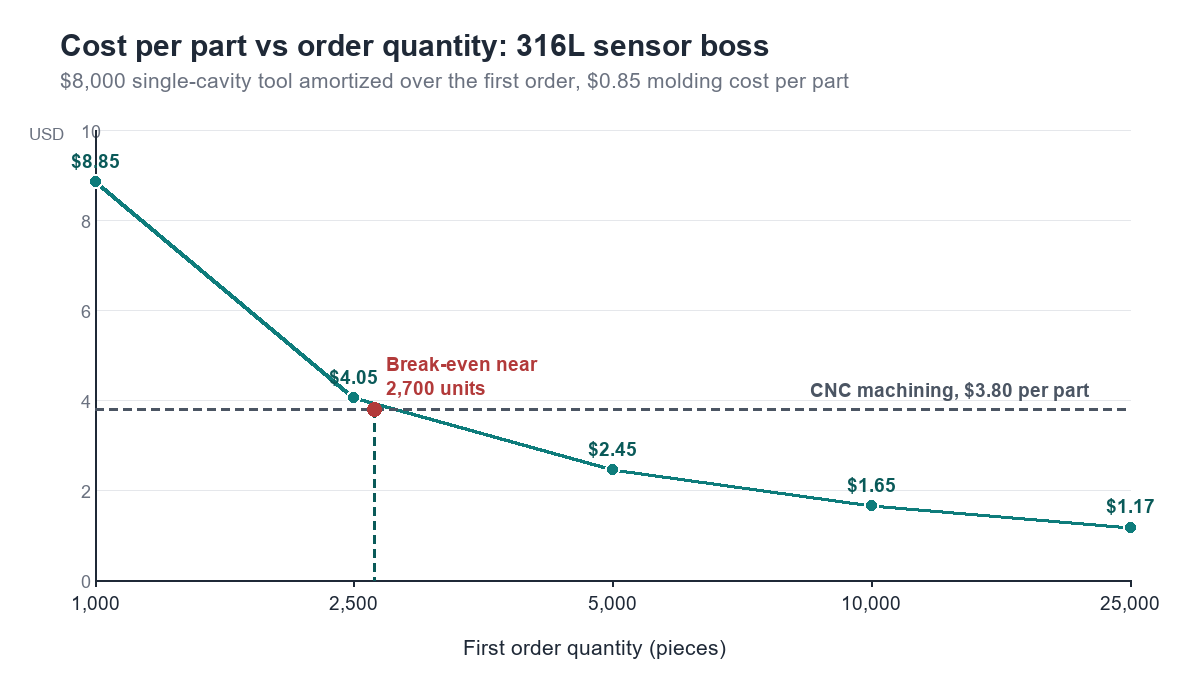
Below that line, machining wins. Above it, the molded part pulls ahead, and by 10,000 pieces it costs less than half the machined one. This is also why a supplier holding a 5,000-piece minimum is not being difficult. Below that volume neither side has a business case. For the full arithmetic, including how mold life expectancy changes the picture over multi-year programs, see my earlier guide on MIM tooling cost amortization.
Four ways to lower your MIM minimum
When a standard minimum does not fit, one of these four levers usually does.
- Start with bridge tooling. An aluminum or P20 bridge tool costs roughly $2,500 to $5,000 and supports first orders of 500 to 1,000 pieces. You pay more per part, you collect real MIM material data, and you keep hardened steel off the table until the design survives field testing.
- Cut one cavity now, leave room for four. Design the mold base for a four-cavity tool but machine only one cavity. The first-order minimum stays near 3,000 pieces, and adding cavities later is a machining job on an existing tool rather than a new purchase. I ask for this on every program with an uncertain forecast, because it keeps the worst case cheap.
- Phase the release. A 5,000-piece MOQ does not have to arrive on one truck. We produce one lot and ship it against a monthly release schedule agreed in advance; the usual structure is described in how we work. The supplier gets the production run the furnace wants, and you get cash flow that matches your assembly plan.
- Trade a forecast for a lower minimum. A signed 12-month forecast changes the conversation. With volume committed, many suppliers will accept quarterly releases against the same tool, and some will fold part of the tooling into the part price. That is not charity. A forecast is a real asset, and it is fair to price it as one.
When machining beats MIM below the minimum
Sometimes the honest answer is to wait on MIM tooling. Under about 2,000 pieces a year, machined parts are almost always cheaper once tooling enters the math, and they carry no minimum beyond the shop's normal lot size. For simple geometries above 10,000 pieces, conventional powder metallurgy deserves a look if the part tolerates about 92 percent density. Investment casting covers the larger parts MIM cannot fit. The whole decision fits on one chart:
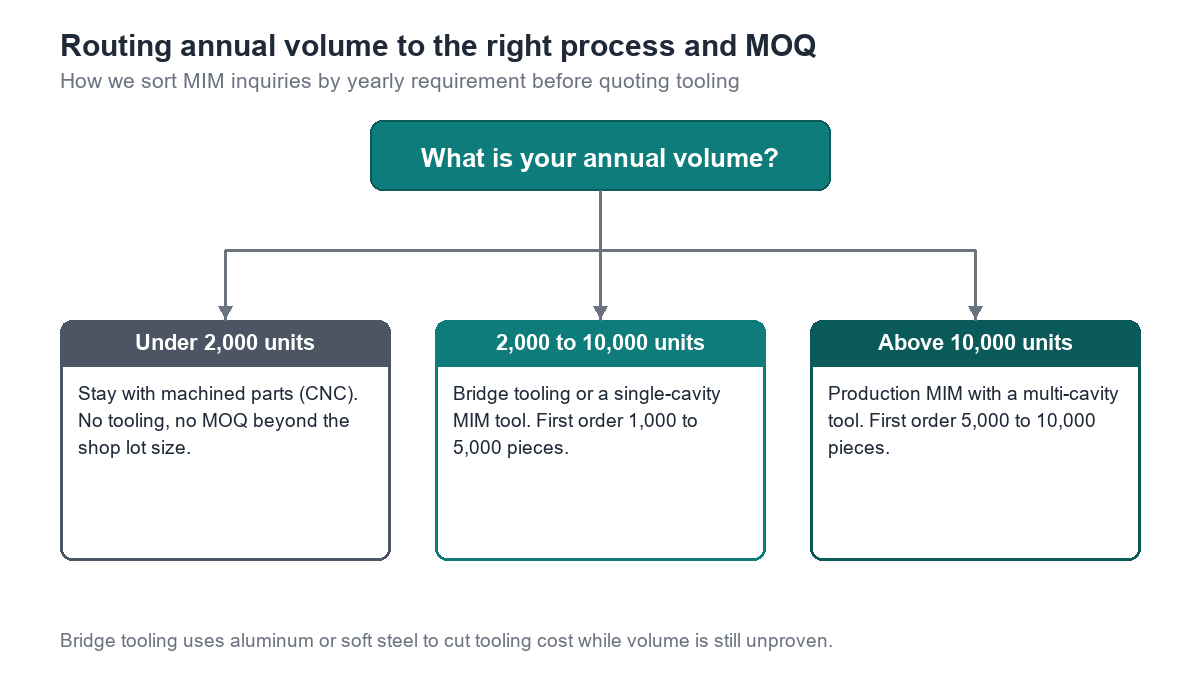
I turn MIM inquiries away on a regular basis, and it is not modesty. A tool that sits idle helps nobody. Buyers remember the honest no when volumes grow, and the ones who grow come back, usually holding a forecast this time. If you are weighing the two routes in detail, the comparison of when to choose MIM over CNC machining for small metal parts lays out the trade-offs.
What to clarify before you sign the tooling PO
Five questions, in the order I would ask them:
- Where does the tooling money appear? A separate line item beats a surcharge buried in the part price. Buried tooling makes every future quotation comparison harder.
- What is the cavity plan? If the quote prices one cavity, confirm the mold base accepts more and what the upgrade costs.
- Who owns the tool? Get ownership, tagging, and relocation terms in writing. A tool you paid for should be a tool you can move.
- What happens if the program stops? Tooling is not refundable; the design, steel, and machining are spent. What matters is whether unpaid amortization is owed and what notice period applies.
- Is the forecast clause realistic? If the purchase order commits you to 20,000 pieces a year, be sure operations can actually consume them.
Most of these questions get straightforward answers from a shop that runs MIM programs every week. If a supplier hesitates on tool ownership or will not explain the amortization line, treat that as information. Before the PO goes out, give the print one more pass for MIM-specific risks; controlling sinter shrinkage on tight features is the one that bites hardest, and our FAQ page answers the tooling and quality questions we hear most.
The short version: ask what the minimum protects rather than whether it exists. The tool and the furnace both need volume to make sense, so the minimum is structural. Buyers who bring a forecast, accept a phased release, or start with bridge tooling nearly always find the number workable in practice.
Questions buyers ask about MIM MOQ
What is a typical MOQ for metal injection molding tooling?
For a small part on a new single-cavity production tool, expect a first order of 3,000 to 5,000 pieces. Bridge tooling brings the minimum down to 500 or 1,000 pieces, and multi-cavity tools usually start at 5,000 to 10,000 pieces.
Why does MIM have a minimum order when CNC machining does not?
The tool has to be paid for out of part sales, and sintering furnaces run efficiently only in full batches. CNC needs no tool, so it prices by machine time and carries no minimum.
Can I get low volume MIM parts without a production tool?
Yes. Bridge tooling in aluminum or soft steel supports first orders of 500 to 1,000 pieces at a higher unit price, or you can buy machined parts while volume develops.
Is MIM tooling cost refundable if I cancel?
No. Tooling payment covers design, steel, machining, and trial shots, and all of that is spent once the tool exists. That is why the volume question deserves an honest answer before the PO is signed.
How do I know if my volume justifies MIM?
Compare the amortized tooling cost per part against the machined price. For small parts, MIM usually breaks even somewhere between 2,000 and 3,000 units against CNC machining, and it pulls further ahead as volume grows.
Need Precision Metal Parts for Your Project?
Yujiaxin Tech specializes in MIM, CNC Machining, Powder Metallurgy, Investment Casting, and Gear Hobbing. Get a free quote within 24 hours.