A shop can quote a fair price and still miss your date. I have sat on both sides of that phone call, and the cause is rarely skill. It is capacity. Whether a CNC shop can hold a schedule comes down to spindle hours, machine mix, and how much of the calendar is already sold. Those are numbers you can ask for. Most buyers never do.
The questions below take about ten minutes to send with an RFQ. They have saved me more schedule pain than any factory tour I have taken. A tour shows you machines. The answers show you time, which is what you are buying.
Why capacity decides your lead time
When a shop runs at 60 percent booked, your job drops into open time and the quoted date is close to the real date. At 90 percent, the same job sits behind everything already committed. The machine does not cut faster because you need it sooner. It works the queue in the order the work arrived.
I treat booked utilization as a multiplier on the quoted date, and I plan around it. Around 70 percent, dates hold. At 85 percent I allow half again as much time, so a four week quote becomes six. At 95 percent the multiplier runs near 2.6, and that same four week quote is really ten or eleven weeks. I would rather plan for the bad number and be early than explain a stockout.
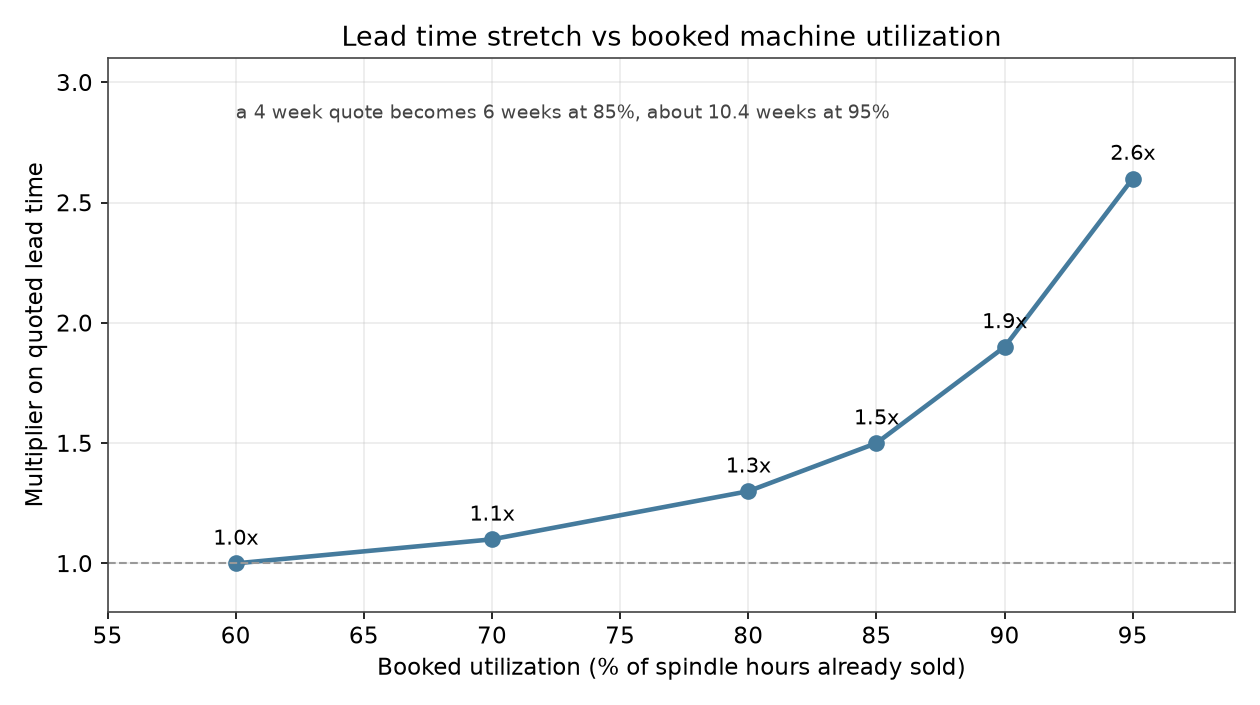
None of this is the shop being dishonest. A scheduler reading a full book is looking at the same calendar you would. The mistake is mine if I take the number without asking what sits in front of it, and I have made that mistake. Once, in 2021, on a housing program where the shop quoted five weeks and shipped in eleven. They told me their utilization when I asked, which was 93 percent. I had not asked until week seven.
The machine hour rate, by machine class
Machine hour rate is the number sitting behind every machining price, and it moves a lot by machine class. Across the Chinese shops I quote against, a 3-axis vertical mill runs $35 to $45 per hour. A 4-axis runs $55 to $70. A 5-axis runs $85 to $120. A Swiss-type lathe is $60 to $80, a mill-turn $90 to $130, and a horizontal machining center $75 to $100.
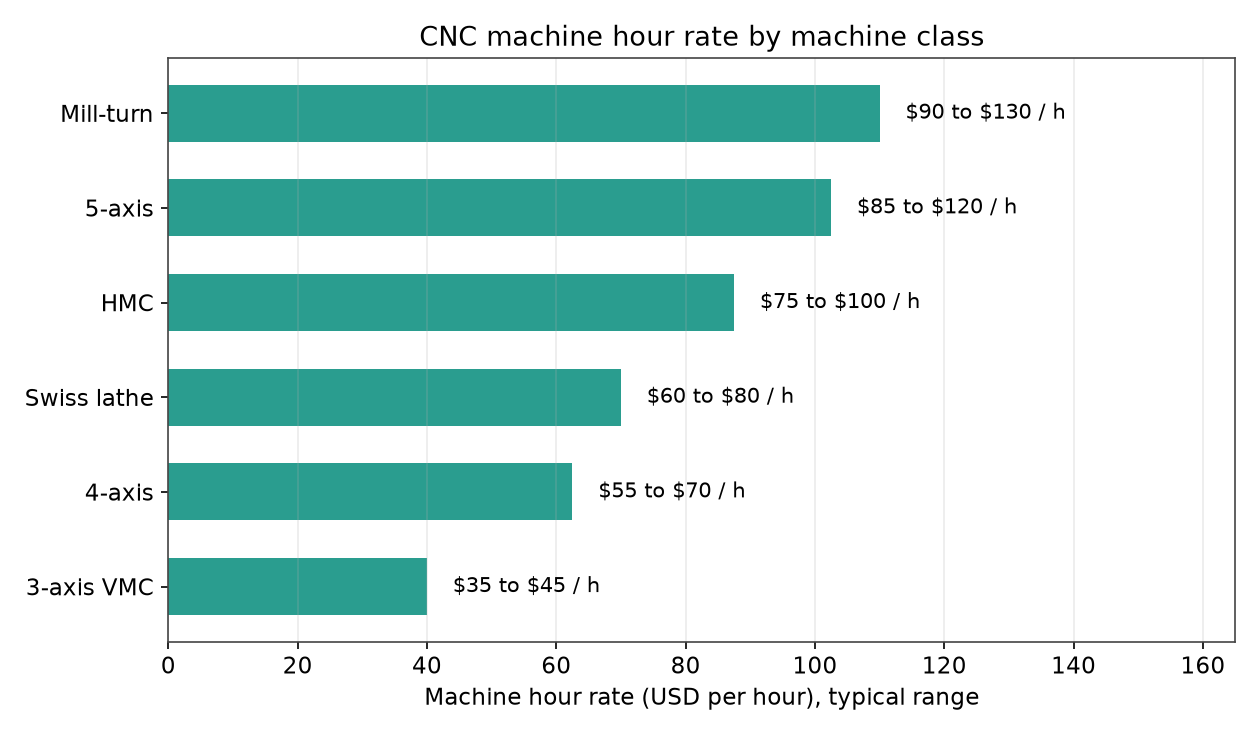
A $20 per hour gap on a part with a 30 minute cycle is $10 per part. Across 5,000 parts that is $50,000, which is worth a phone call. So I always ask which class the quote assumes, and whether the geometry allows a cheaper one. Our CNC machining page lists the classes we run and what each one suits.
Rate alone does not settle the cost. A 5-axis machine that finishes a part in one setup can beat a 3-axis machine that needs three, because setup hours bill at the same rate as cutting hours. Take a part with 2 hours of setup and a 30 minute cycle at $40 per hour. That is $80 of setup plus $20 of machine time per part. Spread over 100 pieces the setup adds $0.80 each. Over 2,000 pieces it adds $0.04. Setup is the line item that hides inside low volume quotes, and it is the one I look at first when a price looks strange.
I am suspicious of rates at the bottom of any range. A shop quoting $22 per hour on a 5-axis machine is either running old equipment with poor uptime, or the rate excludes tooling and programming and those arrive later as separate lines. Ask what the rate includes.
Machine mix and where the bottleneck hides
A shop with thirty machines sounds large. If four of them are 5-axis and your part needs 5-axis work, you are competing for four machines, not thirty. Ask how many machines sit in the class your part needs, and what those are booked at for the next four weeks. A thirty-machine shop whose 5-axis cell runs at 95 percent booked is a worse bet for your job than a six-machine shop with two open 5-axis machines. I have moved work to the smaller shop for exactly this reason.
The same logic applies to turning. Small turned parts under about 20 mm belong on a Swiss-type lathe, which is a class of its own. If a shop runs your 8 mm pin on a gang-tool lathe because the Swiss machines are full, your cycle time and your concentricity will both tell you about it.
Material changes the picture as well. 6061 aluminum cuts three to four times faster than 316L stainless steel, and Ti-6Al-4V is slower again, so the same geometry consumes very different spindle hours depending on the alloy. A shop that quotes by machine class without asking about the material is guessing.
This is also where I decide whether machining is the right process at all. Above a few thousand units, powder metallurgy or metal injection molding can take the part off the machines entirely. That frees capacity rather than fighting for it, which matters when every shop you talk to is booked. The automotive and medical programs I see most often end up splitting volumes that way.
Seven questions to send with the RFQ
- How many spindle hours per machine per month do you plan against, and what share is already booked?
- How many machines do you have in the class this part needs, and what are they booked at for the next four weeks?
- What is the machine hour rate for that class, and which machine did you assume in this quote?
- What is the cycle time per part, and what is the setup time, listed separately?
- If the machine this part runs on goes down, what takes the work instead?
- Which operations leave the building, and to whom?
- What was your on-time rate for the last three months, and which way is it moving?
Send them as plain text alongside the drawing. Shops with real capacity answer the first three from a screen within an hour. Shops without it send a brochure, and that is an answer too, just not the one they think it is.
How to check the answers
Start with the spindle hours. One machine on a single shift gives about 170 to 190 cutting hours a month once setup, tool changes, and maintenance come out. Two shifts roughly doubles it, to 340 to 380. Three shifts adds less than people expect, because unattended hours carry more downtime. If the number you get back is 300 hours a month from a single-shift machine, ask how they counted.
Then ask about the second machine. If the 5-axis your part runs on loses a spindle, what takes the work? Spindle repairs run two to six weeks on some models, and I watched a program lose a month to one failed spindle because the shop had a single machine of that class and no fallback. That is a capacity question, not a maintenance question, and it belongs in the RFQ.
Ask which operations leave the building. Subcontracting happens in every supply chain, and I do not object to it in principle. I want the name, because an outside operation adds a truck, an inspection, and a queue I cannot see. If the subcontracted step is the one holding your tightest tolerance, that matters more. Our How we work page shows which steps we keep in house.
Finish with the on-time rate for the last three months, in percent, and ask which direction it moved. Ninety-two percent and climbing is a different shop from ninety-two percent and sliding, and the single number does not tell you which one you are talking to. If they will not give you the number at all, assume it is bad and move on.
What a booked-out shop costs you
Capacity shows up in price before it shows up in the date. Jumping the queue costs money, and a rush job carries a 15 to 30 percent premium in most shops, more when it needs weekend shifts or overtime. Nobody labels it a rush fee. It arrives as a higher machine hour rate or a setup line that has quietly grown.
Tooling attention moves as well. A dedicated fixture for a small part costs $800 to $3,000 and cuts setup time when the volume justifies it. On a fifty-piece job it is wasted money. On a two-thousand-piece job it pays back inside the first run. I ask the shop where that crossover sits, using their own setup hours and rate, because I can check the arithmetic in a minute.
My rule here is unsentimental. I would rather give 60 percent of a program to a shop at 70 percent booked than all of it to a shop at 95 percent. The second quote looks better on paper right up to the week it slips, and by then the air freight costs more than the discount ever saved. The FAQ and our quality pages cover the rest of what to check before you commit.
Related reading
- CNC machining cost per part estimate
- How to read a CNC quote without missing hidden fees
- How to prepare CAD drawings for a CNC machining quote
- How to reduce features that force 5-axis machining
Frequently asked questions
What is a normal machine hour rate for CNC work?
It depends on the machine. A 3-axis vertical mill runs 35 to 45 USD per hour, a 4-axis 55 to 70, a 5-axis 85 to 120, a Swiss-type lathe 60 to 80, and a mill-turn 90 to 130. Ask which class the quote assumes.
How many spindle hours does one CNC machine produce in a month?
On a single shift, plan on 170 to 190 cutting hours per machine per month after setup, tool changes, and maintenance. Two shifts roughly doubles that to 340 to 380. If a shop claims 300 hours a month from a single-shift machine, either the number is wrong or the definition is.
How do I find out whether a shop is already booked out?
Ask what share of spindle hours is already sold, for the machine class your part needs rather than the shop as a whole. A shop at 60 percent booked holds its dates. Past 90 percent, expect the quoted date to stretch.
Should I pay for a dedicated fixture on a small machining job?
Only when the volume justifies it. A fixture for a small part costs 800 to 3,000 USD and cuts setup time. On a 50 piece job the setup hours cost less than the fixture does. On a 2,000 piece job the fixture usually pays back inside the first run.
Does a bigger shop mean more capacity for my part?
Not always. Count the machines in the class your part needs. A 30 machine shop with four 5-axis machines booked at 95 percent gives you less room than a six machine shop with two open ones. Size is the wrong number; open hours on the right machine is the right one.
Need Precision Metal Parts for Your Project?
Yujiaxin Tech specializes in MIM, CNC Machining, Powder Metallurgy, Investment Casting, and Gear Hobbing. Get a free quote within 24 hours.