A buyer sent me the same titanium bracket drawing twice last year, once in 316L and once in Ti-6Al-4V, then asked why the two quotes came back 4.2 times apart. He expected a premium. He did not expect that. Material price explains maybe 15 percent of the gap. The rest sits in cutting speed, tool wear, and the share of the bar that leaves the shop as chips. Split a titanium quote into those lines and the premium stops looking like a number someone invented.
The gap starts at the mill certificate
Ti-6Al-4V bar in the diameters a job shop keeps on the shelf runs $38 to $55 per kg. 316L bar in the same size runs $6 to $9. That is a five to seven times spread before anyone touches a machine, and it is the first number a buyer sees, which is why so many buyers stop there.
On a 50 g bracket the material line reads $0.55 in 316L and $3.20 in titanium. Bar is bought oversize and a good share of it never becomes a part. That $2.65 difference is real, but on its own it cannot turn a $4.20 part into a $17.60 part.
Scrap credit widens the gap. Clean 316L turnings sell back at roughly 30 to 40 percent of the bar price. Titanium swarf arrives mixed with coolant and often mixed with other alloys, and plenty of shops will not segregate it below a few hundred kilos. I have seen titanium scrap credited at 10 to 15 percent, and I have seen it go in the general bin. Either way, the credit is smaller than the stainless one and it lands on the same quote.
The machinability penalty
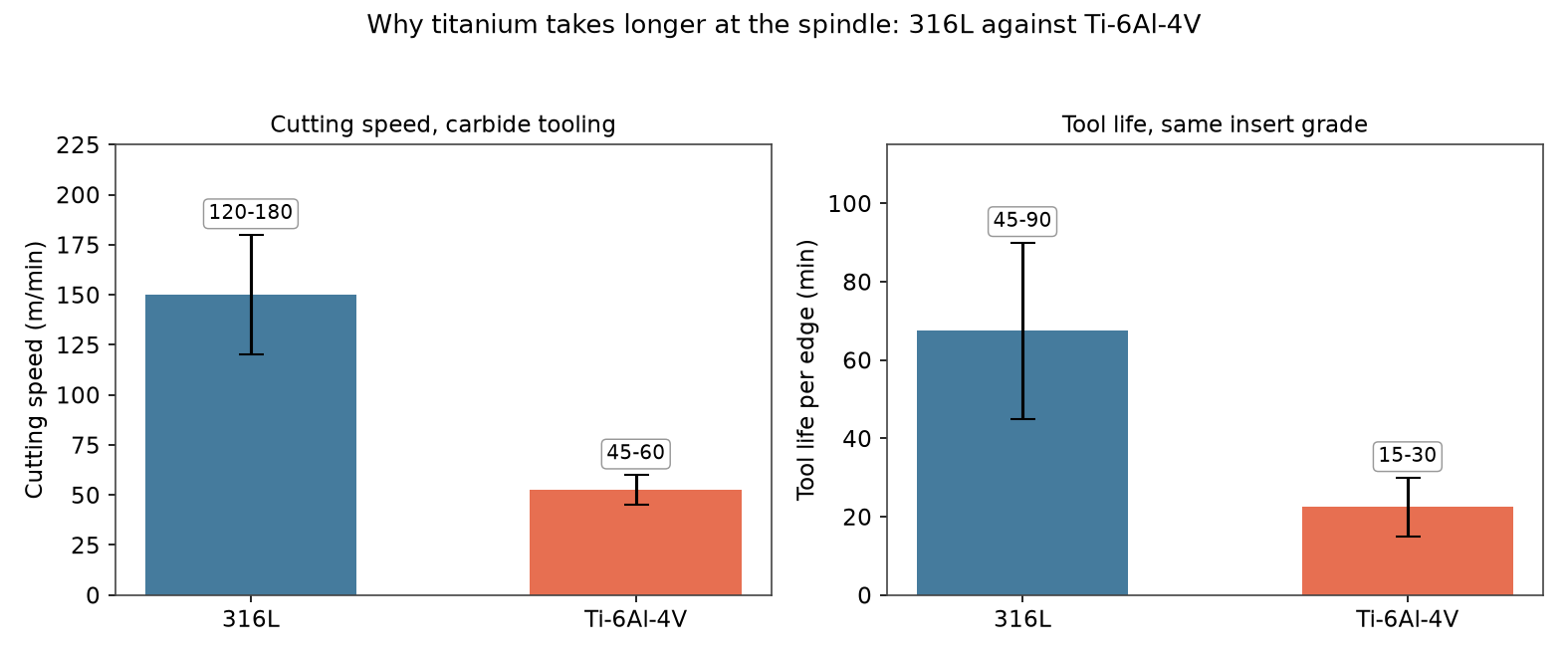
Machinability ratings against B1112 steel put 316L near 45 percent and Ti-6Al-4V near 22. Those ratings come down to cutting speed, and cutting speed is where the money goes. With carbide, 316L runs at 120 to 180 m/min. Ti-6Al-4V runs at 45 to 60 m/min, and pushing past that burns edges in minutes.
You cannot trade speed for depth of cut either. Titanium conducts heat badly, around 7 W/mK against 16 for 316L, so the heat stays in the cutting zone instead of leaving with the chip. The edge runs hotter, the cobalt binder softens, and crater wear starts. The elastic modulus makes it worse: 114 GPa for Ti-6Al-4V against 193 GPa for 316L, so the same wall deflects further under the same force and the finishing pass has to come lighter.
In practice a 6 minute cycle in 316L becomes 19 minutes in titanium on identical features. The toolpath did not change. Every pass runs slower, and there are more of them because thin walls need light finishing cuts. The Ti-6Al-4V material page has the grade data behind these numbers.
Tool wear costs more than the insert
An insert edge costs $9 to $14 whether it cuts stainless or titanium. What changes is how long it lasts. I plan 45 to 90 minutes per edge in 316L and 15 to 30 minutes in Ti-6Al-4V, so a job needing 12 edges in stainless needs 36 to 48 in titanium. On a 40 piece run that is a visible line on the quote. On a 4,000 piece run it is the second largest line after machining time.
There is a cost nobody puts on the quote. Every tool change is a stop, a re-touch, and a chance to scrap the part still sitting in the fixture. Shops that run titanium every day build their schedule around it. Shops that run it twice a year do not, and their first article shows it.
Buy-to-fly, and why titanium scrap hurts more
Buy-to-fly is the bar weight bought divided by the finished part weight. A machined stainless bracket usually lands between 1.5 and 3 to 1. An aerospace titanium bracket lands between 8 and 20 to 1, so a 50 g part can start life as 400 g of bar. That ratio is where the material line and the machining line multiply instead of adding.
Here is how a 50 g bracket breaks down on my own quotes. Same geometry, same plus or minus 0.05 mm tolerances, both run on 3-axis mills.
| Quote line | 316L | Ti-6Al-4V |
|---|---|---|
| Material, 8 to 1 buy-to-fly on the titanium side | $0.55 | $3.20 |
| Machining time, 6 min against 19 min | $2.40 | $9.60 |
| Cutting tools | $0.35 | $3.60 |
| Finishing and inspection | $0.90 | $1.20 |
| Total per part | $4.20 | $17.60 |
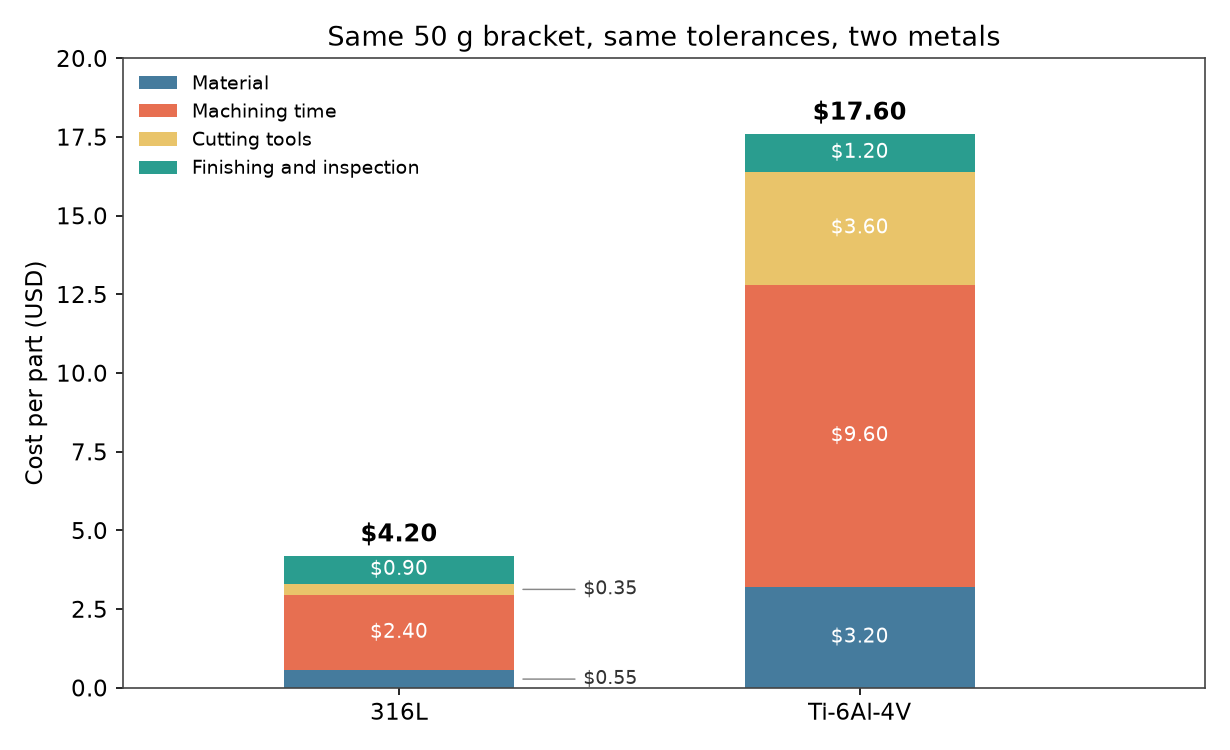
Material is 13 percent of the stainless part and 18 percent of the titanium part. Machining time carries the premium, and machining time follows the numbers above rather than the alloy price. That is the part buyers miss when they budget from a metal index.
When the premium pays for itself
Titanium density is 4.43 g/cm3 against 8.00 for 316L, so the same bracket weighs 45 percent less. On a medical instrument held in a hand all day, or a component at the end of a robot arm, that alone is worth the 4.2, and I say so in writing. In chloride service titanium also ignores the pitting that eventually takes 316L apart, which is why marine hardware and chemical fittings keep moving to it. Our 316L page is honest about where that grade stops.
On a fixed indoor bracket at 2,000 pieces a year, none of that applies. I have watched buyers pay 4 times the price for a part that never moves, never sees salt, and is never weighed. If the only reason for titanium is that the customer asked for titanium, ask the customer why.
One warning I give every time: titanium sits high on the galvanic series. Bolt it to an aluminum housing and the aluminum becomes the anode. I have opened assemblies where the aluminum around a titanium fastener had eaten itself into a 0.5 mm pit in under two years. Insulating washers and a plated fastener fix it, and somebody has to design that in before the aerospace or medical drawing is released.
Where the premium shrinks
Near-net processes cut the buy-to-fly ratio, and that is where titanium pricing gets interesting. Metal injection molding of Ti-6Al-4V is real and it is not cheap. Feedstock costs several times the stainless grade, sintering needs vacuum or argon at 1,250 to 1,350 C, and oxygen pickup has to stay under 0.20 percent or ductility goes. Even so, a 20 g part that would need 160 g of bar on a mill can leave a MIM furnace at 4 to 1, and the gap to stainless drops from 4.2 to about 2.5.
Investment casting titanium is a vacuum process with a yttria facecoat and a shell that has to survive a reactive melt. It works. It is not a cost reduction at 500 pieces. It is the right answer for a 300 mm bracket at 3,000 pieces. Powder metallurgy of titanium exists too, though the available grades and densities are narrower than on the steel side.
The cheapest change is still on the drawing. Deep pockets in titanium mean more passes at 55 m/min. A 1.5 mm wall is routine in 316L; in titanium it deflects, chatters, and forces a lighter final pass. When I redesign a titanium part for cost, I take out pockets and stop machining features that a casting could net in the first place. Our CNC machining team quotes both metals, and the machining side of the quote is where I look first.
How to compare a titanium quote against a stainless quote
Ask for the same four lines on both quotes: material weight and price per kg, cut time in minutes, cutting tool consumption, and outside processing. A quote that shows one lump price for a titanium part hides which of those lines is out of order.
- Ask for the grade in the same sentence as the price. Grade 2 commercially pure is softer, machines faster, and costs less than Grade 5. Quoting Grade 2 and shipping Ti-6Al-4V is a different part, not a discount.
- Ask for the buy-to-fly ratio. A shop that cannot answer it is not tracking its own bar consumption.
- Ask for the mill certificate standard: ASTM B348 or AMS 4911 for Ti-6Al-4V bar, with a heat number that reaches the parts. The method in how to read a material certificate works the same way.
- Ask what happens to the swarf. A shop that segregates titanium can offer a credit. A shop that does not is charging you for the loss.
Titanium machining cost per hour also runs 20 to 40 percent above stainless in most shops, before any of this. The machine is the same. The attention is not. Our how we work page shows where that attention goes on a first order, and the FAQ covers the quoting questions I get most often.
My rule after twenty years of quoting both: if the weight saving or the chloride exposure does not pay back the premium inside two years, the part should be 316L. Titanium is a good answer to a specific problem. It is an expensive answer to a general one.
Related reading
- How to read a material certificate for stainless steel 316L
- CNC machining tolerances complete guide
- What design changes reduce cost in powder metallurgy
- How to calculate landed cost for imported metal parts
Frequently asked questions
How much more does a titanium part cost than a stainless part?
For a 50 g machined bracket, about 4.2 times: $17.60 against $4.20. Simple Grade 2 parts at volume come closer to 2.5 times. The titanium cost per part follows cut time more than metal price, so geometry matters as much as the alloy.
Why is titanium machining cost per hour higher than stainless?
Most shops add 20 to 40 percent for titanium. Cut time runs about 3 times longer, inserts last a third as long, and the machine has to run slower with more coolant. The spindle rate is the same. The throughput is not.
Is titanium worth the cost over stainless steel?
Yes when weight or chlorides govern the design. A 45 percent weight cut on a hand-held tool or a robot arm usually pays back inside a year. On a fixed indoor bracket with no chloride exposure, I keep 316L and spend the money on inspection.
Does the buy-to-fly ratio change titanium pricing that much?
It is the second largest lever after cut time. Going from 8 to 1 down to 4 to 1 on a 50 g part removes $1.60 from the material line and skips several roughing passes. Casting or MIM can get you there. Sometimes a drawing change can too.
What is the titanium versus stainless steel price per kg?
Expect $38 to $55 per kg for Ti-6Al-4V bar in job shop sizes against $6 to $9 for 316L bar. Plate, forgings, and medical grade bar sit above those ranges, and the spread widens in small quantities.
Need Precision Metal Parts for Your Project?
Yujiaxin Tech specializes in MIM, CNC Machining, Powder Metallurgy, Investment Casting, and Gear Hobbing. Get a free quote within 24 hours.