Buyers send me drawings for food equipment parts every month, and the material line reads one of two ways: "304" or a question mark. Food contact service is not one set of conditions. A guide rail over a dry snack line, a nozzle in a brine injector, and a hopper washed nightly with caustic foam want three different metals. I have quoted food contact components for close to twenty years, and the material call is where I push back hardest, because the wrong choice never shows up at delivery. It shows up eighteen months later as pitting inside a weld seam, after the warranty is gone.
This article is the version of that conversation I wish I could have before every purchase order. It covers what food grade obliges you to do, where 304 and 316L stainless each earn their keep, and why the surface finish decides more than the alloy does.
Table of contents
- What food grade actually requires
- Stainless grades that carry the work
- Where aluminum fits and where it does not
- Titanium, 17-4PH, and other options
- Surface finish decides more than the alloy does
- How the manufacturing process changes the answer
- A short checklist before you approve the drawing
- Frequently asked questions
What food grade actually requires
Food grade is not a property of a metal. It is a claim about a finished part in a specific service. In the United States, buyers work from the FDA food contact rules in 21 CFR, and dairy and meat equipment add sanitary design standards such as 3-A. In the European Union, Regulation EC 1935/2004 requires that materials do not transfer substances to food in amounts that endanger health or change the food itself. None of these documents names an alloy. They tell you what the part must survive: repeated cleaning, wet dwell time, and contact with product acids, salts, and cleaning chemistry.
So I read the cleaning spec before the alloy table. Four questions decide most calls. What chemistry and pH? Caustic CIP cycles run at pH 11 to 13, and chlorinated cleaners carry 100 to 200 ppm of active chlorine. How long does the part sit wet between shifts? What wash temperature? Does the product contain salt or acid? A dry part with mild detergent can live on 304. A part that soaks in chlorinated foam nightly cannot, and no certificate will save it.
Stainless grades that carry the work
Two grades do almost all food contact work. 304 is the default: 18 percent chromium, 8 percent nickel, carbon at or under 0.08 percent, PREN around 18. 316L adds 2 to 3 percent molybdenum and holds carbon under 0.03 percent, lifting PREN to 24 to 26 and keeping weld zones from sensitizing and rusting.
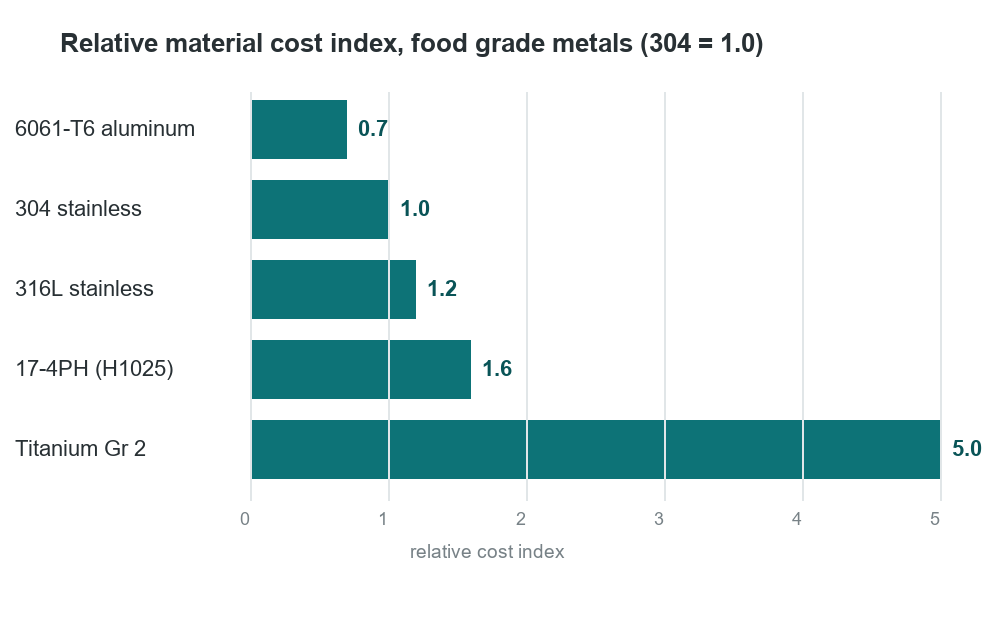
The premium for 316L runs 15 to 25 percent on material, and machining it is 10 to 20 percent slower than 304; the alloy work hardens. On a small fitting that is a rounding error; on a two-kilogram housing it is real money. The question is not which grade is better, it is which grade your cleaning chemistry needs. In continuous wet service, 304 holds up to roughly 200 ppm of chlorides before pitting risk climbs; 316L manages around 1,000 ppm in the same conditions. I put anything that touches brine, chlorinated cleaner, or standing washwater in 316L and I do not negotiate with myself about it. For dry contact and gentle detergents, 304 is honest value.
One warning: the two grades look identical after polishing, and mix-ups happen at the warehouse more often than anyone admits. Insist on an EN 10204 3.1 certificate and read our guide on how to read a material certificate. The molybdenum line separates real 316L from lookalike 304.
Where aluminum fits and where it does not
Aluminum divides food equipment into two camps, and I sit firmly in one of them. On the dry side, 6061-T6 aluminum is light, cheap at around 0.7 times the cost of 304, machines fast, so frames, covers, and heat spreaders on packaging machinery use it everywhere. Food contact is the other story. Bare aluminum reacts with acidic foods, and anodizing is the usual fix: a Type II coat runs 5 to 18 µm and Type III hard coat reaches 13 to 100 µm. The problem is chemistry. Caustic cleaners at pH 11 to 13 attack the oxide film, and once it thins, the aluminum underneath sheds into the product stream. I watched a hard anodized chute chalk and pit inside a year of nightly washdown.
So my rule is blunt. Aluminum earns its place on dry or wipe-clean parts. If a drawing shows a washdown food contact face in 6061, I quote it, then I ask whether the designer has seen what three months of caustic foam does to anodize. Usually the part moves to stainless, and everyone is happier by year two.
Titanium, 17-4PH, and other options
Titanium Grade 2 is what I reach for when nothing else survives. It is immune to seawater-strength chlorides, above 10,000 ppm, shrugs off the sanitizers that eat stainless, and weighs 4.5 g/cm3 against 8.0 for stainless steel. A washer basket in 316L that pits every season often stops being a problem in titanium. The cost index runs near 5.0 against 304, and it machines slowly, so I only specify it where stainless has already failed or the washdown is genuinely aggressive. Paying five times for a part that does not need it is its own kind of waste.
17-4PH sits in a different corner. Precipitation hardened to H1025, it reaches about 155 ksi, which suits filler blades, forming tools, and wear parts that also see food or washdown. Its PREN is around 15, below 304, so it wants regular cleaning and dry-down. If you specify it, read up on 17-4PH heat treatment conditions first, because H900 and H1150 behave like different parts in service.
Surface finish decides more than the alloy does
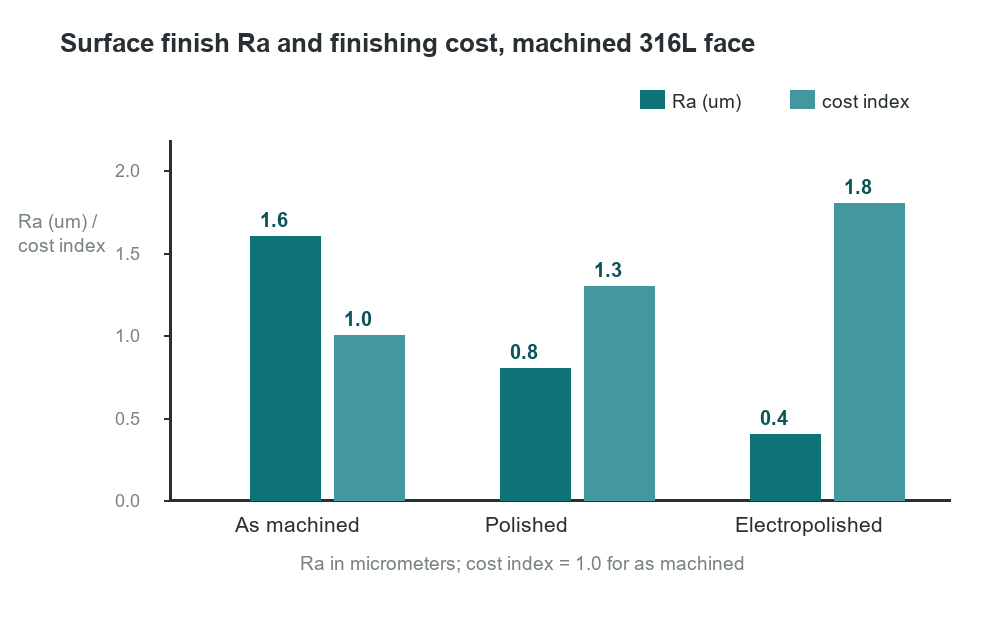
I will say this plainly: buyers over-index on the alloy and under-index on the surface. Bacteria do not care what the mill certificate says about PREN. They care about the valleys. Sanitary standards such as 3-A cap food contact faces at Ra 0.8 µm, or 32 µin, and a machined face at Ra 1.6 needs work to get there. Polishing to 0.8 adds roughly 30 percent to finishing cost; electropolishing to 0.4, with 0.25 reachable on simple geometry, adds about 80 percent. That money buys real cleaning performance, because a smooth face releases biofilm under a caustic cycle that a rough face survives only on paper.
Passivation and finishing interact. Passivation to ASTM A967, in nitric or citric acid, strips free iron from the surface and rebuilds the chromium oxide layer. It does not smooth anything: a passivated Ra 1.6 face is still a Ra 1.6 face. The sequence that works is machine, polish or electropolish to your Ra callout, then passivate as the last step. For how to write that callout, see our guide to surface roughness requirements on drawings.
How the manufacturing process changes the answer
The process you pick changes the surface you can hold. Machining from bar or billet gives you the densest material and the tightest finishing control, so hygiene-critical small parts live on our CNC machining line. Investment casting reaches internal passages that cutters cannot, at an as-cast Ra of 3.2 to 6.3 µm; every wetted surface then needs grind and polish before it meets food. Our investment casting group makes these pump bodies and valve parts routinely.
Powder processes need one honest caveat. MIM and pressed-sinter parts are not fully dense: sintering leaves residual porosity, so 96 to 99 percent density is the realistic band. Micro pores trap product and soil at the surface. For food contact faces we either seal and polish, or steer the part to machining. If your geometry genuinely demands MIM, our metal injection molding and powder metallurgy teams will tell you which faces can stay as-sintered and which cannot. The answer sometimes kills the project early, which is exactly when you want it killed.
A short checklist before you approve the drawing
Before a food contact drawing leaves your desk, run this list. It is short, and every line on it has cost someone I know money.
- Write the cleaning chemistry on the drawing: pH, chlorine level, temperature, and wet dwell time.
- Pick the alloy from that spec, not from habit. Salt or chlorinated wash means 316L.
- Call out Ra on every food contact face, 0.8 µm or better, and name the finishing route.
- Order passivation to ASTM A967 as the final step, after all grinding and polishing.
- Require an EN 10204 3.1 certificate, and check the molybdenum content to confirm the grade.
- Treat weld zones as the weak point: dressed, polished, and passivated, because pitting starts there.
If any line raises a question you cannot answer, our FAQ page covers the common ones, and how we work explains what we need to quote accurately. The same material and finishing decisions play out on our industrial equipment page, and the washdown discipline transfers directly from our medical component work.
Frequently asked questions
Is 304 stainless steel actually food grade?
Yes, and it is the most common grade in food equipment. The fine print is service: dry or mildly detergent-cleaned contact is fine, while brine, chlorinated cleaners, or constant wet dwell push you toward 316L.
Why do food plants pay 15 to 25 percent more for 316L?
Molybdenum buys pitting resistance where it counts. 316L carries a PREN of 24 to 26 against about 18 for 304, and tolerates roughly 1,000 ppm chlorides in wet service against about 200. One prevented corrosion rework pays back the premium.
Does passivation make a stainless part food safe?
Passivation to ASTM A967 removes free iron and restores the chromium oxide film, which helps corrosion resistance. It does not smooth the surface or remove soils. Food safety still depends on the Ra finish, the weld condition, and the cleaning regime.
What Ra surface finish do food contact surfaces need?
Sanitary standards such as 3-A call for Ra 0.8 µm or better on food contact surfaces. Machined parts reach 0.8 after polishing and 0.4 after electropolishing, which also cuts cleaning cost over the life of the machine.
Can MIM or cast parts be used in food contact areas?
Yes, with conditions. Sintered MIM parts run 96 to 99 percent dense, so residual porosity can trap soils; seal or polish food contact faces, then passivate. Cast parts need grind and polish from as-cast Ra 3.2 to 6.3 µm before they meet food.
Need Precision Metal Parts for Your Project?
Yujiaxin Tech specializes in MIM, CNC Machining, Powder Metallurgy, Investment Casting, and Gear Hobbing. Get a free quote within 24 hours.