Steel rusts. That sounds like a sentence a buyer should not need me to write, but I have watched more than one shipment of nicely machined brackets arrive at a customer dock with orange bloom already forming at the edges. Carbon steel and low-alloy steel have no native defense against corrosion. Left bare, a 1018 bracket in a coastal warehouse can show surface rust in a week. Plating is the answer most of my customers reach for, and it works, but the four or five common plating systems do not protect steel the same way or at the same price.
On this page
Why bare steel loses the fight
Bare steel corrodes because iron wants to return to iron oxide. In a humid storeroom the galvanic loop between the metal and a thin film of water runs continuously, and the rate climbs fast once chlorides are present. I measured a 0.4 mm deep pit in a 3 mm thick 4140 bracket that had sat twelve weeks in a port city without any coating. The part was scrap. A coating does two jobs: it bars moisture from the surface, and for zinc it also sacrifices itself to protect the steel underneath. That second mechanism is the reason I reach for zinc before I reach for anything else.
Zinc plating: the default for a reason
Zinc plating throws a thin layer of zinc onto the steel, usually 5 to 25 microns thick, by electroplating. Zinc is more active than iron, so when the coating is scratched the zinc corrodes first and the steel stays sound. That is sacrificial protection, and it is the single most useful property a plating can have.
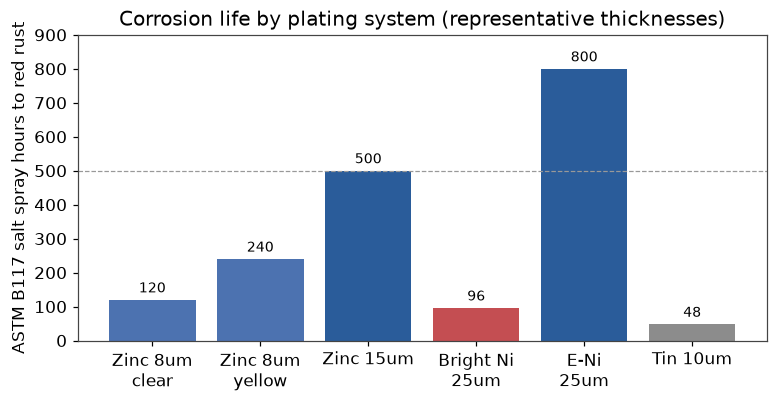
The thickness decides how long the part lasts outdoors. A clear (blue) zinc at 8 microns gives roughly 96 to 120 salt spray hours before red rust under ASTM B117. Move to a yellow (iridescent) passivation and you get about 240 hours at the same thickness. Push the layer to 15 microns with a thick zinc and sealed chromate and you can clear 500 hours. I specify 15 micron yellow zinc for any bracket that lives outside a building. The machined steel brackets we ship to automotive customers run on that spec.
Cost stays low. Zinc runs about 0.08 to 0.20 dollars per square decimeter, which on a 0.5 dm2 machined clip is a few cents a part. That is why zinc plating is the default for high-volume hardware, and why MIM steel parts that need corrosion cover almost always start with zinc.
Nickel and chrome: when looks and wear matter
Nickel plating builds a denser, harder skin. Bright nickel at 25 microns resists abrasion better than zinc and looks like polished metal, but on the salt spray bench it is worse than zinc, around 96 hours to red rust. Decorative chrome is a thin chrome layer over nickel, 0.25 to 0.8 microns of chrome on top of 10 to 25 microns of nickel; it is there for appearance and hardness, not for corrosion life on its own. Hard chrome is different again, 25 to 250 microns, used on shafts and wear surfaces, and it is the most expensive film I will spec.
I tell buyers straight: if the part needs to shine or slide, nickel or chrome. If it needs to not rust in a field, zinc.
Electroless nickel: the uniform film
Electroless nickel deposits by chemical reduction, not current, so it lands evenly on inside corners, threads, and blind holes where rack plating thins out. I use it on parts with deep recesses that rack zinc would miss. A 25 micron electroless nickel layer holds 700 to 900 salt spray hours, the best corrosion number in this group except for thick zinc, and the hardness reaches 450 to 700 Vickers after heat treatment.
The trade is price. Electroless nickel runs 0.50 to 1.20 dollars per square decimeter, four to five times zinc. I reserve it for valves, pump bodies, and threaded parts where uniform coverage is the point, not for a flat clip that zinc handles for a nickel.
Cadmium and the RoHS wall
Ten years ago cadmium was the plating for aerospace and military steel because it protected better than zinc in marine and high-strength applications and resisted galling on threaded joints. Today it is largely gone from commercial work. Cadmium falls under RoHS and REACH controls, and a supplier who plates it commercially without the right exemption is out of compliance. I have turned cadmium inquiries away and pointed buyers at zinc-nickel or electroless nickel instead.
If your drawing still calls out cadmium, read it against current regulation before you quote. Our post on RoHS and REACH compliance covers how I check a supplier declaration on restricted substances.
How I choose a plating for a given part
I do not pick plating from a chart. I pick it from where the part lives and what it touches.
- Indoor, dry, high volume: clear zinc, 8 microns. It is cheap and good enough.
- Outdoor or humid: yellow zinc, 15 microns, or step to zinc-nickel if salt is present.
- Threads, recesses, valves: electroless nickel, 25 microns.
- Wear or appearance surface: bright nickel or hard chrome.
- Food or body contact: skip plating and use 316L stainless, which never needs a coating and passes the same corrosion test without one.
That last option is the one I push most. A part made from 316L does not rust in the first place, so you spend nothing on plating and nothing on the failure mode. I have moved more than one program from plated 1018 to 316L when the volume justified the material premium.
What plating adds to the unit price
Plating shows up on the quote as a per-part line, and buyers are right to watch it. On a small bracket the coating is often a few percent of the machined cost, but on a complex shaped part with threads and blind holes the electroless nickel step can equal the machining.
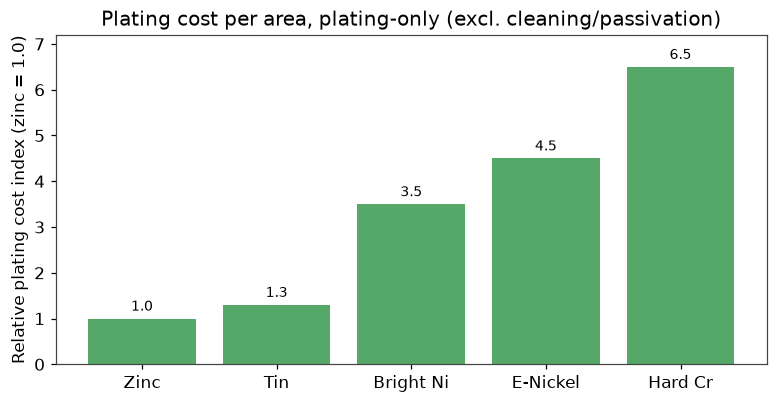
Here is the relative cost index I use, with zinc set at 1.0: zinc 1.0, tin 1.3, bright nickel 3.5, electroless nickel 4.5, hard chrome 6.5. Those are plating-only numbers and they exclude the cleaning and passivation that every system needs. A 0.5 dm2 part costs roughly 0.04 to 0.10 dollars in zinc and 0.25 to 0.60 dollars in electroless nickel.
The cheaper path is often to not plate at all. When I can switch the alloy to 316L or design the part so corrosion is not a risk, the plating line drops to zero. Our surface roughness guide explains why a smooth base also helps a coating last.
Questions buyers ask
How long does zinc plating protect steel from rust?
Clear zinc at 8 microns gives about 96 to 120 salt spray hours to red rust under ASTM B117. Yellow passivation at the same thickness reaches 240 hours, and a 15 micron thick zinc layer with sealed chromate can clear 500 hours. For outdoor parts I specify 15 micron yellow zinc.
What plating is best for steel parts used outdoors?
Yellow zinc at 15 microns is my default for outdoor steel because it is cheap and clears 500 salt spray hours. In salt air I move to zinc-nickel or electroless nickel. The strongest move is to skip plating and make the part from 316L stainless, which resists corrosion without any coating.
Is cadmium plating still allowed for commercial parts?
In most commercial work, no. Cadmium falls under RoHS and REACH restrictions, and plating it without the correct exemption puts a supplier out of compliance. I redirect those inquiries to zinc-nickel or electroless nickel. Aerospace and military programs with the right exemption are a separate case and need a documented waiver.
How much does plating add to the cost per part?
On a small bracket plating is often a few percent of the machined cost. Using a relative index with zinc at 1.0, the plating-only costs run about: zinc 1.0, tin 1.3, bright nickel 3.5, electroless nickel 4.5, hard chrome 6.5. A 0.5 dm2 part costs roughly 0.04 to 0.10 dollars in zinc and 0.25 to 0.60 dollars in electroless nickel, before cleaning and passivation.
Does electroless nickel resist rust better than zinc?
Yes, on a fair thickness comparison. A 25 micron electroless nickel layer holds 700 to 900 salt spray hours, well above zinc at the same thickness, and it lands evenly in threads and blind holes where rack zinc thins out. The cost is four to five times zinc, so I reserve it for valves, pump bodies, and threaded parts where uniform coverage matters.
Related reading
For material choices, see our comparison of 316L and 304 stainless for marine use and our guide to materials for food grade metal components. If your spec still lists a restricted coating, our RoHS and REACH compliance post explains how we read a supplier declaration. Our process engineering team reviews drawings before quoting, and the FAQ covers common lead time and tolerance questions.
Need Precision Metal Parts for Your Project?
Yujiaxin Tech specializes in MIM, CNC Machining, Powder Metallurgy, Investment Casting, and Gear Hobbing. Get a free quote within 24 hours.