Investment castings arrive with a surface that surprises buyers who spend most of their time around machined parts. It is slightly grainy, generally clean, and workable. Every week somebody asks me the same question: what can this surface become, what does each option cost, and what does the drawing actually need. I have quoted cast parts since 1998, and I have paid for finishes a part never needed, so I have opinions here. This article walks through the realistic options for a cast surface, with the Ra numbers and cost per part figures I would put on a quote today.
Table of contents
What the as-cast surface actually looks like
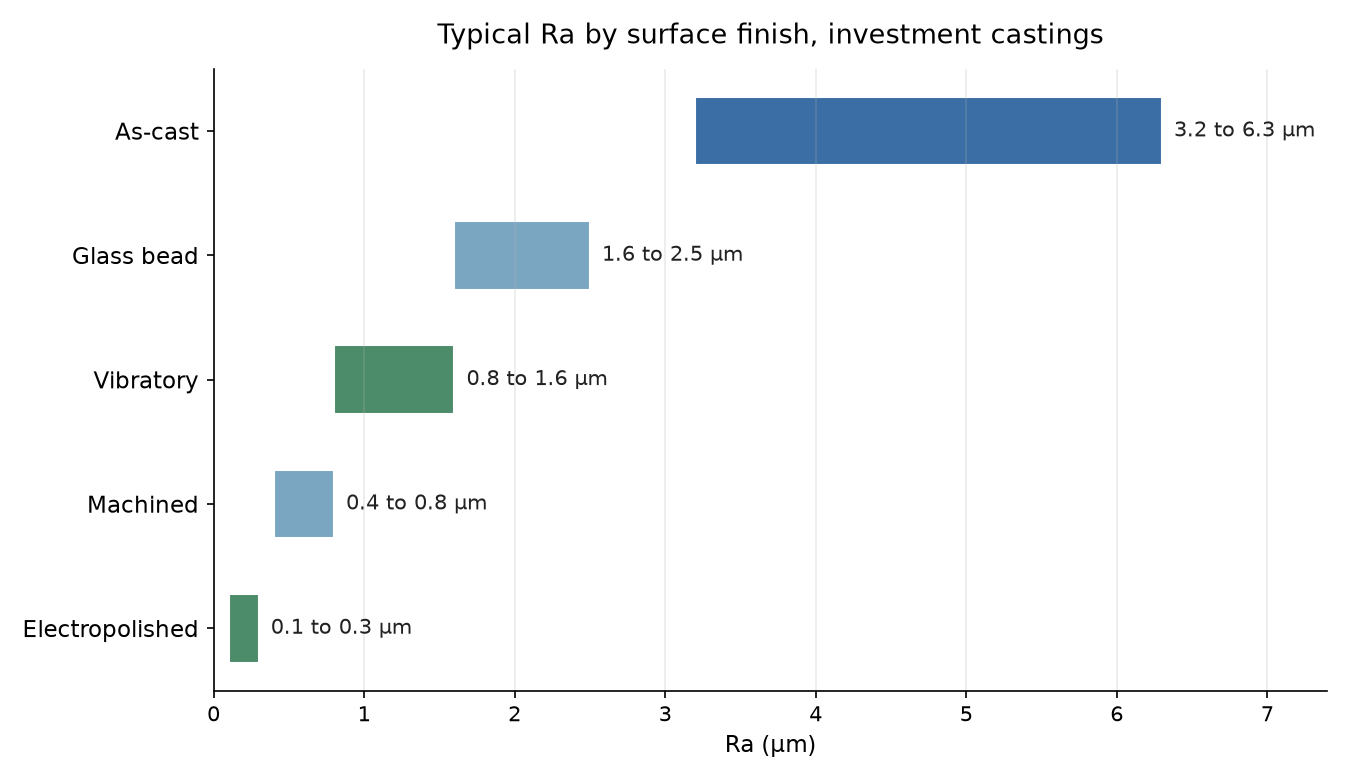
An as-cast surface off a ceramic shell reads Ra 3.2 to 6.3 µm, which is 125 to 250 µin if your drawings work in microinches. Simple geometry with a fine face coat lands closer to Ra 3.2. Deep pockets and thin cores trend toward 6.3, because the slurry cannot flow evenly there.
That number alarms engineers the first time they see it. It should not. Most as-cast surfaces are functional at Ra 6.3, and the cast skin carries a fine grain structure that often wears well. I put Ra 6.3 on a drawing whenever the function allows it, because every step below that number costs money. The exceptions are seal faces, sliding contacts, and anything a person touches regularly, and the sections below handle each of those. If your part never needs a cast skin at all, forming the net shape through metal injection molding or powder metallurgy skips this conversation entirely, though both carry tooling costs of their own. For geometry rules that shape how a casting releases from the shell, see our investment casting design guidelines.
Vibratory finishing
Vibratory finishing is my default for cast parts that people handle. The castings tumble with ceramic or plastic media for two to six hours, sometimes overnight on large batches. The media knocks down the peaks, rounds the edges, and leaves a surface that reads Ra 0.8 to 1.6 µm on most 316L parts. Edges pick up a radius of roughly 0.2 to 0.5 mm, which matters more than the Ra number for hand-held parts, because a sharp as-cast edge catches gloves and skin.
Cost per part runs 0.10 to 0.35 dollars for palm-size castings at normal volumes. The catch is geometry: media packs into blind holes and jams in slots narrower than about 1 mm. Parts with fine internal details go to blasting instead. A supplier who answers "we can vibrate anything" without asking about your hole sizes is guessing. I trust the one who asks.
Glass bead and abrasive blasting
Blasting changes texture without removing much metal. Glass bead at low pressure leaves a uniform matte face around Ra 1.6 to 2.5 µm and hides minor cast blemishes well. Aluminum oxide cuts harder, cleans scale faster, and leaves a rougher profile closer to Ra 3.2, which suits parts headed for paint.
At 0.20 to 0.50 dollars per part, blasting is cheap, and it barely moves the surface dimensionally, usually under 0.01 mm. Two cautions from experience. Beads lodge in threads and small bores, so I ask the blaster to mask them or to run a tap chase afterward. And I want a blasted sample with the first article, because media that is too coarse on 17-4PH leaves a smeared finish you then have to explain to your customer.
Machining the faces that matter
When a sealing face or a bearing seat needs Ra 0.8 µm or better, machining is the honest answer. Leave 0.5 mm of stock on the casting at those features, cut the faces on a CNC machining cell, and you land Ra 0.8 routinely, Ra 0.4 with a fine turning pass. This is the only step on the list that adds real cycle time, so it deserves restraint.
Cost per part depends on setup and seconds. A two-face operation with a fixture setup near 280 dollars adds about 2.40 dollars per part at 1,000 pieces, most of that cycle time rather than amortized setup. At 100 pieces the same operation runs closer to 5.10 dollars per part. I will not pay for machining on a face that touches air. Tolerance follows function, and so does finish.
Polishing and electropolishing
Polish comes in two forms. Mechanical polishing with progressively finer abrasives takes a cast face down to Ra 0.2 to 0.4 µm and a visible shine, at roughly 0.90 dollars per part for small housings at 1,000 pieces. It is labor, so it scales badly. At 100 pieces, expect triple.
Electropolishing strips 5 to 15 µm of metal electrochemically, levels the micro peaks, and leaves a bright surface that resists bacteria buildup. For 316L parts in the medical industry and for food contact, I push electropolishing hard, and I explain the price honestly: 0.60 to 1.20 dollars per square decimeter, which lands near 0.85 dollars per part for a palm-size housing once batch minimums and handling are counted. The surface reads Ra 0.1 to 0.3 µm afterward. Cleanability is the reason to spend that money, and the finish is the proof.
Passivation, plating and paint
Passivation does not change texture. It strips free iron from the surface and rebuilds the chromium oxide layer, which is what makes stainless steel 316L behave like stainless. After any blasting or vibratory work on 316L, I specify passivation per ASTM A967. The numbers make the case. A blasted 316L casting without passivation holds 72 to 150 hours in an ASTM B117 salt spray test before rust bloom, while the same casting passivated runs past 300 hours. The step adds 0.08 to 0.15 dollars per part, which is the cheapest corrosion insurance in casting.
Carbon steel castings need a barrier instead. Zinc or electroless nickel plating, or paint over a blasted profile, do that work. Paint adhesion on an as-cast surface is mediocre, so blast to Ra 3.2 first and the coating bonds. Anodizing does not enter this conversation, because aluminum investment castings are rare and die casting owns that space. The automotive industry suppliers I work with plate far more often than they polish.
What each finish costs per part
The chart below collects the midpoints of the ranges quoted above at 1,000 pieces: 0.25 dollars for vibratory, 0.35 for glass bead blasting, 2.40 for a two-face machining operation, 0.90 for mechanical polish, 0.85 for electropolishing, and 0.12 for passivation.
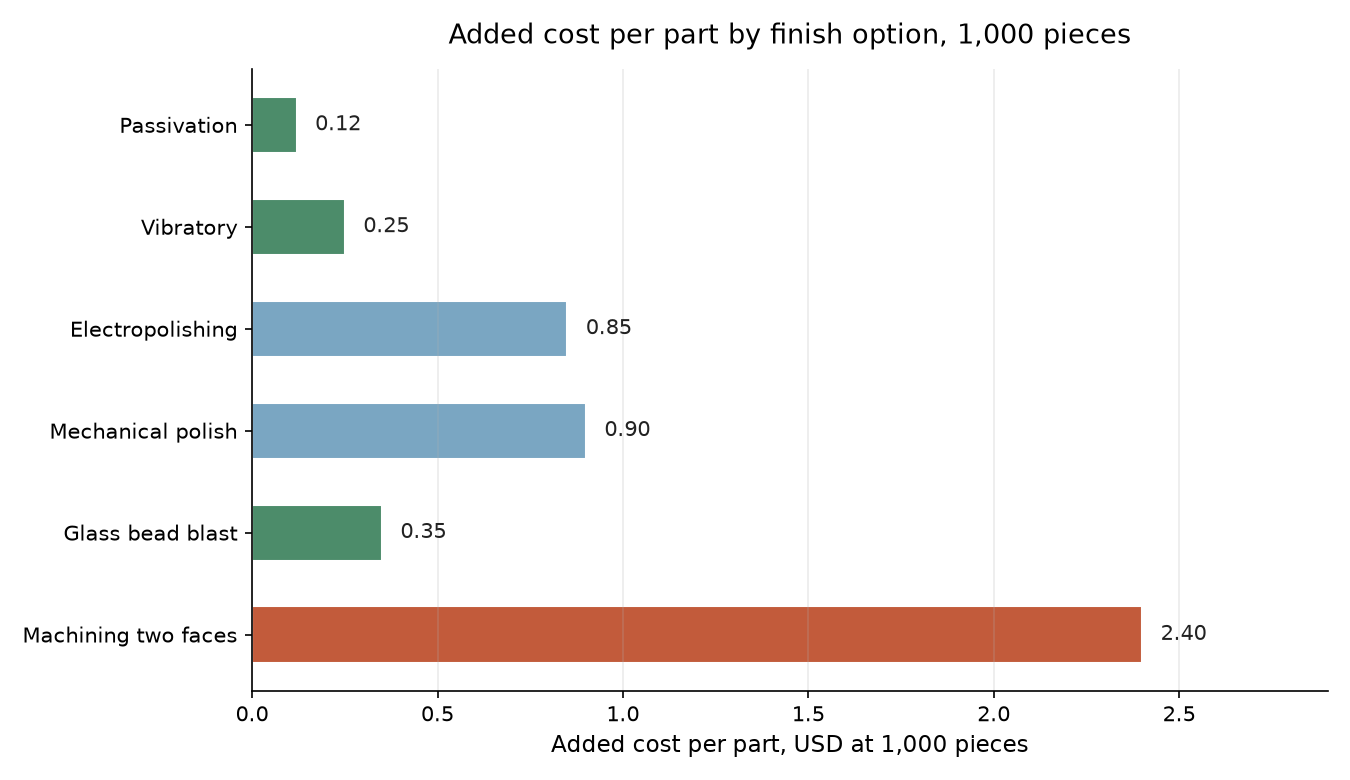
Vibratory and blasting are finishing for feel and appearance. Machining is finishing for function. Electropolishing sits between, buying cleanability along with the surface. When a buyer asks me to "make it shiny" on a carbon steel part, I quote plating and paint instead of polishing, because a polished carbon steel casting rusts in a warehouse and the polish was wasted money. The full menu across all our processes lives in the metal parts surface finish options guide.
Volume shifts these numbers. Setup-driven steps like machining amortize hard, and 2.40 dollars per part becomes roughly 1.10 at 5,000 pieces. Per-batch steps like electropolishing barely move. If your quantities are still uncertain, our article on realistic lead times for castings in China covers the batch size assumptions behind quotes like these.
How I choose a finish for a drawing
I ask three questions, in order. What touches the surface: a seal, a bearing, a hand, or air. What is the alloy: 316L passivates and electropolishes, carbon steel does neither. And what does the part cost without the finish, because a finish that doubles the part price needs a functional reason to exist.
Air-touching faces on a bracket stay as-cast at Ra 6.3. A hand-held handle gets vibratory. A seal face gets machined to Ra 0.8 with 0.5 mm of stock. A medical or food housing gets electropolished and passivated. That covers ninety percent of the drawings I review. Before the foundry conversation, make sure your Ra callouts are readable; our guide on specifying surface roughness on a drawing shows the symbols and notes that survive a quote review. The questions that come up after that usually belong on the FAQ page, and the inspection paperwork that follows a finished order is listed on our quality page. If you want to see how we run a program from RFQ to shipment, the how we work page lays out each step.
Frequently asked questions
What Ra can I expect on an as-cast investment casting?
Most ceramic shell castings read Ra 3.2 to 6.3 µm, or 125 to 250 µin, as-cast. Fine face coats on simple geometry trend toward 3.2. Deep pockets and thin cores trend toward 6.3.
How much does vibratory finishing add to the cost per part?
For palm-size castings at normal volumes, 0.10 to 0.35 dollars per part. Cycles run two to six hours depending on batch size and the Ra target.
Can an investment casting hold Ra 0.8 µm without machining?
Not reliably across a full face. Vibratory work reaches Ra 0.8 to 1.6 µm overall. A sealing face that must hold Ra 0.8 everywhere needs 0.5 mm of machining stock and a cutting pass.
Does passivation change the surface finish of 316L castings?
No. Passivation removes free iron chemically and rebuilds the oxide layer without moving the Ra reading. Its value is corrosion resistance. Passivated 316L survives past 300 hours of salt spray where a blasted bare surface starts at 72 to 150 hours.
Which finish should I specify for a food or medical casting?
Electropolish to Ra 0.1 to 0.3 µm, then passivate per ASTM A967. Expect 0.60 to 1.20 dollars per square decimeter for the electropolish step on 316L.
Need Precision Metal Parts for Your Project?
Yujiaxin Tech specializes in MIM, CNC Machining, Powder Metallurgy, Investment Casting, and Gear Hobbing. Get a free quote within 24 hours.