I have scheduled investment casting jobs in China for more than fifteen years. The question I get most often is not about price or tolerance. It is about time. Buyers want to know when the first box will land, and they want a number they can trust. The honest answer is rarely a single week. It is a stack of dependent steps, and each step has its own realistic range.
Why lead time quotes vary so much
A supplier who tells you "four weeks" without seeing a drawing is guessing. I have seen the same part quoted at six weeks by one shop and ten by another, and both quotes were honest at the moment they were written. The difference comes from what each shop already has on the floor.
Tooling is the biggest variable. If the part needs a new wax die, add two to four weeks before first articles. If the supplier has a compatible tree or can gang your part onto an existing runner, you may cut that in half. Alloy matters too. 316L stainless steel is common; most shops keep bar stock. A nickel-base superalloy or a custom heat of cobalt-chrome can add two to three weeks just for material certification.
Volume changes the calendar. A first-article lot of five pieces is not the same as a production lot of five thousand. The shell building, dewaxing, and pouring steps scale, but drying time between shell coats does not. You still wait twenty-four hours between coats whether you pour one piece or one hundred.
Process choice also changes the clock. If your geometry is simple and the quantity is high, powder metallurgy or metal injection molding may beat investment casting on repeat orders. I bring those options up early so the buyer does not lock into a process that is slower than necessary.
Typical investment casting timeline in China
Here is the schedule I use when I plan a new investment casting program in China. These numbers assume the drawing is complete, the alloy is standard, and the supplier has open furnace capacity.
Week 1: drawing review and DFM feedback. A good shop returns comments on wall thickness, draft, and parting lines within three to five days. If you skip this step, you save five days and usually lose three weeks later. I wrote a separate guide on investment casting design guidelines because the decisions made here echo through the whole schedule.
Weeks 2-3: wax die or pattern making. Simple aluminum dies take ten to twelve days. Complex multi-cavity steel dies take eighteen to twenty-four days. For prototype quantities, some shops print wax patterns and skip hard tooling entirely. That saves the tooling time but limits you to dozens of pieces, not thousands.
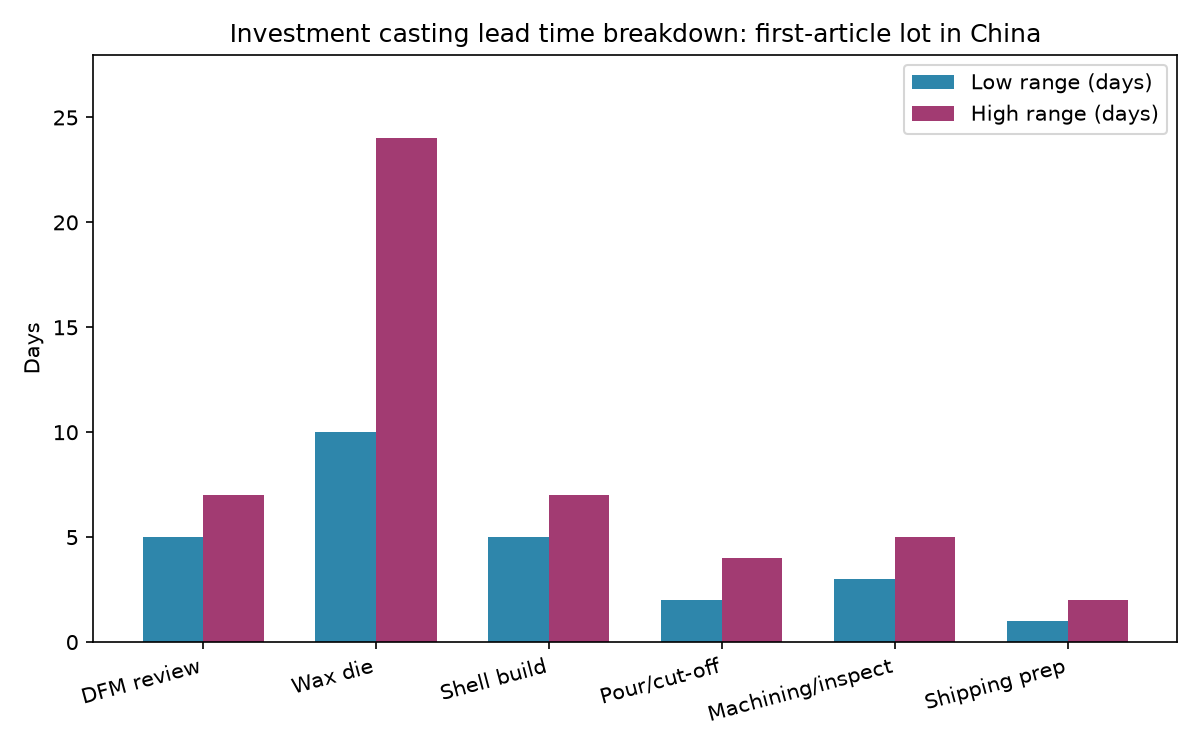
Week 4: shell building and drying. A typical shell has six to eight ceramic coats. Each coat needs a dip, a stucco, and a dry. The full shell cycle is five to seven days. Rushing this by force-drying coats is possible, but I avoid it on thin-wall or high-integrity parts because it raises shell cracking risk.
Week 5: pouring, cut-off, and initial finishing. The actual pour is fast. Cut-off, gate grinding, and blast take two to four days. Heat treatment, if required, adds two to three days.
Week 6: machining, inspection, and shipping prep. Secondary operations such as CNC drilling or tapping add time based on complexity. First-article inspection and report generation take one to three days. Then the parts sit in outbound logistics for one to two days before they move.
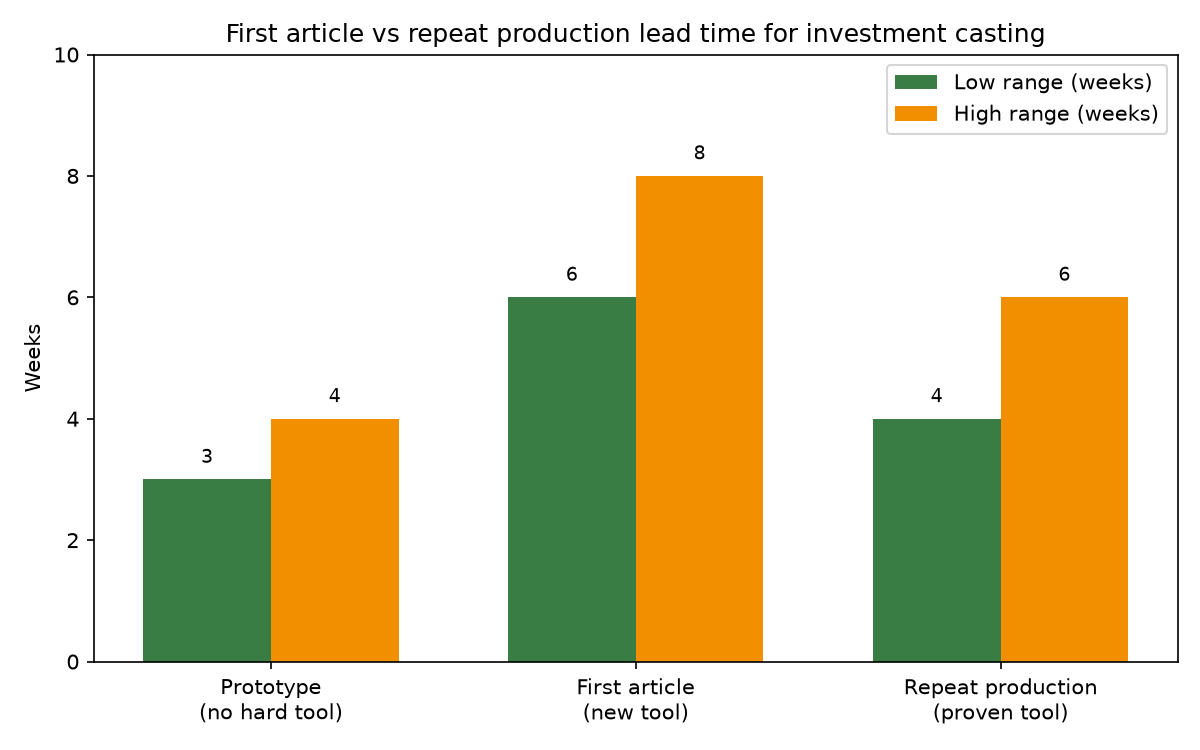
So the realistic base range is six to eight weeks for a tooled, first-article lot. Repeat production lots usually run four to six weeks once the die is proven. Prototype lots without hard tooling can land in three to four weeks, but the per-piece cost is higher and the geometry options are narrower.
Where delays actually happen
Most delays are not acts of nature. They are information gaps.
Incomplete drawings are the worst offender. I once had a buyer send a 3D model with no GD&T and one sentence in the tolerance block: "per drawing." The shop stopped everything for four days while we clarified critical dimensions. That four days cost more than the tooling revision that followed.
Material certification delays are next. If your specification calls for lot-traceable 316L with EN 10204 3.1 certificates, the shop cannot simply melt scrap from the corner. They need a mill cert that matches the heat number. When mills are back-ordered, this adds one to three weeks. For automotive or aerospace work, this is non-negotiable, so I order material the same week the die starts.
Heat treatment and NDT queues are quieter killers. A shop may pour on schedule, then discover its vacuum furnace is booked two weeks out for a larger customer. Radiographic inspection has the same problem. One X-ray cabinet can become the bottleneck for ten jobs.
Holiday effects are real. Chinese New Year shuts down most foundries for two to four weeks. National Day in October often removes a week. I build these into schedules by default. If a buyer tells me the parts must ship before January 15, I assume the foundry stops taking new work by December 10.
Quality escapes also stretch time. A warp, a crack, or a dimensional miss on first articles means a second sample loop. I have written about how to avoid warping in thin wall investment castings before; thin walls and large flat faces are the usual suspects when a second loop is needed.
How to shorten the cycle without paying rush charges
Rush charges are usually a sign that someone upstream lost time. I try to avoid them by controlling what I can control on the buyer side.
Send a complete drawing package. Include 3D model, 2D PDF with GD&T, material specification, heat treatment callout, inspection level, and finish requirement. The more questions the shop has to ask, the more calendar days disappear.
Approve the wax pattern quickly. I have seen first-article delays stretch because the approval email sat in someone's inbox for a week. If the pattern looks right, say yes the same day. If it does not, say exactly what is wrong so the revision is one step, not three.
Order long-lead material early. For alloys the shop does not stock, ask them to order the raw material at the same time they start the die. Do not wait for the die to finish. The material certification can run in parallel.
Build a small buffer for the first order. A schedule that assumes zero problems is a schedule that will fail. I add two weeks of float on the first order of a new part. Once the process is proven, I tighten it. The buyer who plans for eight weeks and gets six is happy. The buyer who plans for four and gets six is not.
Consider whether you really need hard tooling. For annual volumes below two thousand pieces, machined wax patterns or printed patterns may get you to market faster than a die. You trade unit cost for speed, but sometimes speed is the right trade. I discuss this with buyers during the how we work review so the process choice matches the business goal.
Cost and time are linked. If you want a deeper breakdown of what drives the price side, see my notes on what drives the unit price of precision cast components. Understanding both halves helps you negotiate a schedule that is realistic instead of optimistic.
Frequently asked questions
What is the fastest realistic lead time for investment casting in China?
Three to four weeks is possible for small prototype lots using printed wax patterns and a standard alloy like 316L. That drops tooling from the schedule. It is not free; the per-piece cost is higher and the geometry must suit the pattern process.
How much does Chinese New Year add to investment casting lead time?
Most foundries stop accepting new orders two to three weeks before the holiday and need one to two weeks to restart after it. I add four to five weeks of buffer around Chinese New Year for any new program.
How long does investment casting tooling take in China?
Simple aluminum dies take ten to twelve days. Complex steel dies take eighteen to twenty-four days. For quantities above five thousand pieces per year, the steel die pays for itself. Below two thousand pieces, printed or machined patterns are often faster.
Are rush charges worth paying for investment casting?
Not usually. Rush charges buy overtime on steps that cannot safely be shortened, like shell drying. A better use of money is to start the job earlier and remove the information gaps that cause delay.
What information does a supplier need to quote a reliable lead time?
Complete 2D drawing with GD&T, 3D model, alloy grade, quantity, finish, heat treatment, inspection level, and shipping terms. With that package, a supplier can quote a lead time you can put in a project plan. See our FAQ for a full checklist.
Need Precision Metal Parts for Your Project?
Yujiaxin Tech specializes in MIM, CNC Machining, Powder Metallurgy, Investment Casting, and Gear Hobbing. Get a free quote within 24 hours.