A four cavity MIM mold takes about eleven weeks to build. Once it runs, the same mold makes fifty thousand 316L parts in under four days. Buyers who see those numbers side by side usually suspect the tool shop is padding the schedule. I have quoted metal injection molding since 1998, and the eleven weeks are not padding. Every decision the process depends on gets settled before the first shot, in hardened steel, where a mistake costs weeks instead of minutes.
In this guide
- The short version
- What the mold decides before anyone cuts steel
- Where the eleven weeks actually go
- Why production looks easy once the tool exists
- What a tool trial proves, and what it does not
- Tooling cost per part and your break-even volume
- What buyers do that adds two weeks
- Questions I would ask before approving a mold
- Frequently asked questions
The short version
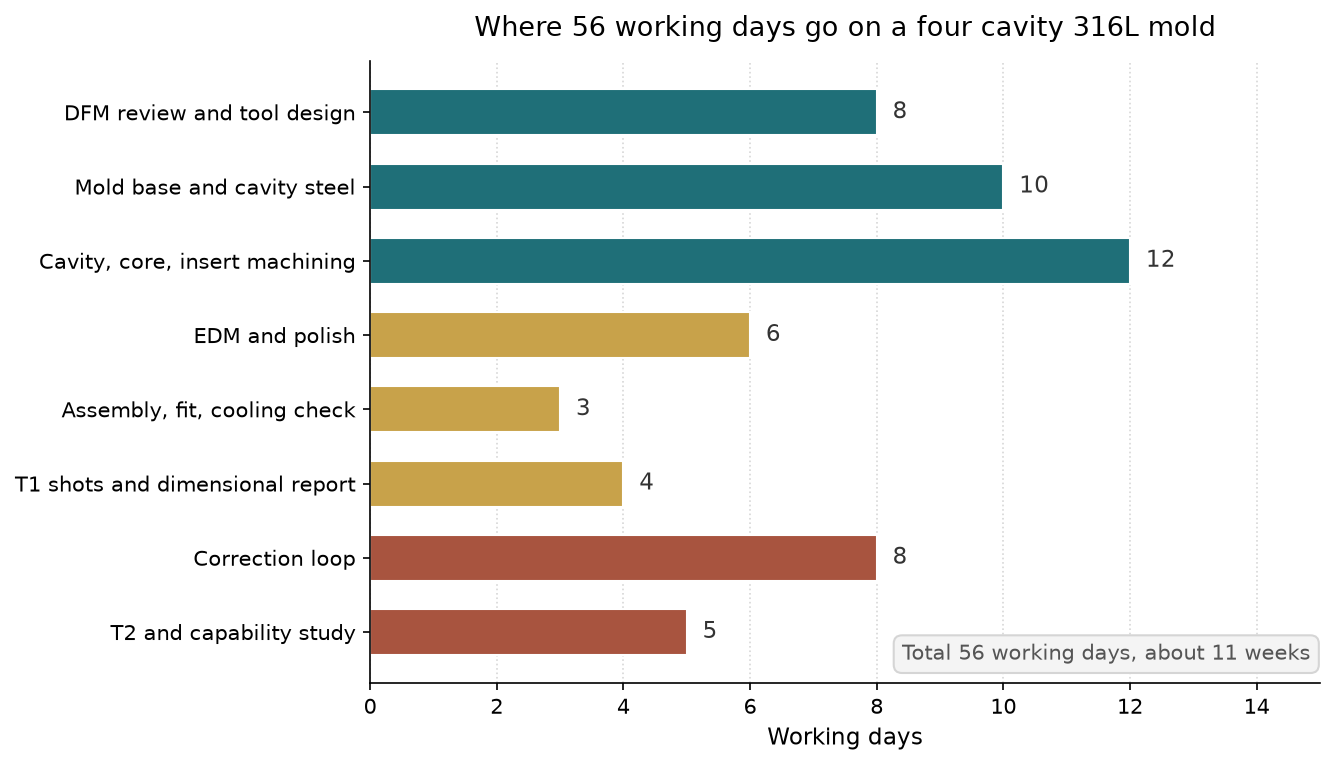
The example below is a four cavity tool for a 316L bracket, cut from a 1.2343 ESR block at 50 HRC. Kickoff to a capability report takes 56 working days, eleven weeks on a calm calendar and thirteen in a shop that hits a holiday shutdown. Fifty thousand parts then take about 90 machine hours. Roughly 70 percent of the project sits in front of the first shot, and none of that work repeats on the second order.
| Stage | Working days | What slips |
|---|---|---|
| DFM review and tool design | 8 | Wall under 1 mm |
| Mold base and cavity steel | 10 | Block wrong for the press |
| Cavity, core, insert machining | 12 | Deep ribs, 50 HRC stock |
| EDM and polish | 6 | Finish agreed verbally |
| Assembly, fit, cooling check | 3 | Interference found late |
| T1 shots and dimensional report | 4 | Feedstock lot not ready |
| Correction loop | 8 | Gate weld, shutoff recut |
| T2 and capability study | 5 | Cpk under 1.33 |
What the mold decides before anyone cuts steel
Every cavity dimension is scaled up by a factor near 1.17, because 316L feedstock shrinks 16 to 18 percent linearly during sintering. A 10.00 mm finished dimension is cut at roughly 11.70 mm, and it lands at 10.00 mm only if the feedstock behaves like the lot the tool was designed around. Change powder supplier mid-program and that factor moves enough to put a tight bore outside tolerance. This is why tool design wants a locked feedstock spec, not a note saying stainless.
The rest is geometry nobody adjusts with a wrench later. Gate position sets where the weld line lands and whether a cosmetic face shows a mark. Parting line sets which edge carries flash. Cooling layout sets cycle time: a mold running 26 seconds instead of 22 costs about 18 percent more per part for the life of the program. Ejector pins press on green parts that are weak before sintering, so pin position follows wall structure. Undercuts need a slide, and that decision belongs in week two.
A careful shop sends a DFM report of 20 to 40 items before it quotes a tool. The list is cheap to read and expensive to ignore: a wall below 1 mm, a rib filling 40 mm from the gate, a hole that has to be molded rather than drilled, a thread that will not survive sintering without a core pin. On a recent medical bracket the report flagged a 0.8 mm wall between two bosses, and the buyer agreed to 1.2 mm after one call. That saved a slide and about 3,400 dollars of tool work. The same review is described in our MIM design guide for engineers.
Where the eleven weeks actually go
Fifty six working days. Design takes eight days, steel and mold base ten, cavity machining twelve, EDM and polish six, assembly three, the first trial four, the correction loop eight, the second trial five. Two stages carry most of the risk: hard milling at 50 HRC with a 1 mm cutter, and the correction loop, because repairs happen in the same steel.
Recutting a shutoff or welding a gate on a hardened block is EDM work, three to five days for a small pocket, plus polish and another trial. That is why I plan eight days for one loop rather than two. A tool needing two loops is a thirteen week tool. A shop promising this mold in six weeks is quoting a different mold, or planning to skip the trial.
The calendar differs from the day count. Steel delivery, Chinese New Year, a polishing backlog, and a customer who takes nine days to approve a T1 sample all sit outside the 56 days. I add 15 percent to any date I give a program manager, and I say why. For a device needing medical validation, the paperwork adds another week.
Why production looks easy once the tool exists
Four cavities on a 22 second cycle produce 654 parts an hour at full rate, about 556 at 85 percent overall equipment effectiveness. Fifty thousand parts need 90 machine hours, under four days on three shifts. Add debinding at 30 hours per batch and sintering at 20 hours including ramp, run as two batches, and the order ships inside two weeks of trial approval.
Compare cutting the same part from bar. At six minutes per piece on a lathe with a bar feeder, 50,000 parts is 5,000 machine hours, about 60 weeks on one machine. That is the trade the mold buys: eleven weeks and 22,000 dollars up front so the next fifty thousand parts take four days. The same logic splits powder metallurgy from CNC machining by volume rather than by preference.
The fast number hides how little room the process leaves. Cycle time and cooling are set by the steel, so a wall change after the cut changes the tool.
What a tool trial proves, and what it does not
A T1 trial runs 200 to 500 shots. The shop measures 12 parts across the shot sequence, reports dimensions, and shows a capability study on three features the buyer names in advance. I ask for Cpk 1.33 on those three, not on forty dimensions, because a long report with no capability data says nothing about the next 50,000 parts.
T1 is not an approval. It measures the tool as cut. A mold making good parts at shot 300 can fail at 8,000 when a gate freezes early or a slide wears into a burr. I watched a buyer sign off a T1 from a photo without a dimension checked, then reject three production lots. The tool was fine. The approval was not.
My rule: two good lots before production release, a third measured before anyone talks blanket order. That is where quality documentation starts to matter, since a capability study without sample records is a number on a page.
Tooling cost per part and your break-even volume
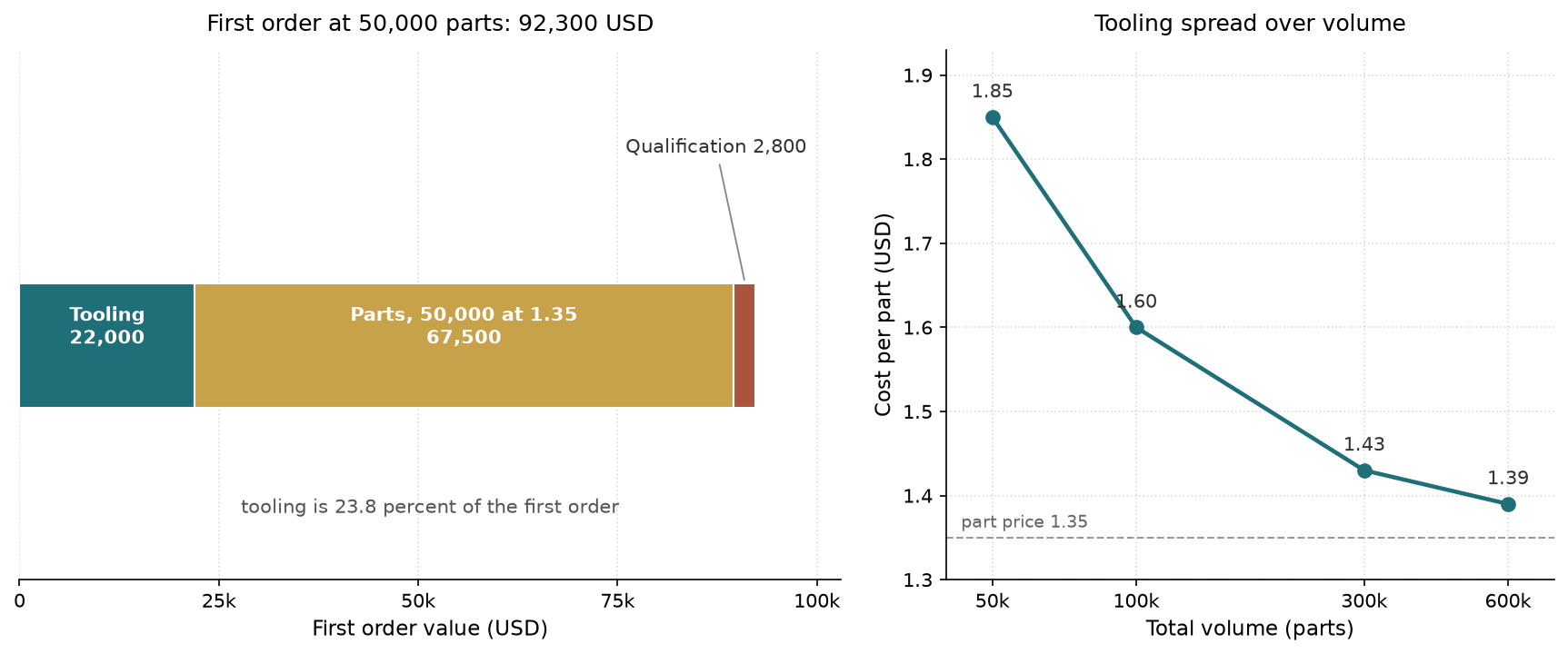
Tooling is 22,000 dollars for four cavities. Qualification, first article inspection, and the capability study add 2,800. The part is 1.35 dollars at 50,000 pieces, so the first order totals 92,300, and tooling is 23.8 percent of it. The first order costs 1.85 per part against 1.35 on the reorder. At 100,000 pieces the tooling share drops to 1.60, at 300,000 to 1.43, and at 600,000 it flattens near 1.39.
That is why the same part looks expensive on a first order and cheap on a third. Tool life expectancy runs 300,000 to 500,000 shots for a 1.2343 cavity in 316L, so four cavities cover 1.2 to 2 million parts. Spread over 300,000 parts, tooling adds 7 cents per piece.
Break-even against machining is the number I put in front of a program team. At 4.80 dollars machined and 1.35 molded, the 22,000 dollar tool pays back near 6,400 pieces, or 7,200 with the 2,800 dollars of qualification. Below 5,000 pieces I would not build a mold, even with budget approved, because a 22,000 dollar tool that runs twice is a bad purchase.
What buyers do that adds two weeks
I lost six weeks in 2023 on a tool that was already cut. The buyer moved a cosmetic surface from the B side to the A side after T1, which meant a new gate position, a new polish, a second trial. Nothing changed except which face a customer would see, and that decision was available in week one.
Four habits cost time on almost every program. Approving a T1 from a photo instead of a dimensional report, which pushes the argument to first article. Sending the material certificate after the cavity steel is ordered, which can force a feedstock change and a new shrink factor. Revising the drawing after the design freeze, which restarts the DFM review. Holding the purchase order until the tool is finished, when most shops will not hold an EDM slot without a deposit.
Work that belongs in week one shows up in week nine, and steel cannot absorb it. Our how we work page sets out the checkpoints we use to catch this before the block is cut.
Questions I would ask before approving a mold
Five questions, in this order. What shrink factor is assumed, and which feedstock lot is it based on? Where is the gate, and what does the weld line do to the cosmetic face? What cycle time and cavity count is the price built on? Which three dimensions carry the capability study, and what Cpk is promised? What happens to the tool if volume drops by half in year two?
A supplier who answers all five with numbers designed the tool. One who answers with adjectives copied it. The steel grades behind those answers are on our tool steel page, and the 316L side is on the stainless steel 316L page. For the cost side, the tooling amortization guide runs the same numbers over five years, and the FAQ covers what buyers ask before a tool is released. An automotive program adds launch audits on top.
Frequently asked questions
Why does mold making take longer than production in MIM?
A four cavity 316L mold takes about 56 working days to design, cut, polish, trial, and correct. The same tool then makes 50,000 parts in about 90 machine hours. The mold carries every process decision, so the schedule sits in front of the first shot.
What is a realistic MIM tool lead time in 2026?
Eight to ten weeks for a simple two plate tool with one trial, and fourteen to eighteen weeks for a tool with slides, multiple gates, and a tight cosmetic spec. Add two weeks if the program needs a full validation package.
What is the break-even volume for MIM against CNC machining?
On a 316L bracket at 4.80 dollars machined and 1.35 molded with a 22,000 dollar tool, the break-even sits near 6,400 pieces. Count the 2,800 dollars of qualification work and it moves to about 7,200.
How long is MIM tool life expectancy for a 316L part?
A 1.2343 cavity at 50 HRC holds 300,000 to 500,000 shots in 316L. With four cavities that is 1.2 to 2 million parts, or about 7 cents of tooling per part at 300,000 pieces.
Can a MIM mold be changed after the first trial?
Yes, and most molds are. Gates get welded, shutoffs get recut, ejector pins move. Each correction loop costs about eight working days because the work happens in hardened steel. Cosmetic changes after T1 are the expensive ones.
Need Precision Metal Parts for Your Project?
Yujiaxin Tech specializes in MIM, CNC Machining, Powder Metallurgy, Investment Casting, and Gear Hobbing. Get a free quote within 24 hours.