Supplier certificates land on my desk every week. Some carry ISO 9001, some carry IATF 16949, and plenty of buyers treat the two as interchangeable. They are not. I have worked with factories certified under both standards for close to twenty years, and the gap between them is bigger than most purchasing teams expect. This guide walks through what each standard covers, what IATF 16949 adds, what certification actually costs, and when you should insist on the automotive version. By the end you should be able to read a supplier certificate and know what it promises and what it leaves out.
In this guide
What ISO 9001 covers
ISO 9001:2015 is the general quality management standard. It applies to any organization in any industry: a bakery, a machine shop, a software firm. The standard asks a company to define its processes, control its documents, train its people, measure output, and correct problems when they appear. The substance sits in clauses 4 through 10, covering context, leadership, planning, support, operation, performance evaluation, and improvement.
What it does not do is tell a factory how to run automotive programs. There is no requirement for PPAP submissions, no mandated measurement system analysis, and no reference to Cpk targets. A certified shop must have a documented quality system and show it works at each surveillance audit, but the depth of that system is left to the company. I have seen ISO 9001 certificates on the wall of shops whose incoming inspection was a caliper and a good memory.
The certificate runs on a three year cycle, with a surveillance audit in years one and two and a full recertification in year three. Any accredited certification body can issue it. That is both a strength and a weakness: it is easy to obtain, and easy to obtain badly. For a plain view of how a shop runs without an automotive layer, compare our CNC machining and powder metallurgy operations, both of which serve customers under both standards.
What IATF 16949 adds on top
IATF 16949:2016 was written by the automotive industry for the automotive industry. It is built on top of ISO 9001:2015, which means an IATF certified company meets every ISO 9001 requirement plus a thick layer of automotive specific ones. A factory cannot hold IATF 16949 on its own; the certificate is always paired with ISO 9001. If a supplier ever sends you a standalone IATF document with no ISO 9001 behind it, that alone is worth a phone call.
The added layer is where buyers get real protection. APQP structures the program timeline from quote to launch. PPAP submissions come with defined levels of evidence instead of whatever the supplier feels like sending. FMEA is maintained as a living document, not a one time exercise filed at launch. Measurement system analysis happens before anyone trusts a gauge. Statistical process control watches the characteristics that matter. Traceability requirements reach back to the material heat lot. And customer specific requirements are tracked formally, so one OEM's rules do not get blended into another's.
One detail people miss: certification bodies must follow the IATF audit rules, which standardize audit duration and auditor qualification. The auditor on an IATF audit has automotive manufacturing experience. On a general ISO 9001 audit, the auditor may have spent their career in textiles or food processing. That difference shows up in the questions they ask on the floor, and I have been present for enough of both audits to feel it within an hour.
The differences a buyer actually sees
Paperwork comes first. Under ISO 9001, a supplier can define what first article approval means. Under IATF 16949, the PPAP structure fixes it: dimensional results on every drawing characteristic, material and performance test results, capability studies, MSA data, and control plans aligned to the PFMEA. If you have ever received an FAI that was three photos and a friendly email, you were dealing with the first kind of supplier. Our own checklist for PPAP submissions shows what the automotive version should contain.
Capability comes second. An automotive program expects Cpk of 1.33 or better on significant characteristics, demonstrated over a production run, not promised in a quotation. The supplier also needs reaction plans: what happens when a dimension drifts, who gets called, and how fast suspect parts get quarantined. Under a plain ISO 9001 system, capability studies may exist only when a customer asks, and the answer to "what did you do when it drifted" is often a shrug.
Traceability comes third. On an automotive part, a defect has to be traceable to a production shift and a material heat lot, because the recall math is brutal. A single bracket recall can cost an automaker more than your entire annual spend with that supplier. That is why the requirements exist. If my part ends up inside a vehicle cabin or a braking assembly, I want the IATF certificate, and I want to watch the traceability drill during the audit, not read the procedure in a binder. The same discipline shows up in how the shop handles material certificates, which I covered separately for 316L material certificates, a topic that starts with the alloy itself on our 316L stainless steel page.
Cost and audit effort
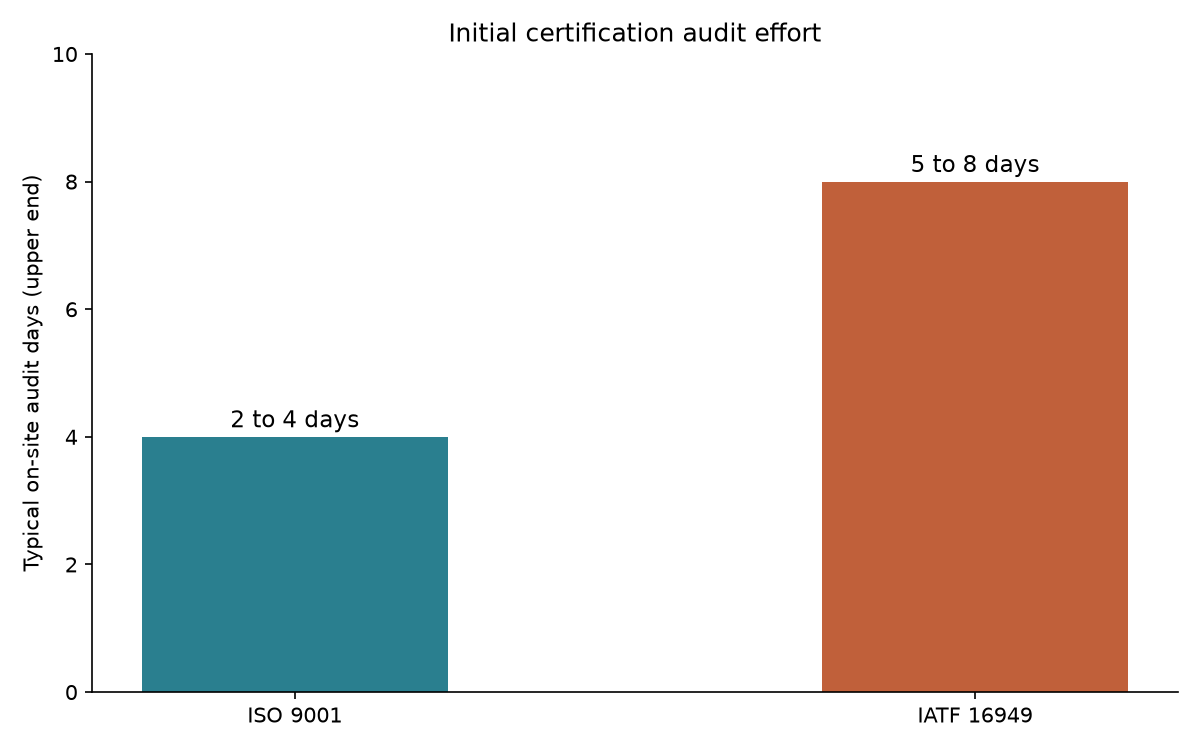
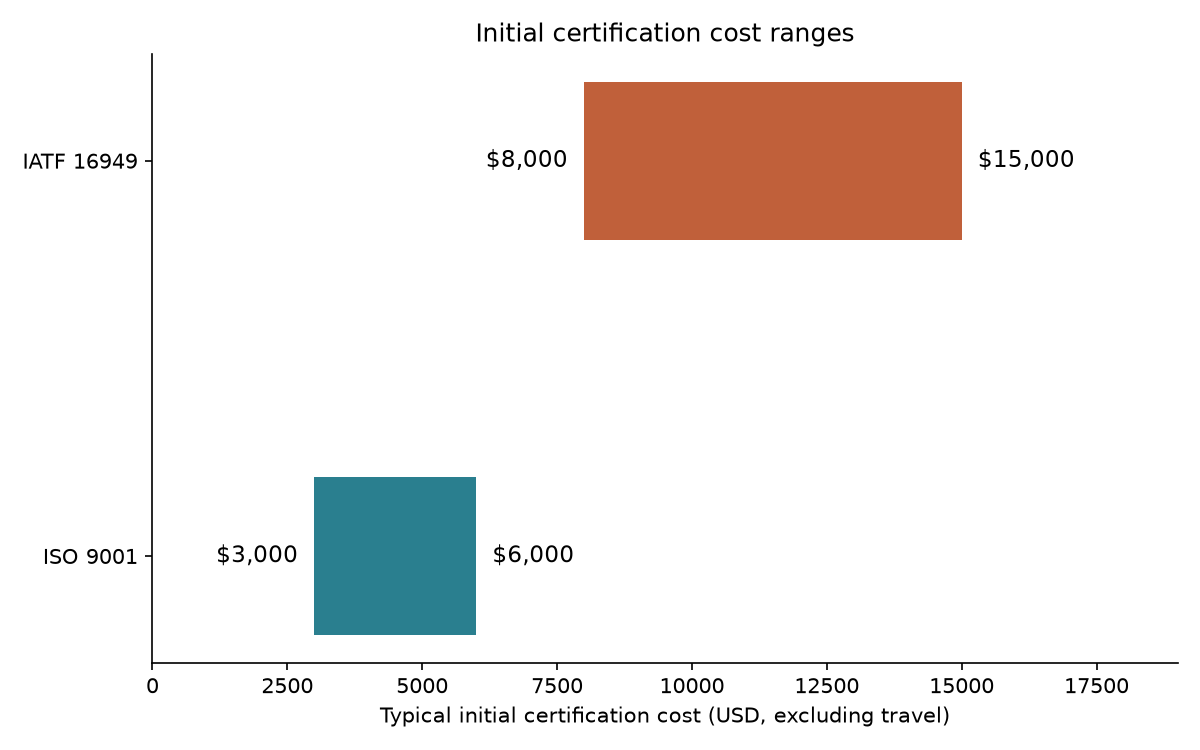
I have sat on the supplier side of both audits, and the difference in effort is real. A typical initial ISO 9001 audit for a small to mid size factory takes 2 to 4 days on site. An IATF 16949 initial audit takes 5 to 8 days, spread across system, manufacturing site, and process specific sessions. Auditor fees follow the same pattern: budget roughly 3,000 to 6,000 USD for the initial ISO 9001 audit and 8,000 to 15,000 USD for IATF 16949, before travel. Surveillance visits repeat every year under both standards, so the spread between them compounds over the three year cycle.
For the buyer, none of this is your invoice to pay. It matters because cost pressure is one reason some suppliers quietly narrow their certificate scope or drop surveillance audits. A factory that lets its IATF certificate lapse to save the audit fee is telling you something about how it will react when your program gets tight. I read certificate maintenance as a character reference.
When you actually need IATF 16949
If your parts enter the automotive series production stream, directly or through a tier 1, the answer is usually yes. Most OEM sourcing manuals require it for production suppliers, and our own automotive industry work runs under that expectation. Prototype and tooling activity is often outside certification scope, so a prototype-only shop without the certificate is not automatically a red flag for early phase work.
If your parts feed industrial machinery, electronics, or general equipment, ISO 9001 plus your own incoming inspection regime is usually enough. I have bought millions of dollars of industrial components from ISO 9001 certified shops and slept fine. The deciding question is not the industry name on the part; it is what happens when the part fails in the field. If the failure mode involves a vehicle moving at speed, pay for the automotive standard.
One gray zone worth naming: aftermarket and performance parts. Some buyers demand IATF 16949 for these, some accept ISO 9001 with PPAP style first articles. I usually accept the second for low volume work and ask for capability data on the two or three dimensions that actually matter. Requiring a full IATF program for a 500 piece run mostly buys you a higher quote, and I have watched buyers walk away from good shops over it. For a sense of what that first article review should still cover, see our guide to first article inspection.
How to verify a supplier certificate
Certificates are easy to fake and easy to exaggerate, so verify before you rely on one. Four checks cover most of the ground.
First, read the scope line. A certificate covers defined activities at defined sites, and I have seen scopes carved down to "machining of components excluding automotive safety parts" while the sales team quoted exactly those parts. The scope line is the certificate. Everything else is decoration.
Second, check the certification body. IATF 16949 can only be issued by a certification body contracted under the IATF system, and the certificate carries a number you can check against the public IATF certificate database. For ISO 9001, confirm the body is accredited by a recognized accreditation organization rather than a mailbox with a logo.
Third, check the dates. Expiry date, issue date, and the next surveillance due date. A certificate issued three years ago with no surveillance stamp is a dead certificate, whatever the expiry says.
Fourth, match the certificate to the site. Group certificates covering "multiple locations" deserve a second look, because the site actually molding your parts may hold nothing itself. When the part is safety relevant and the material matters, extend the same skepticism to the mill test report, as I describe in our supplier qualification walkthrough. And if a supplier hesitates when you ask to see the raw audit summary rather than the certificate, that hesitation is an answer. More of my thinking on supplier vetting sits in our how we work page, and the short version of all four checks is this: trust the scope line, check the number, check the dates, match the site.
Frequently asked questions
What is the main difference between ISO 9001 and IATF 16949?
IATF 16949 contains every ISO 9001 requirement plus automotive specific ones: PPAP, APQP, FMEA discipline, measurement system analysis, SPC, and heat lot traceability. It cannot be held on its own and is always paired with ISO 9001.
How much does IATF 16949 certification cost?
Typical initial certification runs 8,000 to 15,000 USD in audit fees, versus 3,000 to 6,000 USD for ISO 9001, with on-site audit effort of 5 to 8 days versus 2 to 4 days. Travel and yearly surveillance audits add to both.
Does my supplier need IATF 16949 for prototype parts?
Usually not. Prototype and tooling work is often outside certification scope, and most OEMs qualify prototype shops through part approval rather than certificates. The certificate matters when parts enter series production.
How long is an IATF 16949 certificate valid?
Three years, the same cycle as ISO 9001, with a surveillance audit every year and a full recertification audit in year three. Check both the expiry date and the next surveillance due date on every certificate.
Can a supplier be IATF 16949 certified without ISO 9001?
No. IATF 16949 is built on top of ISO 9001:2015, so an IATF certificate is always issued together with an ISO 9001 certificate. A claim of standalone IATF certification is a red flag.
Need Precision Metal Parts for Your Project?
Yujiaxin Tech specializes in MIM, CNC Machining, Powder Metallurgy, Investment Casting, and Gear Hobbing. Get a free quote within 24 hours.