I have quoted surface treatments on aluminum parts for close to twenty years, and the anodize-or-powder question shows up on almost every drawing that comes through our CNC machining shop. Buyers often treat it like a color choice. It is not. The two finishes protect aluminum through completely different mechanisms, they fail in different ways, and they behave differently on threads, ground pads and edges. Pick the wrong one and you pay for protection you never needed, or you learn about the gap when parts come back spotted with white corrosion after one wet season.
Table of contents
How each coating works
Anodizing is not a coating that sits on the part. It is a controlled growth of the aluminum oxide layer itself. We submerge the part in a sulfuric acid bath, run current through it, and the surface converts to a porous ceramic layer that we then seal in hot water. On aluminum 6061, a standard Type II sulfuric anodize builds a layer of roughly 8 to 25 microns. A Type III hardcoat pushes that to 50 to 100 microns and much higher hardness. Because the layer grows out of the base metal, it cannot peel, chip or delaminate. That is the property I trust most about anodizing.
Powder coating is a dry polyester or epoxy powder sprayed onto the part electrostatically, then cured in an oven at about 180 to 200 degrees C for 10 to 15 minutes. It melts, flows and crosslinks into a plastic film, typically 50 to 100 microns thick. It bonds mechanically and chemically to a pretreated surface, but it is still a film on top of the metal. Scratch through it and bare aluminum is exposed. That single difference sits behind most of the decisions below.
Corrosion protection and salt spray life
Anodized aluminum resists corrosion because the oxide layer is already the corrosion product. It cannot rust the way steel does, and a sealed Type II anodize on 6061 routinely passes 336 hours of ASTM B117 salt spray. Hardcoat goes further, around 500 hours on the same test. What anodizing does not do well is survive a breach. A deep scratch in an anodized surface exposes bare metal in a spot where the surrounding oxide can actually accelerate localized pitting in chloride environments. I saw this on 316L sensor housings we made for a coastal customer: the stainless parts were fine, but the aluminum brackets with scratched anodize pit-marked within a year. If you care about that failure mode on mixed-material assemblies, it is worth reading how 316L and 304 differ for marine use.
Powder coat takes the opposite path. The film is a physical barrier, thick and continuous, and over proper pretreatment it will pass 1,000 hours of salt spray without breaking a sweat. Its weakness is impact and creep. A stone chip or a fastener overstressed into the film opens a window straight to the metal, and corrosion creeps under the film from that point, lifting it in bubbles. On parts that get handled, assembled with power tools or shipped loose, I count on that happening somewhere.
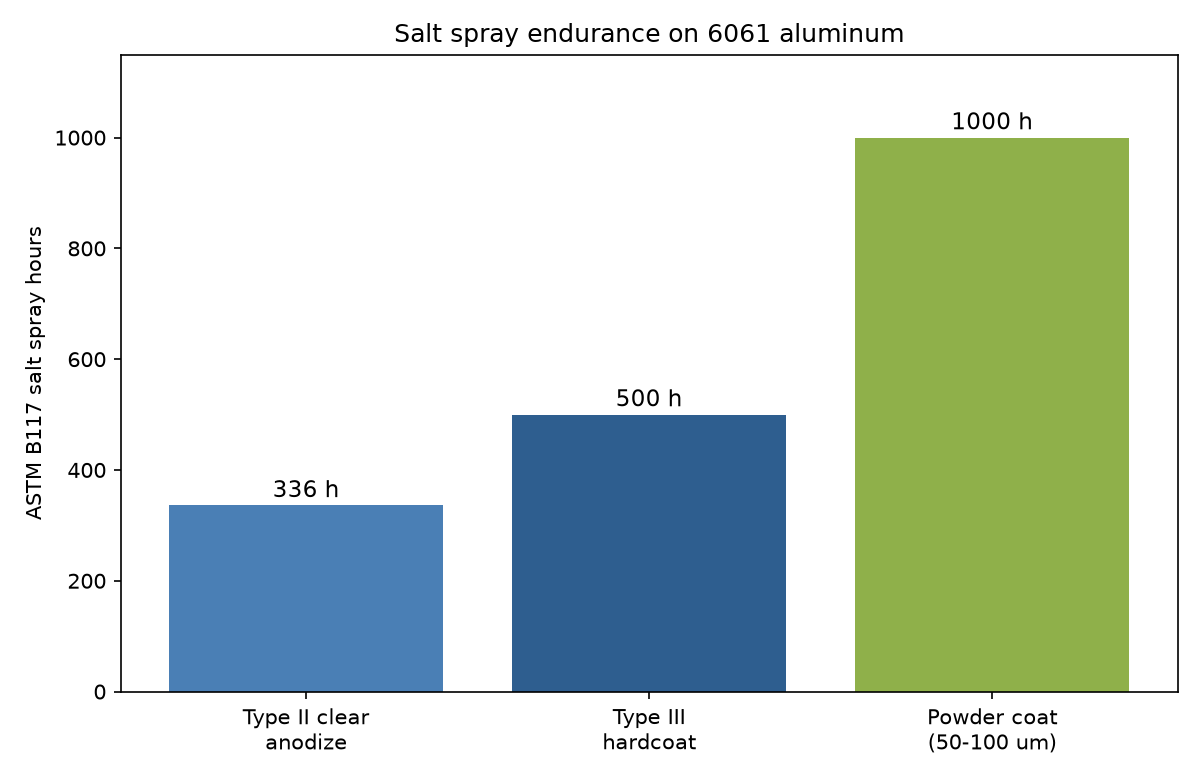
For outdoor exposure where the surface stays intact, powder wins on raw hours. For a sealed environment or a part that will be handled gently, clear anodize gives honest protection with a much thinner, harder layer. Neither approach protects a part that sits wet in contact with steel or brass fasteners. That is a galvanic problem no coating fully solves, and we cover it plainly in our FAQ.
Wear, hardness and edge coverage
Anodize is a ceramic, and hardcoat anodize is one of the hardest surfaces you can put on aluminum, around 400 to 500 HV. Sliding wear, abrasive dust, piston bores, guide rails: hardcoat belongs there. It holds tight edges well because the layer grows uniformly, including around sharp corners. What it does not like is impact. A hard anodized surface can crack under a point load, and on fatigue-critical aerospace parts we specify Type I chromic anodize precisely because its thin 0.5 to 1.2 mil layer costs the base metal almost no fatigue strength.
Powder coat is the softer but tougher option in the impact sense. A cured polyester film flexes and rebounds instead of cracking, and because it is sprayed and flowed, it wraps edges reasonably well and tolerates some surface texture. It abrades much faster than hardcoat, though. On a conveyor guide or a cam track I would never run powder. On an enclosure panel that gets bumped by forklifts, powder heals my nerves better than hardcoat does, because a cracked hardcoat edge is a stress riser I then have to explain to the customer.
Appearance and color control
Powder coat wins appearance decisions more often than not. The color palette is effectively unlimited, gloss and texture levels are easy to match across batches, and touch-up paint exists for nearly any RAL. If your product brand lives on a specific color, powder is the safer bet. Anodize dye chemistry is less forgiving. Dyed Type II parts vary between batches with alloy, bath temperature and seal quality, and there is no touch-up. I have had a customer reject a batch of black anodized housings against their master sample because our bath ran two degrees warm and the black went slightly brown. We re-ran it, but I remember the conversation.
Clear anodize has its own look, a matte metallic finish that reads as aluminum rather than paint. For industrial equipment and electronics housings where a raw-metal aesthetic matters, that look is the reason to specify anodize at all. There is also an honesty to it: what you see is the part, not a film hiding it.
Where each finish wins by application
My quick chooser, from jobs I have actually quoted:
- Sliding or abrasive wear on aluminum: Type III hardcoat. Nothing else comes close at the thickness.
- Outdoor enclosures, signage, architectural panels: powder coat over pretreatment. Longest salt spray life and best color control.
- Fatigue-limited or thin aerospace brackets: Type I chromic anodize, or Type II thin-film. I always ask about fatigue limits before quoting hardcoat.
- Electrical enclosures with internal grounds: anodize, masked at the ground pads. Masking is a solved problem, covered in the section below.
- Food equipment frames and industrial machinery guards: powder coat, smooth texture, easy to wipe down. On wet food contact parts we usually push the whole discussion to stainless and our food grade material options note.
- Small complex parts that come off our MIM or investment casting lines are usually stainless rather than aluminum, and for those the anodize question disappears. If the part is steel or 316L, the comparison that matters is which plating protects steel from rust.
One pattern I flag on drawings: parts anodized before being welded into a larger structure need the finish removed at the joint, and the joint area will not match afterward. That is not a defect, it is physics, but it surprises buyers every year.
Cost per part and lead time
Rough numbers from the quotes I write each month. Clear Type II anodize on small machined parts runs about $0.15 to $0.40 per square decimeter, and dyed colors add 10 to 20 percent. Hardcoat is thicker and slower, typically 1.5 to 2 times the Type II price. Powder coat lands near $0.20 to $0.50 per square decimeter for a standard color, with special colors and textures higher. Add a masking-heavy job or a two-coat system, e-coat under powder for the harshest outdoor duty, and the price index nearly doubles again.
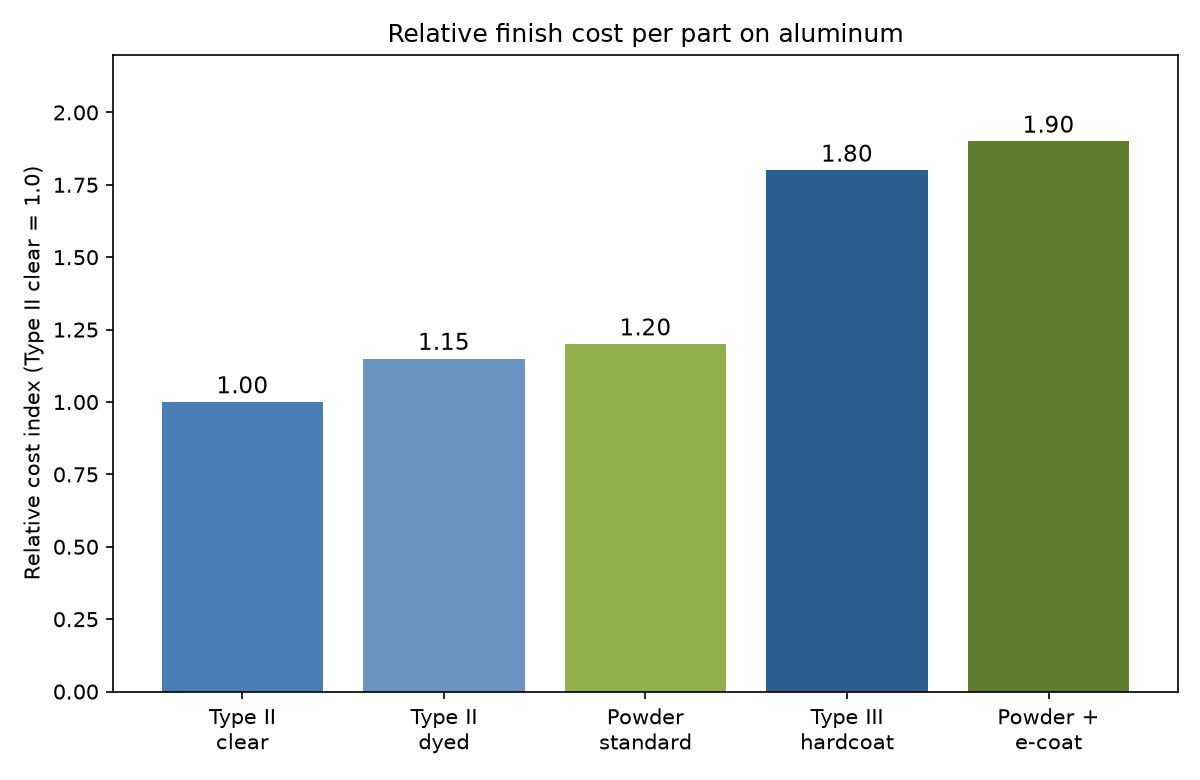
Lead time differences are modest but real. Anodizing lines run daily and small batches turn in 2 to 4 days. Powder coat with a standard color is similar, but a matched special color or textured powder can add a week for powder procurement. Volume pricing behaves the same way on both: racking density and line speed decide cost per part more than chemistry does. When a drawing arrives with five tight callouts and a finish we need to mask heavily, I quote the finish with the same care as the machining, because a $0.20 finish can quietly become a $0.80 finish on a feature-rich part. How we quote and what we check before committing is documented in how we work.
Masking, dimensions and conductive surfaces
Anodize is an electrical insulator, which surprises buyers the first time a ground strap will not conduct through it. Any area that must stay conductive, usually threaded holes, ground pads and O-ring seats, needs plugging before the bath. We mask with silicone caps and plugs, and on a part with a dozen features the masking labor can pass the chemistry cost. Dimensions matter too. The oxide layer grows about half outward, so a 25 micron Type II coat adds roughly 12 microns per surface, which matters on a press fit. Hardcoat adds more, up to 50 microns per surface at full thickness, and I ask for pre-coat machining dimensions when a bore tolerance is tighter than plus or minus 0.025 mm.
Powder coat adds its full 50 to 100 microns outward on every face, so assembly clearances and thread engagement need to account for it. Threads are almost always masked or chased after coating. The film also softens at high temperature, cured at around 180 to 200 degrees C as it is, so parts that run hot near the cure temperature need a different answer. On those jobs the honest comparison is sometimes not anodize versus powder at all but how the finish callout interacts with the surface roughness you specified, because both coatings follow the profile they land on and neither hides a sloppy machine finish.
So which do I pick? Wear and thin-section parts get anodized. Outdoor, cosmetic and high-salt-spray parts get powder. Everything else starts with the drawing, the assembly and the corrosion environment, and the answer falls out of those three. If you are staring at a drawing and the choice is not obvious, that is a normal place to be, and it is a better question to ask before the PO than after.
How much does anodizing or powder coating cost per part?
For small aluminum parts, clear Type II anodizing lands between $0.15 and $0.40 per square decimeter, and a standard color powder coat between $0.20 and $0.50. Setups and masking can double that on either process.
How long does each finish last in salt spray testing?
Clear Type II anodizing meets 336 hours in ASTM B117 salt spray on 6061. Sealed hardcoat reaches 500 hours or more. Powder coat over chromate or phosphate pretreatment routinely passes 1,000 hours.
Can you mask holes and threaded features on anodized parts?
Yes. We plug threaded holes and ground pads with silicone caps or masks before anodizing so those areas stay conductive and hold thread class. Powder coating can be masked the same way.
Which finish adds more dimensions to the part?
Anodizing grows about half into the metal and half outward, so a 25 micron coat adds roughly 12 microns per surface. Powder coat sits fully on top, so its full 50 to 100 micron thickness adds outward.
Can I use both anodizing and powder coating on one part?
Yes. A common stack for outdoor aluminum enclosures is Type II anodize under powder coat. The anodize seals the surface and the powder adds UV and impact resistance. It costs more, so we apply it where corrosion life matters.
Need Precision Metal Parts for Your Project?
Yujiaxin Tech specializes in MIM, CNC Machining, Powder Metallurgy, Investment Casting, and Gear Hobbing. Get a free quote within 24 hours.