I bought my first batch of brackets from a job shop in 1998 and half did not fit. The hole pattern was right. The face that bolted to the gearbox was not flat: the 6 mm plate had bowed 0.9 mm across 240 mm after the welds cooled. The shop built what the drawing showed, and the drawing said nothing about flatness.
Procuring custom brackets for industrial machinery is a drawing problem before it is a price problem. Write down the interfaces, the datum scheme and the annual volume, and most of the risk goes away before the first quote.
- What the drawing has to say before anyone quotes
- Pick the route from the load case and the annual quantity
- How the quote and the break-even volume work
- Tolerances worth paying for
- Inspection that catches the failures that happen
- Packing, marking and spares
- FAQ
What the drawing has to say before anyone quotes
A drawing that shows the outline and the hole positions is an invitation to rework. I want four things on it: mating faces, datum scheme, load case, finish. General tolerance blocks such as ISO 2768 m give plus or minus 0.2 mm at 120 mm and say nothing about flatness. Fine for a cable tray support, not for a motor mount that feeds vibration into a frame.
For a bracket bolted to a machined face I write flatness 0.15 mm over 300 mm, hole position within 0.10 mm, and perpendicularity 0.2 mm to the mounting face. Where a bearing sits in the bracket, the bore goes to 0.025 mm and true position to 0.05 mm at MMC. Those two lines decide whether the assembly bolts up first time.
Material callout matters as much: 6061-T6 plate for an anodized bracket, 316L sheet around conveyors, S355 plate for weldments that carry a motor. Put the temper and thickness on the drawing, because 6061-O and 6061-T6 behave differently. The 6061 aluminum page lists the tempers we stock and the flatness we hold after machining. The drawing mistakes in how to prepare CAD drawings for a CNC quote are the ones that cost a week.
Pick the route from the load case and the annual quantity
Four routes cover almost every industrial bracket: cut and formed plate, machined from solid, investment cast, metal injection molded. The right one depends on weight, wall thickness, load path and volume.
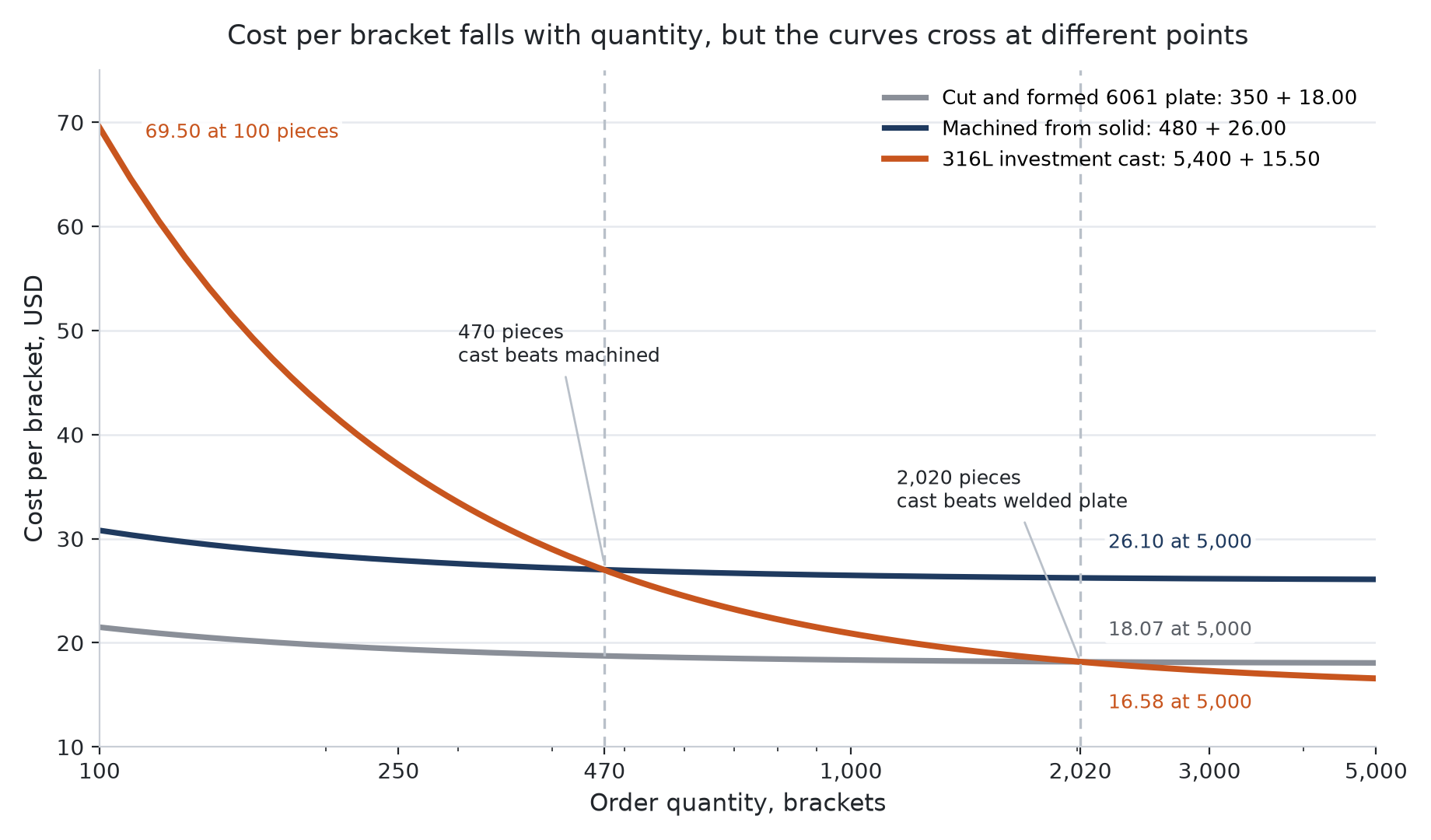
Laser cut and press brake from 6 mm 6061 plate suits a 1.2 kg guard or sensor mount. Setup is 350 to 600 dollars for a program and fixture, and the part lands at 18.00 dollars at 250 pieces.
Machining from solid gives 0.08 mm flatness and 0.05 mm hole position with no weld in the part. The same bracket costs 26.00 dollars at 250 pieces with 480 dollars of setup and 22 minutes on a three axis mill.
Investment casting in 316L needs 4,000 to 6,000 dollars of wax tooling and runs 15.50 a part at 1,000 pieces. A 300 mm casting holds 0.6 mm flatness as cast and takes a 1.5 mm wall.
MIM only makes sense below about 150 g and above 3,000 pieces a year. A 90 g stainless bracket with a deep boss is a good MIM part. Powder metallurgy sits between: pressing at 300 MPa, parts from 20 g to 500 g, a die good for 300,000 to 500,000 pieces.
How the quote and the break-even volume work
Ask a shop to split the unit price into material, run time and finish. On the 26.00 dollar bracket, material is 8.40: 1.35 kg of 6061 at 6.20 a kilo with 30 percent allowed for kerf and fixture. Run time is 22 minutes at 42 an hour, so 15.40. Anodize adds 1.20 and inspection adds 1.00.
Setup is 480 dollars and it is not padding: three hours of programming at 65, three and a half hours of fixture build at 60, and 75 dollars of first article. A shop quoting 150 dollars of setup either has the fixture already or has not thought about holding the part. I trust a quote that shows hours and a rate, not one that arrives as a single number with a date attached. Our CNC machining page shows how we structure that breakdown, and how to read a CNC quote without missing hidden fees covers the lines buyers misread.
Tooling is a loan you give the supplier, repaid in parts. The cast bracket needs 5,400 dollars of wax tooling. At 250 pieces a year the tool adds 21.60 to every bracket in year one and takes 6.8 years to pay back. The design will change first. At 2,000 a year it adds 2.70 and pays back in ten months.
The break-even volume that matters is total pieces, not pieces per year. Casting beats machining at 470 and welded plate at 2,020. Six hundred brackets a year for five years means casting wins in year two; two hundred a year on a machine due for redesign means stay with plate.
Tool life expectancy changes the arithmetic again. A wax die holds 50,000 shots before refurbishment, so a 4,000 a year program uses 8 percent of it in a decade. A MIM mold runs 300,000 to 1,000,000 shots. A powder metallurgy die runs 300,000 to 500,000 parts. In all three the tool outlives the product, which makes the design freeze the real cost, not the steel.
Tolerances worth paying for
Brackets are not precision parts. Plate thickness 0.3 mm, bend angle half a degree, hole position 0.10 mm and flatness 0.15 mm over 300 mm cover almost every industrial bracket I have quoted. A welded bracket moves 1.5 to 3 mm during welding unless it is fixture welded and stress relieved, and no callout changes that.
I will not pay for 0.05 mm on a bracket unless a bearing, a seal or a rail bears on it. When something does, I pay 4.50 a part for post-weld machining and get 0.15 mm flatness instead of sorting the lot by hand. The industrial machinery page lists the bracket families we build and the flatness each route holds.
Corrosion is simpler: 316L for washdown and caustic splash, 6061-T6 with clear anodize for machine frames, galvanized steel for outdoor skids. The 316L page covers passivation and salt spray.
Inspection that catches the failures that happen
Brackets fail in four ways: the hole pattern drifts, the mounting face is not flat after coating, a thread is too shallow, a weld undercuts at the toe. None of that shows up on a caliper check at the bench; it shows up at your assembly station three weeks later.
For an industrial bracket I ask for a dimensional report on 8 to 12 characteristics, a material certificate to EN 10204 3.1, and first article inspection on the first piece. Hole position goes on a CMM, flatness on a surface plate with a height gauge. Cpk 1.33 on hole position once the process runs, gauge repeatability under 10 percent.
The chart below compares a local machined bracket at 27.50 landed with two overseas casting options: one bought on price at 21.80, one with source inspection at 20.40. The gap is the rework allowance, 3.90 a bracket when 12 percent of a 1,000 piece lot arrives out of tolerance and each replacement costs 32.50 with air freight.
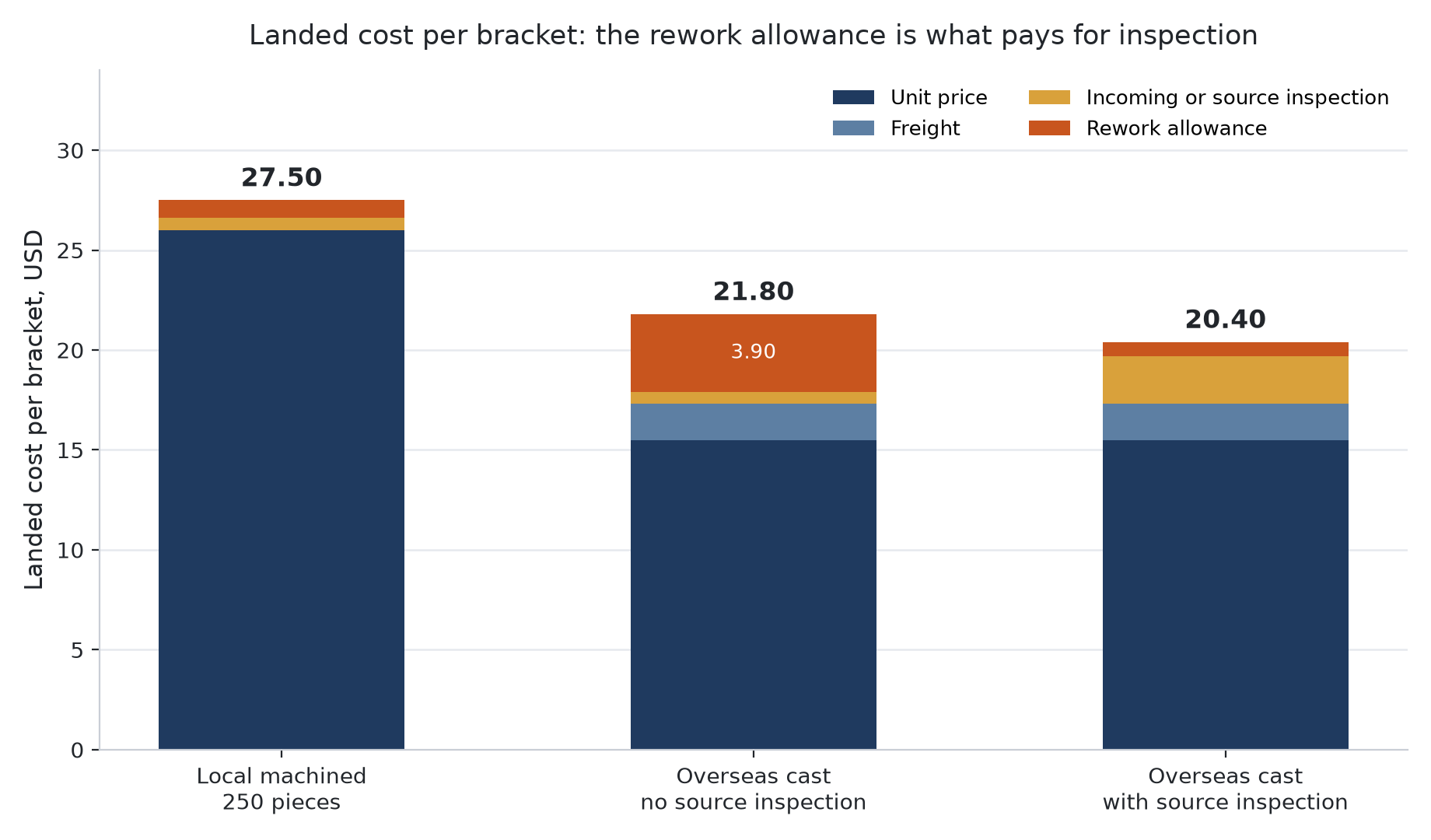
Source inspection costs 2.40 a part because 1,000 pieces get eight hours of checking at 300 dollars a day. The quality page lists what we measure by default, and how to verify dimensional inspection reports covers the numbers that are easy to fake.
Packing, marking and spares
A bracket is bulky and cheap per kilo, so freight eats margin. Twenty 1.2 kg brackets fill a 0.06 cubic metre carton at 26 kg gross. Consolidated LCL puts that carton near 36 dollars door to door once fixed fees are spread across the order, which is 1.80 a bracket.
Marking saves more than buyers expect. Part number, revision letter, lot and date on the carton, revision letter stamped on the bracket. I have seen 400 revision B brackets installed in a frame designed for revision C because the cartons were unmarked. The FAQ covers revision changes on an open order. Order 3 to 5 percent spares on the first lot, because a second run of 20 pieces costs more than 50 spares bought with the order. If the part is welded, keep the fixture for the life of the program.
A bracket program that runs well looks boring: one drawing that says what matters, one route chosen for total pieces, one first article signed before the lot ships. I have watched programs fail on all three, never on the price of the bracket.
FAQ
How much does a custom bracket cost per part?
For a 1.2 kg 6061 bracket, cut and formed plate runs 18.00 dollars at 250 pieces with 350 to 600 dollars of setup. Machined from solid it runs 26.00 with 480 dollars of setup. Investment cast 316L runs 15.50 at 1,000 pieces with 4,000 to 6,000 dollars of tooling.
What is a realistic break-even volume for a cast bracket?
With 5,400 dollars of wax tooling and a 10.50 dollar gap in unit price, casting beats machining at 470 pieces and welded plate at 2,020. Count total pieces over the program life, not pieces per year. A design change resets the tool.
What flatness can a welded bracket hold without machining?
A 300 mm welded steel bracket typically moves 1.5 to 3 mm unless it is fixture welded and stress relieved. Post-weld machining of the mounting face brings it to 0.15 mm for about 4.50 dollars a part, which is cheaper than sorting or shimming at assembly.
What is the minimum order quantity for custom brackets?
Machined brackets start at one piece. Cast brackets usually start at 250 to 500 because the wax tree has to justify a furnace run. MIM starts at 3,000 to 5,000. Powder metallurgy sits near 3,000 for a new die.
Which documents should ship with a bracket order?
A dimensional report on 8 to 12 characteristics, a material certificate to EN 10204 3.1, a first article report, a finish certificate for plating or anodize, and a packing list with part number, revision and lot on every carton.
Need Precision Metal Parts for Your Project?
Yujiaxin Tech specializes in MIM, CNC Machining, Powder Metallurgy, Investment Casting, and Gear Hobbing. Get a free quote within 24 hours.