A 0.5 module, 18 tooth pinion for a 12 V linear actuator weighs under two grams and sits on a fingertip. It also comes back from three suppliers at 0.55, 1.40 and 2.90 dollars, all quoting the same drawing. The spread is not greed. It is process choice, and most of the difference hides in tooling, tooth flank quality and how the teeth get measured.
I have quoted gears at this size since the late 1990s, first for printer mechanisms, now mostly for valve actuators, robot joints and pump drives. Here is how I compare those quotes.
In this guide
What an actuator gear train actually demands
A gear drawing lists module, tooth count, pressure angle and a tolerance block. It does not say the gear sits in a handset held to someone's ear, or in a valve that opens 40 times a shift for ten years. Those two duty cycles want different parts. Much of this work ends up in consumer and electronics products, where noise and cost carry equal weight.
For a consumer actuator I watch three things: noise at speed, backlash in the mesh, and flank wear after the rated cycle count. A 20 degree, module 0.5 spur pair running 3,000 rpm howls if backlash drops under 0.04 mm and rattles past 0.15 mm. On a molded or sintered gear the practical window is 0.05 to 0.12 mm, and holding it takes control of tooth thickness, not the outside diameter alone.
Industrial drives add load. A gearbox that sees 2.5 Nm at the output puts maybe 0.4 Nm on an 8 mm pinion, and root stress then matters more than profile grade. I have watched 316L pinions polish themselves smooth against a hardened steel mate in eight months, dimensionally perfect the whole time.
Gear quality is graded. AGMA 2015 and DIN 3962 both run from coarse to fine, and a small actuator gear normally lands at AGMA 8 to 9. Asking for AGMA 11 on a 2 mm face width buys grinding and a price that doubles. Hobbing reaches AGMA 9 to 10 in one pass on a part this size, which is one reason the process survives.
Hobbing, MIM or PM: which one fits your volume
Three processes cover small steel gears.
Cutting from bar is the flexible option. Setup runs about 480 dollars on a small hobbing machine, and the tool is a standard hob. Per part cost at 1,000 pieces is roughly 2.40 dollars for an 8 mm pinion with a reamed bore, and it falls as the batch grows. You get wrought density, a real bore, and a part you can span-check the same afternoon.
Powder metallurgy presses the tooth profile straight into the die, with no draft on the flanks and no secondary cut on the teeth. A two level die for a gear this size runs about 4,200 dollars and produces 300,000 to 500,000 parts before it needs work. Density lands at 7.0 to 7.2 g/cm3 against 7.85 for wrought 316L, tooth thickness holds about plus or minus 0.05 mm, and the bore usually needs sizing.
Metal injection molding is the tightest of the three on geometry. A two cavity tool at 7,500 dollars holds tooth thickness to plus or minus 0.03 mm and molds the hub, the gear and a mounting boss as one piece. Sintered density reaches 7.6 g/cm3 or better. The catch is gate placement. A gate on a tooth leaves a vestige that clicks once per revolution, and on an actuator held to the ear that click is the whole complaint.
I trust a hobbing quote more on the first 300 pieces, because a machine can be corrected in minutes. I trust MIM more on the thirty thousandth, because the cavity does not get tired. Between them sits PM, the process most buyers forget to ask about.
Tolerances worth putting on the drawing
A gear drawing that lists only tip diameter and bore size gives the supplier room to deliver a part that gauges well and whines. These are the callouts I want to see.
Tooth thickness measured as span over pins, with the pin diameter stated, because that number sets backlash. Bore at H7 with perpendicularity to the face of 0.02 mm. Total runout on the pitch circle of 0.03 mm. Tip diameter with a minus tolerance only, since a tip that runs large binds in the mating root. Profile grade to AGMA 9 or a composite double flank requirement, not both, because a supplier will pick whichever is easier to pass.
One caution that has cost me money. Do not copy an AGMA 10 callout onto a sintered or molded gear unless you have priced the 100 percent sorting that comes with it. On a molded part the cavity sets the profile and the profile does not drift, but the sintering shrink does. A 0.4 percent shrink variation on an 8 mm pitch diameter is 0.032 mm, which is most of your backlash budget already.
For prototypes, a machined blank with cut teeth gives you a metal gear in five days. If you are still choosing the module, the tradeoffs are in our module selection guide.
Material choice for a gear that runs all day
Most small actuator gears are ordered in 316L because it resists corrosion and passivates easily. It is also soft, around 200 HV annealed, and a poor choice for a loaded tooth pair that runs dry.
Where load and wear matter, 17-4PH at H900 gives 40 HRC and about three times the yield strength of annealed 316L. It costs more per kilo and adds a heat treat step, and it is still the cheaper answer over five years of field returns. For a gear that runs against a hardened steel mate at speed, M2 tool steel at 60 to 62 HRC is the wear answer, with one caveat: a hard thin tooth chips instead of bending. Pick your failure mode on purpose.
Density is the quiet variable on sintered and molded parts. Sintered 316L at 7.0 g/cm3 carries roughly 88 percent of wrought density, and fatigue strength at ten million cycles falls further, closer to 40 percent below wrought in bending. If the gear sees reversing load, that number belongs in the decision, not in a footnote. See our note on sintered versus machined stainless for the same tradeoff.
Tooling, cost per part and break-even volume
Quotes for the same pinion rarely arrive in comparable form. I put everything on one basis: total cost per good part including tooling, at the volume the buyer actually expects to order in a year. Here is that comparison for an 8 mm, 18 tooth, 0.5 module 316L pinion with a 3 mm bore.
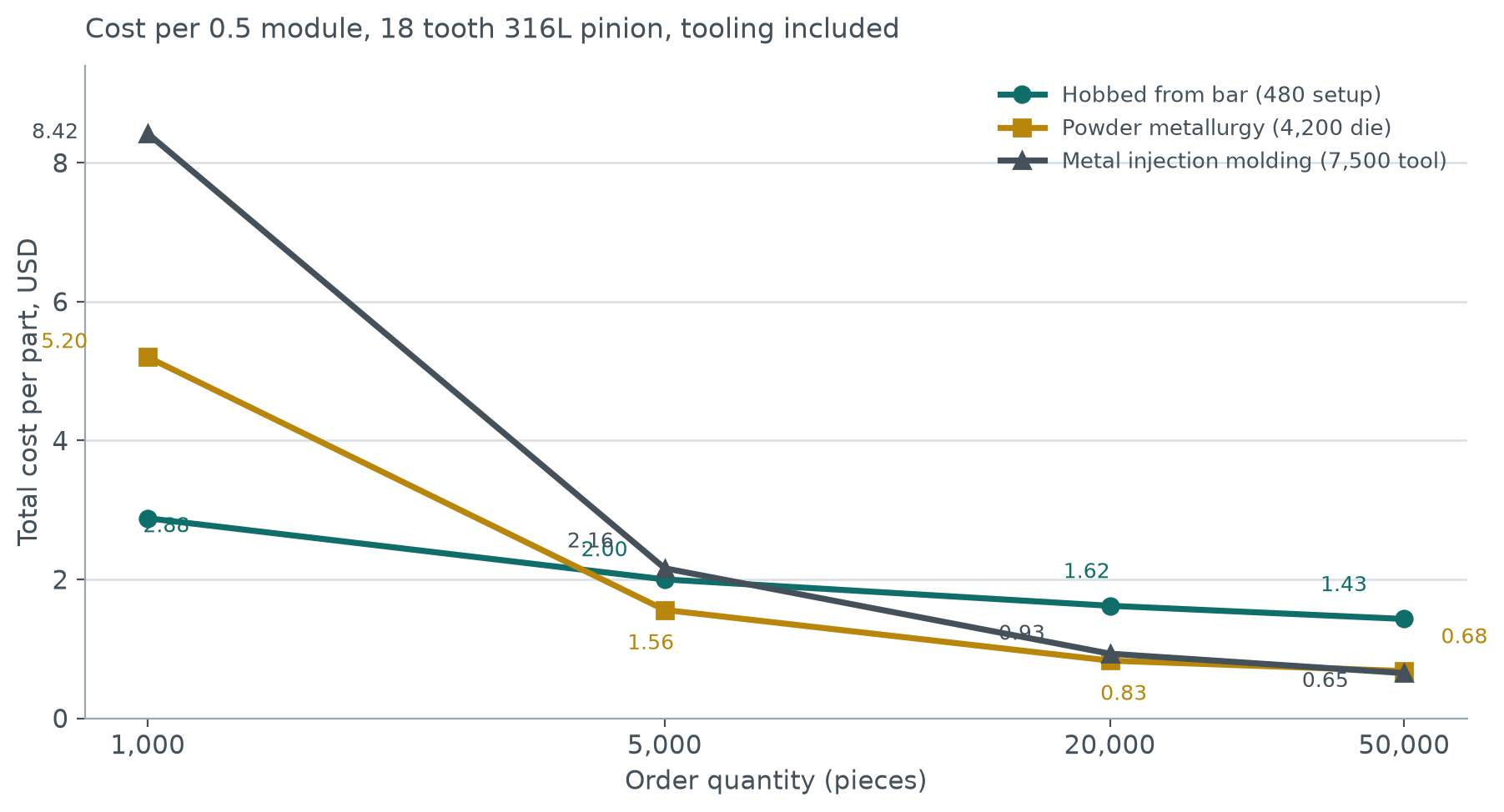
At 1,000 pieces hobbing wins by a wide margin, 2.88 dollars against 5.20 for PM and 8.42 for MIM, and that gap is tooling. At 5,000 pieces the order flips, with PM at 1.56 and hobbing at 2.00. Holding the 1,000 piece unit rates, the crossovers sit at about 2,650 pieces for PM against hobbing, 4,750 for MIM against hobbing, and 41,000 for MIM against PM.
Those break-even volumes move with part size, cavity count and secondary machining. A gear with a keyway and two cross holes can add 0.35 dollars of secondary work that erases the molding advantage until 20,000 pieces. If a supplier hands you a break-even without asking about your bore, the number is a guess.
Mold life expectancy belongs in the same calculation. A 4,200 dollar PM die over 350,000 parts adds 0.012 dollars per part. A 7,500 dollar MIM tool over 600,000 shots in two cavities adds 0.006. The driver is what happens at 80 percent of die life, when the tool needs refurbishment.
Inspection: what to ask for and what a missed batch costs
Gear inspection is where cheap quotes get expensive. Tip diameter rarely causes a failure, yet it is often the only thing measured. Ask for three things instead.
Span over pins on every lot, with actual numbers reported rather than a pass stamp. A composite double flank roll test on 12 pieces per lot, which catches profile and runout together. And a first article with a full layout, 12 pieces, reported against the drawing. For automotive programs this arrives as a PPAP level 3 package, and our quality system page lists what we hold.
Material certificates matter on a gear too. A 316L heat with high sulfur machines beautifully and welds badly. Ask for EN 10204 3.1 with the heat number tied to the lot, and check that the number prints on the bag label. The reading method is the same one in our note on verifying dimensional inspection reports.
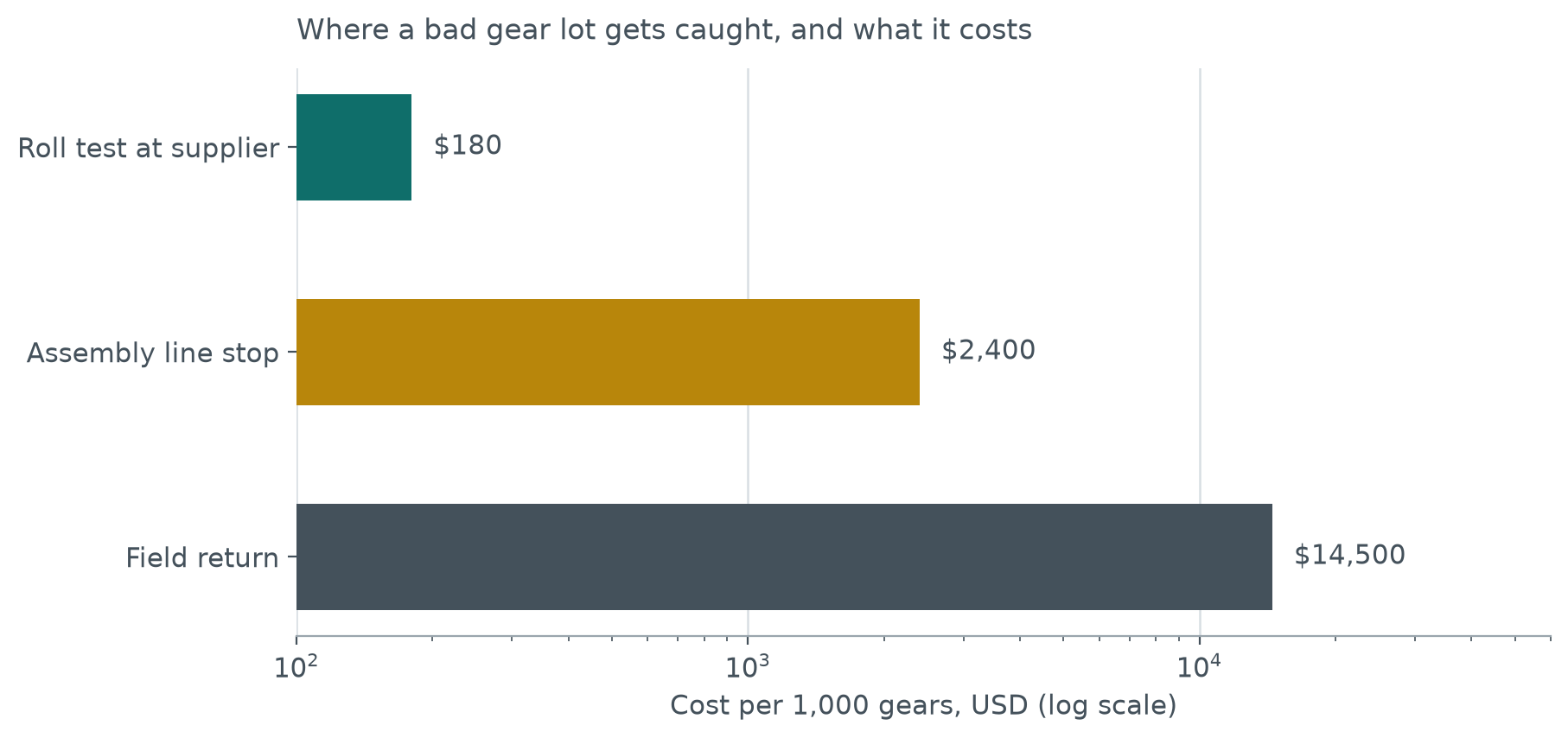
The three bars are what a bad gear lot costs per 1,000 pieces depending on where it is caught: 180 dollars at a roll test on the supplier floor, 2,400 at an assembly line stop, 14,500 at a field return with freight and a service visit. That is a 1 to 80 ratio, and it is why I will pay 0.03 dollars more per part for a supplier who reports span data on every lot. The math is not close.
A roll test needs a master gear matched to the module and pressure angle, and not every shop owns one for module 0.5. And a CMM report on a 2 mm face width gear is close to useless for profile, because the stylus cannot reach the root fillet. On small gears the roll test is the honest measurement, and CMM work belongs on the hub and bore, not the flanks.
Questions buyers ask before the first order
What does a small gear cost per part at 5,000 pieces?
For an 8 mm, 18 tooth, 0.5 module 316L pinion, total cost per part including tooling runs about 1.56 dollars in powder metallurgy, 2.00 hobbed from bar, and 2.16 in metal injection molding. Below roughly 2,650 pieces, hobbing wins because it carries no dedicated tool.
What tooth thickness tolerance can I expect?
Plus or minus 0.03 mm on a MIM gear, plus or minus 0.02 mm hobbed, and plus or minus 0.05 mm on a sintered gear before sizing. If backlash is critical, control tooth thickness over pins and state the pin diameter on the drawing.
What is the mold life expectancy for a MIM gear tool?
A P20 or similar tool steel cavity for a small gear typically runs 300,000 to 500,000 shots before refurbishment. With two cavities that is 600,000 to 1,000,000 parts. Amortized over that life, a 7,500 dollar tool adds roughly 0.006 to 0.012 dollars per part.
Is a molded gear as strong as a machined one?
Not quite. Sintered density at 7.6 g/cm3 is about 97 percent of wrought, and fatigue strength in bending at ten million cycles runs roughly 15 percent lower. Static torque capacity is close. If the gear sees reversing load or shock, step up to 17-4PH H900 or thicken the tooth root.
How long does tooling take before production?
MIM tooling takes 18 to 25 working days, a PM die 20 to 30, and hobbing needs 3 to 5 days of programming and setup with no tool build at all. Add 5 to 8 days for a first article on the molded routes. Our process page shows where those days land, and the FAQ covers first order questions.
Need Precision Metal Parts for Your Project?
Yujiaxin Tech specializes in MIM, CNC Machining, Powder Metallurgy, Investment Casting, and Gear Hobbing. Get a free quote within 24 hours.