Most shops that quote your machined part do not own a heat treat furnace. They send the lot down the road, wait three days, and hand back a certificate with a company name you have never seen. In the Pearl River Delta that is closer to the rule than the exception. Of the shops I have walked through since 1998, about seven in ten subcontract the hardening and do the tempering themselves, if they do anything at all.
None of that is a scandal. What is a scandal is a supplier who says "we do everything in house" and then cannot show you the furnace, the load card, or the hardness bench. I have watched a buyer pay for 40 HRC on 17-4PH and receive 32, which is the difference between a hinge pin that lasts a season and one that bends in the press.
In this guide
- Three versions of in house
- What the answer does to your price and your risk
- Five documents that prove a furnace exists
- Six questions for a video call
- Sequence, distortion, and why the grind comes last
- When outsourced is the better answer
- Red flags I look for in a certificate
- What to write into the purchase order
- Frequently asked questions
Three versions of in house
The first version is a real heat treat department: vacuum furnaces on site, an oil quench line, its own pyrometry program, a bench tester with certified blocks. The second is a tempering oven and a stress relief pit, with austenitizing bought outside. The third is a broker with a phone number.
The second version is common and can be good. Hardening a 4140 section properly needs a quench press, agitated oil, and a pyrometry program somebody maintains. A shop with 40 employees can justify tempering and not austenitizing, and pretending otherwise is how you get a furnace running without calibration.
Sintering is not heat treatment. A sintering furnace runs at 1,300 to 1,400 C in hydrogen or vacuum to densify a molded part, so a MIM shop that sinters in house may still send aging out. The metal injection molding page covers that route.
What the answer does to your price and your risk
Two costs hide behind the phrase we send it out. Freight both ways, at 80 to 200 dollars each way on a 400 kg lot. And a lot charge, usually 150 to 250 dollars minimum.
Then the clock. An in-house run on a Tuesday ships Wednesday. Subcontracted work queues, runs Thursday, comes back Friday, and the grind starts Monday. Three extra days in a good week, eight in a bad one.
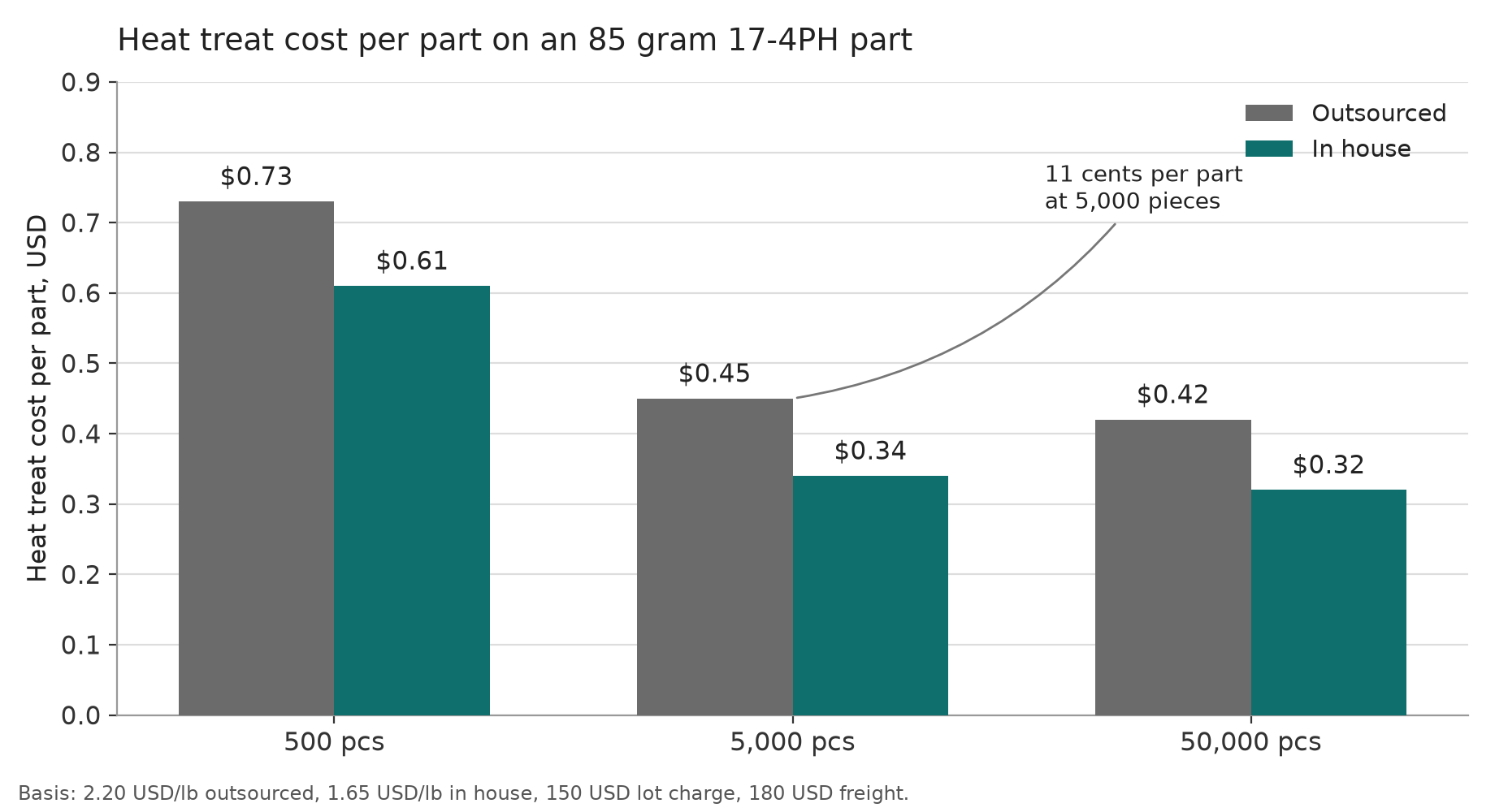
| Lot size | Outsourced, per part | In house, per part |
|---|---|---|
| 500 pieces | $0.73 | $0.61 |
| 5,000 pieces | $0.45 | $0.34 |
| 50,000 pieces | $0.42 | $0.32 |
Figures assume an 85 gram 17-4PH part, 2.20 dollars per pound subcontracted against 1.65 in house, a 150 dollar lot charge, and 180 dollars of freight. At 5,000 pieces the gap is 11 cents a part, about 20 percent of the line.
The number that should worry you is 14,000 dollars, which is what a 5,000 piece lot at 2.80 dollars costs when it comes back soft. That material and machine time sits in a furnace you have never seen.
Five documents that prove a furnace exists
I ask for these before I ask for a price. A shop with a real heat treat department produces them in an hour. A shop without one sends a certificate and changes the subject. I have never lost a supplier worth keeping by asking.
- A furnace load card from a comparable run, with part numbers, cycle, date, and thermocouple positions. A filled one, not a blank template.
- A temperature uniformity survey within the past twelve months, run to AMS 2750. Class 2 holds plus or minus 5.5 C across the working zone; Class 4 allows 14 C. Both are legal, only one suits a part with a 0.05 mm bore position.
- Pyrometry records for instruments and thermocouples, including system accuracy tests. A furnace with no SAT history is a furnace nobody is watching.
- A hardness report from a bench Rockwell tester to ASTM E18, three readings minimum, test block ID and calibration date on the sheet. A Leeb or UCI portable tester screens; it is not acceptance evidence on a 3 mm wall.
- A CQI-9 assessment for automotive work, or Nadcap heat treating accreditation for aerospace. Both are audited and both expire.
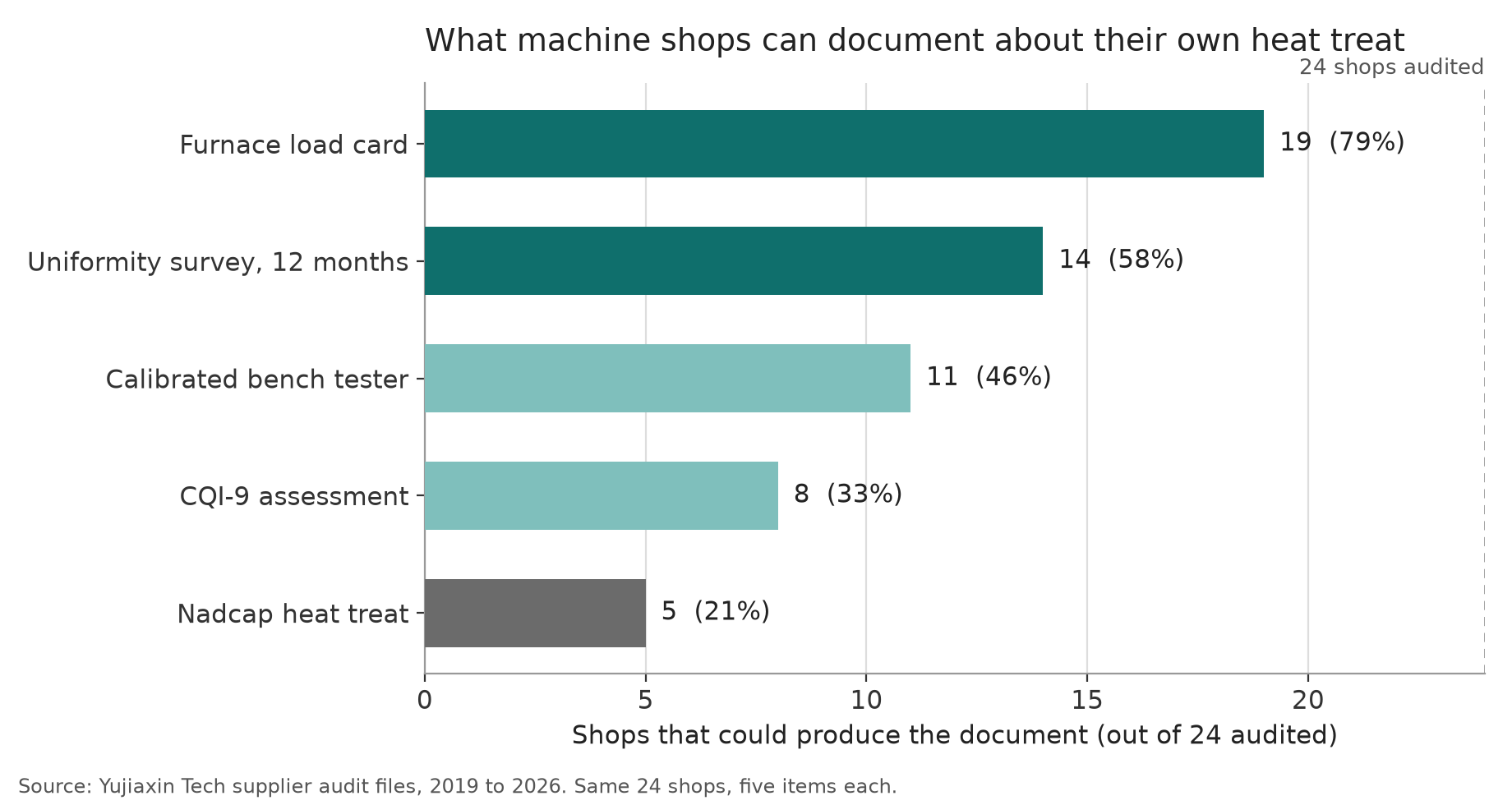
My own figures, from audits since 2019. Nineteen of 24 shops produced a load card, 14 had a survey from the past twelve months, 11 could show a calibrated bench tester, 8 held a CQI-9 assessment, and 5 held Nadcap for heat treating. A shop that owns a furnace and cannot document it is nearly as risky as one that owns nothing, because the paperwork proves the cycle ran on your parts and not someone else's.
Six questions for a video call
Photos prove nothing. Fifteen minutes with the furnace in the frame proves plenty.
- Which furnace, and what is inside it? Vacuum at 10-2 to 10-4 torr behaves differently from an endothermic atmosphere.
- Where does the load thermocouple sit, in the hot zone or in the wall? A control couple near the elements reads 20 C above the load.
- What is the quench, and how is it agitated? Oil at 40 to 60 C, polymer, or 2 to 6 bar nitrogen. Weak agitation leaves soft spots you find at the grinder.
- Who signs the cycle chart, and can I see one for an aging run at 480 C?
- How are 4140 and 316L loads separated? Mixing happens at the loading dock, not in the furnace.
- Who tests hardness, with what instrument, at what location on the part?
Sequence, distortion, and why the grind comes last
17-4PH arrives solution annealed at 1,040 C and takes its strength from aging. H900 is one hour at 480 C, which lands 40 to 47 HRC, usually 44. H1150 is four hours at 620 C, which lands 28 to 38 HRC, usually 33. A drawing that says 17-4PH without a condition will produce an argument at first article. The condition table is in the 17-4PH heat treatment guide.
4140 through hardens at 845 to 870 C in oil, then tempers between 540 and 650 C for 28 to 32 HRC. A 300 mm shaft moves 0.05 to 0.15 mm in the quench, which is physics rather than a defect. That is why the grind allowance is 0.3 to 0.5 mm, and why grinding follows the furnace and never the other way round.
316L cannot be hardened by heat treatment at all. Solution annealing at 1,040 to 1,120 C followed by a water quench restores corrosion resistance after welding or heavy cold work, and does not raise hardness. If a quote promises 316L at 40 HRC, the shop is carburizing it, which ties up free chromium as carbide and turns a corrosion resistant part into a rusting one, or the shop is guessing. Both answers end in a salt spray claim. The 316L material page has the annealed properties, and the sintered versus machined comparison covers what happens before any furnace touches the alloy.
When outsourced is the better answer
Commodity parts, a hardness range instead of a single value, no thin walls, no bearing bores to hold. A shop that sends those out and says so is doing you a favor.
What matters is who owns the nonconformance. If the subcontractor runs 20 C cold and the parts come back at 36 HRC, does your supplier scrap the lot or forward the bill? I trust the shop that names its heat treater in the quote. I trust the one claiming everything happens under one roof a lot less, because that sentence is usually about marketing. The how we work page shows where the furnace step sits in a routing.
Red flags I look for in a certificate
A certificate carrying another company's name when the quote never mentioned a subcontractor. Sometimes that is honest sourcing. Sometimes it is a 12 percent margin and an operator nobody has met.
Hardness readings that match the mill certificate typical values to the digit. A mill ships 17-4PH at a typical 33 HRC in H1150. A treater reporting exactly 33.0 at three points did not test three points.
A single hardness figure with no method, location, or date. A zero dollar heat treat line on a part that must be hardened. A certificate dated after the ship date. Or 316L listed at 45 HRC, which cannot happen without carburizing.
Stack those against a dimensional report and the story holds together or falls apart in ten minutes. The inspection report guide covers the dimensional half, and the supplier qualification walkthrough puts it on one timeline.
What to write into the purchase order
Six clauses that cost nothing today and settle an argument in six months.
- Material and condition: 17-4PH per AMS 5643, solution annealed, aged to H900.
- Final hardness with method and location: 40 to 47 HRC, ASTM E18, three readings at mid-section.
- Evidence with each lot: load card copy, current uniformity survey, hardness report with test block ID.
- No change of heat treater without written approval.
- One re-age allowed. No re-austenitize without a deviation.
- Certificate per EN 10204 3.1, tied to the heat number on the mill certificate.
Our quality page lists what travels with a hardened lot. An automotive program usually adds a CQI-9 copy and a PPAP element on hardness, while aerospace wants the Nadcap scope and a certificate of conformance naming the pyrometry class. On castings, furnace work often starts with stress relief, which is an investment casting question; on machined parts it falls between roughing and grinding, a CNC machining routing question. Tooling at 58 to 62 HRC is covered on the M2 tool steel page.
Frequently asked questions
How much does outsourced heat treatment cost per pound?
Vacuum work runs 1.50 to 3.00 dollars per pound in southern China, plus a 150 to 250 dollar lot charge and 80 to 200 dollars of freight each way. On an 85 gram part at 5,000 pieces that lands near 45 cents per part.
What is a normal heat treat lead time?
Three to five working days inside a subcontractor, plus two days of transit each way. An in-house run ships in one or two days. Add a week if the lot fails hardness and needs a re-age.
Can a supplier hit 40 HRC on 17-4PH without owning a furnace?
Yes, and many do. Aging to H900 is a one hour cycle at 480 C that a subcontractor runs every day. The supplier still owns the sequence and the acceptance test.
What hardness can 316L reach after heat treatment?
None. 316L is austenitic and work hardens only. Solution annealing restores corrosion resistance, not strength. A 316L part at 40 HRC has been carburized or mislabeled.
Does hardness have to be tested on the part itself?
On a section thick enough for a valid Rockwell reading, yes. Below roughly 1.5 mm, use a coupon from the same load or a Vickers test at HV1. A bench tester on a 0.8 mm wall measures the anvil.
Need Precision Metal Parts for Your Project?
Yujiaxin Tech specializes in MIM, CNC Machining, Powder Metallurgy, Investment Casting, and Gear Hobbing. Get a free quote within 24 hours.