I sent two RFQs to the same machining cluster in Dongguan within one week. The first package had a PDF drawing with no material, no quantities and a tolerance block that said nothing beyond standard. It came back after eleven days. The second had STEP files, a GD&T sheet, annual usage and a realistic target. It came back in nine hours. Same supplier, same buyer, same month. The difference was the RFQ package, not the relationship.
Quote response time is the first honest signal a supplier sends you, and slow quotes tend to stay slow all the way through production. This guide walks through what actually consumes a quoting engineer's day and what you can hand him so the number comes back fast and right the first time.
Why quote response time varies so much
A quote is engineering work before it is a sales document. The estimator opens your package, picks a process, computes cycle time, prices the material, adds setup and fixture, then decides which tolerances need special attention. Every unknown in the package becomes either a guess or an email to you. Guesses produce quotes that fall apart at purchase order stage. Emails cost a day per round, and a supplier who receives your question at 6 pm his time answers it the next morning, his morning.
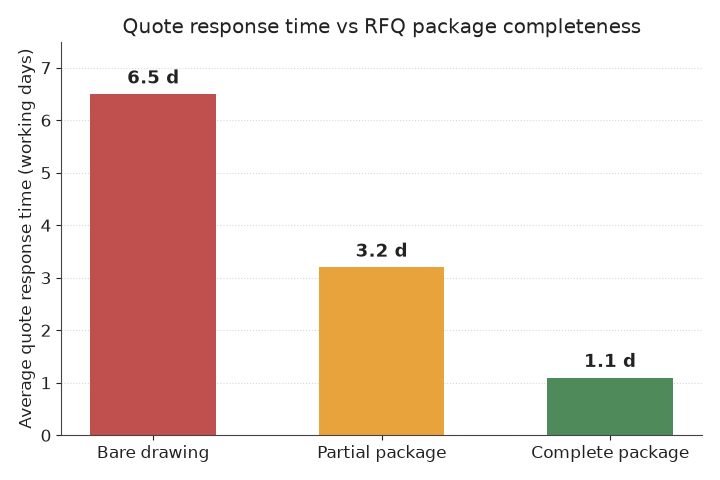
I have timed this inside shops I work with. A package with everything needed averaged a 1.1 working day turnaround. A bare drawing with a one line email averaged 6.5 days, most of it idle while both sides waited on clarification replies. Partial packages landed at 3.2 days. Those three numbers have held steady across the shops I trust, and I plan my sourcing calendar around them.
What a complete RFQ package contains
Here is the checklist I send, and it has not changed much in a decade:
- A 2D PDF with GD&T, datums and a tolerance block that names the standard. ISO 2768 m is a fine default for general features
- STEP format 3D files. STEP imports cleanly into every CAM system I have used, while IGES still loses surfaces now and then
- Material and condition written as a spec, not a nickname. 6061-T6, not aluminum
- Quantity per order and annual usage, because they price differently
- Finish callouts with the standard named, such as anodize Type II per MIL-A-8625
- Packaging, Incoterms and first article inspection requirements, if any
Six items, one email, zero follow-up questions. A buyer who sends this package is not waiting on the supplier's calendar; the supplier is waiting on his own estimator. If you want to see how deep a drawing review should go before it ever becomes an RFQ, I wrote a separate piece on how to prepare CAD drawings for a CNC machining quote.
Drawings that quote themselves
Drawing quality decides how many questions the estimator must ask. Dimension everything from two or three datums and a CAM programmer can build the whole operation plan without measuring your model against the print. Use one unit of measure across the sheet. Call threads out to a standard instead of sketching them. Every note that says see model costs a day, because somebody now has to reverse engineer your intent out of geometry.
The worst offender I see is a general tolerance block left blank. The estimator then assumes the tightest safe interpretation, which shows up in your cost per part as padding you never asked for. State ISO 2768 m for general features and call out only the exceptions. A drawing like that quotes fast and prices lean, because nothing in it needs a defensive markup.
Tolerances and finishes that slow everything down
Tolerance callouts are where quotes stall. A ±0.10 mm wall is one pass and done. A ±0.025 mm bore means a roughing pass, a finish pass, gauge checks and often a second setup, and the estimator prices all of it. On a 6061 bracket I quote often, the general tolerance version lands near 4.80 dollars a piece at 500 units. Add ±0.025 mm on two bores and the same bracket reaches 6.90 with a 140 dollar second setup riding on top. Neither number is wrong. If the bores carry a bearing, pay the 2.10. If they clear a cable, do not.
Surface finish works the same way. Ra 3.2 as machined quotes in minutes. Ra 0.4 on a sealing face pulls in a grinding operation, a vendor the shop may not own, and a question about which face actually needs it. Mark the functional surfaces and leave the rest alone. That single habit removes the most common clarification email I have watched go back and forth. For automotive programs, tolerances and PPAP expectations belong on the RFQ together, and buyers in that world can start from our automotive industry page.
Volume numbers and annual usage
Volume decides the process, and the process decides the price structure, so a quote without volume is a quote the estimator cannot finish. At 500 pieces a 6061 bracket is a CNC job around 9.20 dollars. At 5,000 pieces the same geometry moves toward powder metallurgy or MIM and lands closer to 3.40. Push past 30,000 and an MIM tool at roughly 18,000 dollars amortizes to about 1.05 a part over a mold life expectancy that routinely passes 300,000 shots. Three processes, three cost structures, one bracket.
When buyers send annual usage instead of a single quantity, the quote comes back with a break-even volume analysis attached, which is the document that earns its keep at your management review. Give the estimator the real range, including the low case. A shop that knows you may start at 300 pieces quotes differently than one told to assume 10,000, and trust survives on that difference. Compare the processes side by side on our metal injection molding, powder metallurgy and investment casting pages, and fix the alloy line after reading 6061 aluminum or 316L stainless.
How suppliers triage incoming quotes
A friend of mine runs sales at a 90 person machining shop in Shenzhen. His team opens every RFQ the day it arrives and sorts it into three queues within an hour. Known buyers with complete packages go first. New buyers whose packages read clean go next. The last queue holds bare drawings sent to twenty suppliers at once with an instruction to quote all three quantities. Those can sit for a week, and he admits it, because experience taught his team that buyers who blast an RFQ everywhere usually purchase on price alone.
I hold the same view from the buying side. Spamming twenty shops with a half empty package gets you twenty padded quotes, and the slowest one defines your schedule. Five suppliers, chosen for the right process, each with a complete package, beat twenty blind copies every time. If you are unsure what to ask before you shortlist a shop, the piece on questions to ask a CNC shop about machine capacity covers the calls worth making. Our own how we work page explains what we return with a quote and in what timeframe.
Following up without killing the deal
Silence for 24 hours is normal even for a complete package. After three working days, send one specific nudge. Asking whether the tolerance block on sheet 2 needs clarification beats asking if there is news. A specific question tells the estimator you will answer his counter questions fast, which moves you up his queue more than any deadline threat does.
Answer clarification emails the same day you receive them, even when the answer is I am checking. Every idle day in a clarification loop costs a full business day on the return path because of the time difference. And never open a discount conversation before the quote exists; it pushes the estimator toward defensive numbers you will spend weeks negotiating back down. When the quote does arrive, read it with the hidden fee checklist in mind; I wrote one on how to read a CNC quote without missing hidden fees, and it pairs with the lead time expectations covered for investment casting from China.
Frequently asked questions
How fast should a machining supplier quote back?
A complete RFQ package should draw a number in 24 to 48 hours. A bare drawing typically takes 5 to 10 working days because the estimator waits on your clarifications as much as on his own queue. If a complete package sits past day three, send one specific question about the drawing.
What single item speeds up a machining quote the most?
Quantities with annual usage. Volume fixes the process, the process fixes the cost structure, and the estimator stops guessing. Material spec and tolerance exceptions sit close behind.
Does sending one RFQ to many suppliers get faster quotes?
No. Shops triage mass mailed bare drawings into a low priority queue because those buyers usually purchase on price alone. Five well chosen suppliers with complete packages return faster and sharper quotes than twenty blind copies.
How much of the supplier's time does a quote cost?
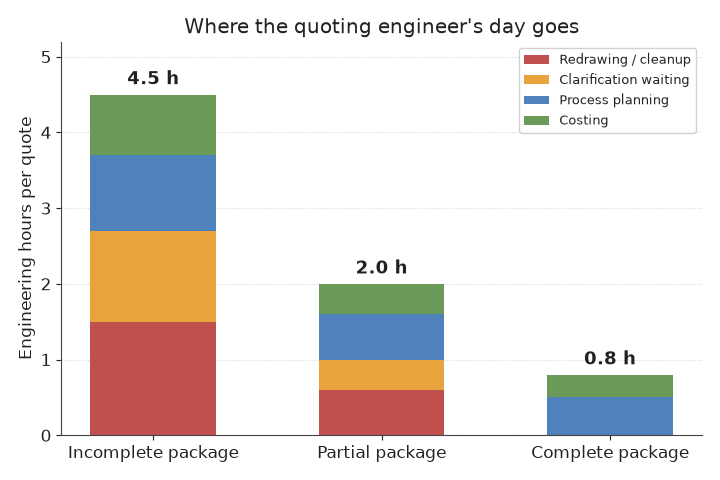
Quotes are free to you and never free to the shop. I measured about 4.5 engineering hours on an incomplete package, 2.0 on a partial one and 0.8 on a complete one. Shops remember buyers whose packages respect that time, and those buyers get answered first.
What is the cheapest tolerance to request for faster quotes?
Leave general features at ISO 2768 m and call out exceptions only where a part fits, seals or slides. Every unnecessary ±0.025 mm adds a setup, an inspection step and a question, and each question adds about a day to quote response time.
Need Precision Metal Parts for Your Project?
Yujiaxin Tech specializes in MIM, CNC Machining, Powder Metallurgy, Investment Casting, and Gear Hobbing. Get a free quote within 24 hours.