The first fitness band housing I quoted was a 6061 aluminum shell with a hardcoat finish. It looked fine on the drawing and failed in the field inside four months, when sweat crept under the coating at the charge contact edge and lifted it. That failure still shapes the questions I ask a new buyer.
A wearable housing answers to two masters: the seal that keeps water out, and the skin it rests against most of the day. Retail appearance and cost per part pile on top. Buyers get into trouble when they shop for a look first and find out later what the material does against sweat. Start at the material, and the rest gets easier.
- Why wearable enclosures are a different sourcing problem
- Pick the material before the process
- Match the process to volume and wall thickness
- Tolerances, finish and the seal interface
- Skin contact, sweat and corrosion testing
- What a housing quote needs before you commit
- Qualifying the supplier and the first article
- FAQ
Why wearable enclosures are a different sourcing problem
An internal bracket can sit 0.1 mm off and still assemble. A housing cannot. The part a customer touches carries constraints the rest of the assembly does not: a groove that compresses an O-ring by 15 to 25 percent, a surface that passes a cosmetic standard under retail lighting, and edges that stay smooth after thousands of wrist flexes.
Size works against you too. A 40 mm watch housing in 316L runs 28 to 35 grams after machining, so a wall at 1.2 mm is carrying structure, not decoration. Thin it to 0.8 mm to save weight and it flexes during polishing, and a part that flexes does not hold a flat seal. I have watched that trade go wrong twice, and both times the fix was adding material back.
Volume changes the answer as well. Buyers in the electronics industry rarely ask for 500 housings. They ask for 50,000, and again next quarter. That forecast is what puts tooling on the table.
Pick the material before the process
Engineers send me drawings with a process already picked, and I start by asking what the material has to do against skin. Four candidates come up in almost every program.
316L is my default for anything worn for hours a day. Nickel release under EN 1811 stays below the 0.2 microgram per square centimeter per week limit once the part is passivated, and it polishes to Ra 0.2 to 0.4 micrometers without a coating that can chip. 316L stainless steel is dense at 8.0 grams per cubic centimeter, so a full size housing gets heavy.
Ti-6Al-4V answers the weight problem. At 4.43 grams per cubic centimeter it is roughly 45 percent lighter, it is inert against skin, and it takes a clean bead blast. I also watch buyers flinch when the cost lands at 2.3 times the 316L price, and I warn them that Ti-6Al-4V machines slowly, so cycle time adds to that multiplier.
Aluminum 6061 is the cheapest and lightest of the group, and the one I argue about most. Hardcoat anodizing gives a hard, dyeable surface, but the layer is brittle at edges and sweat finds its way under a chipped edge in weeks. For a housing worn on skin, I have turned this option down more than once. It is fine for a buckle that touches fabric. Aluminum 6061 earns its place in wearables, just not where I see it used most often.
17-4PH matters because it is the standard feedstock for small metal injection molding hardware, reaching 40 to 45 HRC in H900 condition. Corrosion resistance sits below 316L, so passivation is not optional, and I have seen 17-4PH stain in sweat tests where 316L stayed clean.
Match the process to volume and wall thickness
Process choice follows material and volume, and the break-even volumes are not what most buyers guess. The arithmetic below is for a 316L housing about 38 mm across and 9 mm deep, with two seal grooves and four threaded bosses.
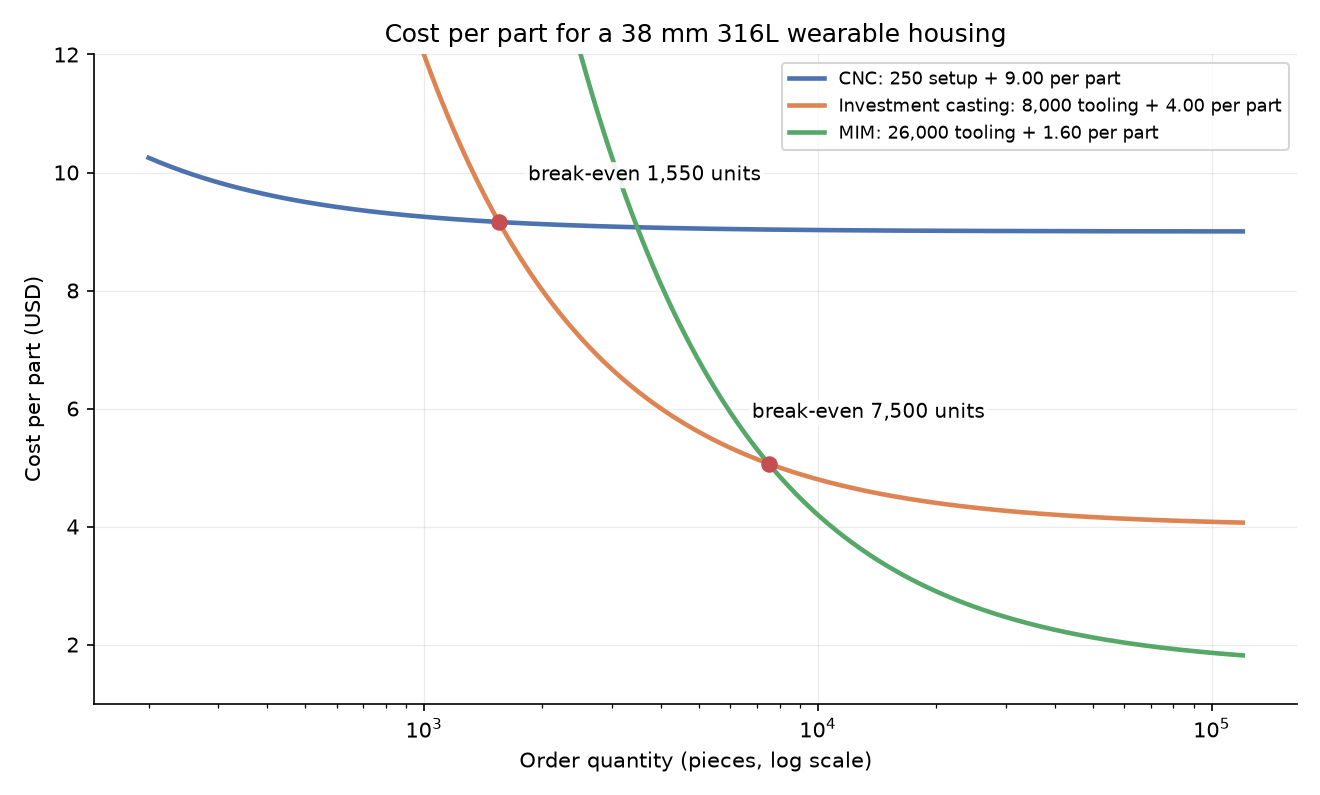
CNC machining carries a 250 dollar setup and 9.00 dollars per part. No tooling, samples in seven days, and the right answer up to about 1,500 pieces.
Investment casting needs 8,000 dollars of tooling and lands near 4.00 dollars per part, with a 1.5 mm minimum wall that needs a light polish before it looks like a retail part.
MIM asks 26,000 dollars for the tool and delivers 1.60 dollars per part, with walls down to 0.3 mm and near-net features that skip several machining passes. The tooling buys a mold life expectancy of 200,000 to 300,000 shots. Our pages on investment casting and CNC machining carry the detail.
Figure 1 puts the three routes on one chart. Below 1,550 units machining is cheapest, casting takes over from 1,550 to 7,500, and above 7,500 MIM wins with the gap widening on every order. At 5,000 units a year, the tool pays for itself inside twelve months.
Ceramic deserves a mention for bezels. Ceramic injection molding in zirconia gives a scratch resistance that metal cannot match.
Tolerances, finish and the seal interface
The seal groove is where a housing program succeeds or fails. A radial O-ring groove wants plus or minus 0.03 mm on width and depth, roughness at Ra 0.8 micrometers or better on the sealing faces, and 15 to 25 percent compression on the ring. Miss one and the IP68 claim on your spec sheet is fiction.
I ask for Cpk 1.33 on groove width before I believe a process holds it, and I want the study run on production parts rather than on samples picked for the first article. Machined housings meet this easily. Cast housings meet it after a machining pass across the groove, and that pass is the line item that eats the casting cost advantage on a small shell.
Cosmetic standard comes next. A brushed directional finish hides handling marks and costs less than a mirror polish. Polishing a curved housing to Ra 0.2 micrometers is hand work at 1.20 to 2.50 dollars a part, and yield drops when an inspector rejects a hairline. Our roughness callout guide covers the language, and the bracket tolerance guide explains what each process holds.
Skin contact, sweat and corrosion testing
Sweat is a mild acid with salt in it, and it sits on the housing most of the day. Artificial sweat testing to ISO 3160-2 is the screen I rely on, and I ask for the report before tooling starts. Figure 2 shows what we measured on the four candidates next to their relative cost index.
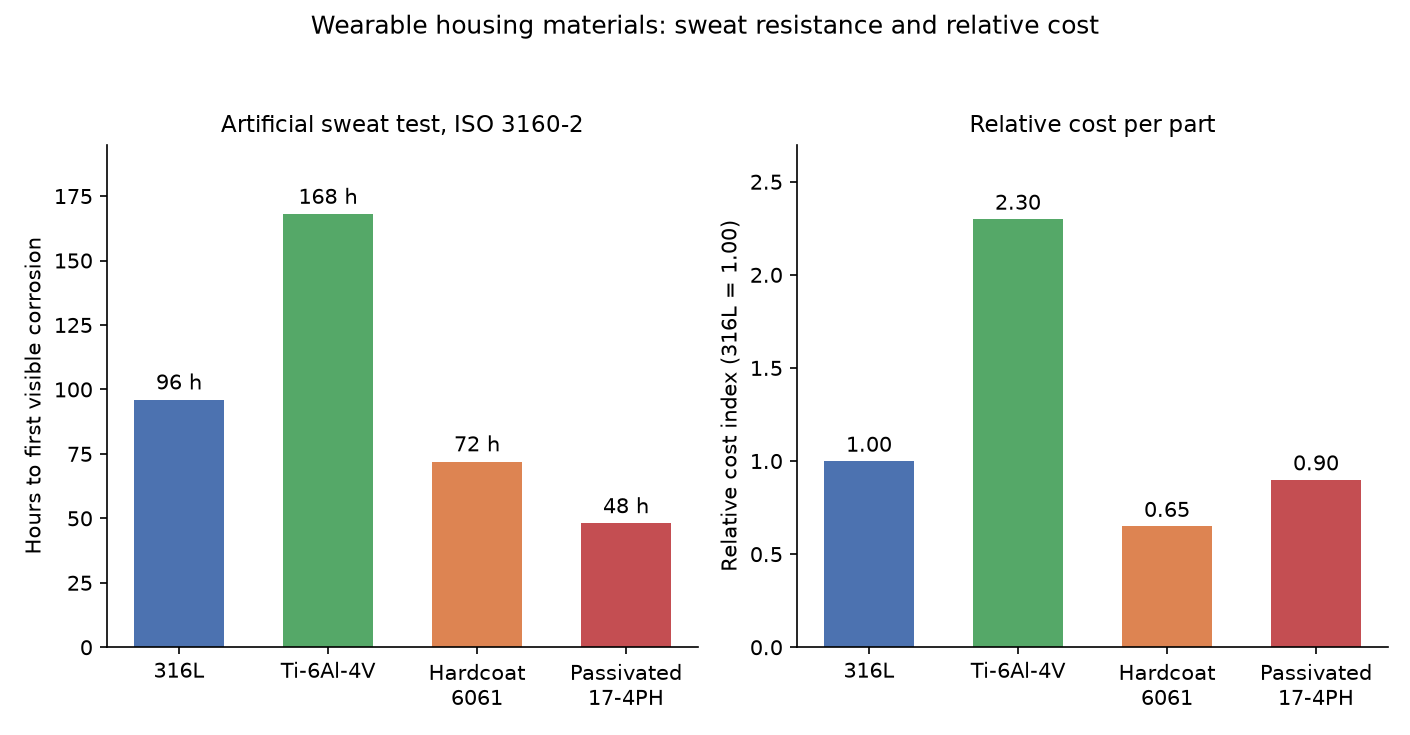
The titanium result is the best of the group, and the 17-4PH result surprises people. Passivated 17-4PH reached 48 hours before visible staining, adequate for a buckle that meets skin occasionally and short of what I want on a housing worn all day. Hardcoat 6061 blistered at the edges by 72 hours, which matches the failure I saw years ago. 316L with electropolishing reached 96 hours, and that is the number I quote against.
Cost per part tells the other half. With 316L at 1.00, 6061 sits at 0.65, 17-4PH at 0.90, and Ti-6Al-4V at 2.30. Cheap and skin safe are different axes. Two discussions go deeper: 316L versus 304 and food grade materials. For aluminum finishes, see anodizing versus powder coating.
What a housing quote needs before you commit
A housing quote that arrives as one number is not a quote, it is a guess. I want it split into tooling or setup, unit price at three volume tiers, secondary operations priced separately, and inspection as its own line.
Tooling questions go in writing. What is the mold life expectancy in shots, and who pays for the rebuild? A MIM tool quoted at 200,000 shots on a 100,000 unit a year program is a two year asset, and the rebuild belongs in your model now rather than in a surprise quote later. Who owns the tool if the program is cancelled? I watched a buyer lose 30,000 dollars on a tool he never used because the contract did not say.
On quality, ask which standard the documentation follows. Automotive programs want PPAP Level 3 with dimensional reports on every characteristic and IATF 16949 discipline behind it. Aerospace enclosures pull in AS9100 and full traceability to the melt. Our quality page lists what gets checked, and how we work walks through the order flow.
Qualifying the supplier and the first article
First article is where a housing program earns trust or starts an argument. I ask for 20 pieces off the production process, not a hand-built setup. Five get a full dimensional report, two get sectioned for porosity, and one goes into a seal test rig with the real gasket and torque sequence.
Ask for a cosmetic limit sample before production starts. A signed-off pair of parts, one at the acceptable limit and one just past it, ends more disputes than any written standard I have seen.
Seal testing needs a decision rather than a default. Full pressure testing on a 50,000 unit program is slow, and most buyers settle on AQL sampling with a higher pressure margin. Our dimensional report guide covers what a trustworthy report contains, and secondary operation costs is where housing quotes grow. The FAQ answers questions buyers raise before a first order.
If you take one thing from this, take the order of decisions: material, process, tolerance, compliance, then price. Buyers who shop unit price first come back with a housing that fails sweat testing, and by then the tooling is cut.
FAQ
What is a realistic cost per part for a wearable device enclosure?
For a 316L housing around 38 mm, expect 9.00 dollars per part machined at low volume, about 4.00 dollars from investment casting, and around 1.60 dollars from metal injection molding once tooling is amortized. Cosmetic finishing adds 1.20 to 2.50 dollars on top.
What break-even volume justifies MIM tooling for a watch housing?
Around 7,500 units against investment casting on the housing costed above. Below that, casting or machining is cheaper once the 26,000 dollar tool enters the model. The break-even volume moves down when a part has complex features that machining would need several setups for.
How long does a MIM mold last for wearable enclosures?
Expect a mold life expectancy of 200,000 to 300,000 shots for 316L or 17-4PH feedstock, depending on feedstock abrasiveness and cavity geometry. Put the shot count and the rebuild cost in the tooling agreement before the tool is cut.
Which material passes nickel release limits for skin contact?
316L is the safest common choice, with nickel release under the EN 1811 limit of 0.2 micrograms per square centimeter per week after passivation. Ti-6Al-4V contains no nickel. Hardcoat 6061 seals the surface but blisters once the layer is chipped.
What minimum order quantity should I expect for a custom wearable housing?
Machined prototypes start at 5 to 20 pieces with no tooling. Casting programs usually start near 500 pieces, and MIM programs near 3,000 to 5,000. A supplier quoting far below those numbers is often spreading tooling into the unit price.
Need Precision Metal Parts for Your Project?
Yujiaxin Tech specializes in MIM, CNC Machining, Powder Metallurgy, Investment Casting, and Gear Hobbing. Get a free quote within 24 hours.