I opened a quote last month that listed a $480 setup fee for twelve aluminum brackets. The same afternoon a second shop quoted the identical part at $95 setup with a unit price $3.10 higher. Both were being straight with me. They had decided different things about who pays for programming, soft jaws, and the first article check.
Setup is the least standardized line on any machining quote. Material cost is what the mill charges. Cycle time can be argued with a stopwatch. Setup is a judgment call. I have quoted machined parts since 1998, and this is the line item customers ask about most. Here is how the number gets built, and where you can push back.
What a setup fee covers
Four costs sit behind the number I write on a quote.
Programming comes first. Someone loads your model, picks cutters, builds toolpaths, and posts code for one machine and control. A prismatic bracket in 6061 aluminum takes me two to three hours of CAM work. A part with blended surfaces and hand-edited entry moves takes ten or twelve.
Workholding is second, and it is the cost buyers most often assume is free. Standard vise jaws are already bolted to the table, so they cost nothing. Soft jaws bored to hold your part take about forty minutes of machine time plus an hour of a toolmaker's time. A dedicated plate for an awkward shape can absorb half a day.
Third is the physical setup and prove-out. Cutters get preset, work offsets get touched in, the first part gets roughed with the feed override at 50 percent, dimensions get measured, and offsets get corrected. On a part holding plus or minus 0.025 mm across six features, that loop runs three times before the machine runs alone.
Last is first article inspection. A full CMM layout on twenty callouts takes forty minutes to an hour of machine time, plus a quality engineer's time to write it up. AS9102 or PPAP Level 3 packages are separate work, and we went through the reasons in why first article inspection matters for procurement.
Setup fee numbers on real quotes
For a small job, which I define as one to fifty pieces on a three-axis mill or a turning center, the shops I know in southern China charge between $180 and $650. Below $150 I get suspicious, because programming alone takes longer at any honest rate. Above $700 on a simple part I want a written reason.
Here are three jobs I quoted this year, broken out the way I would show a customer who asked.
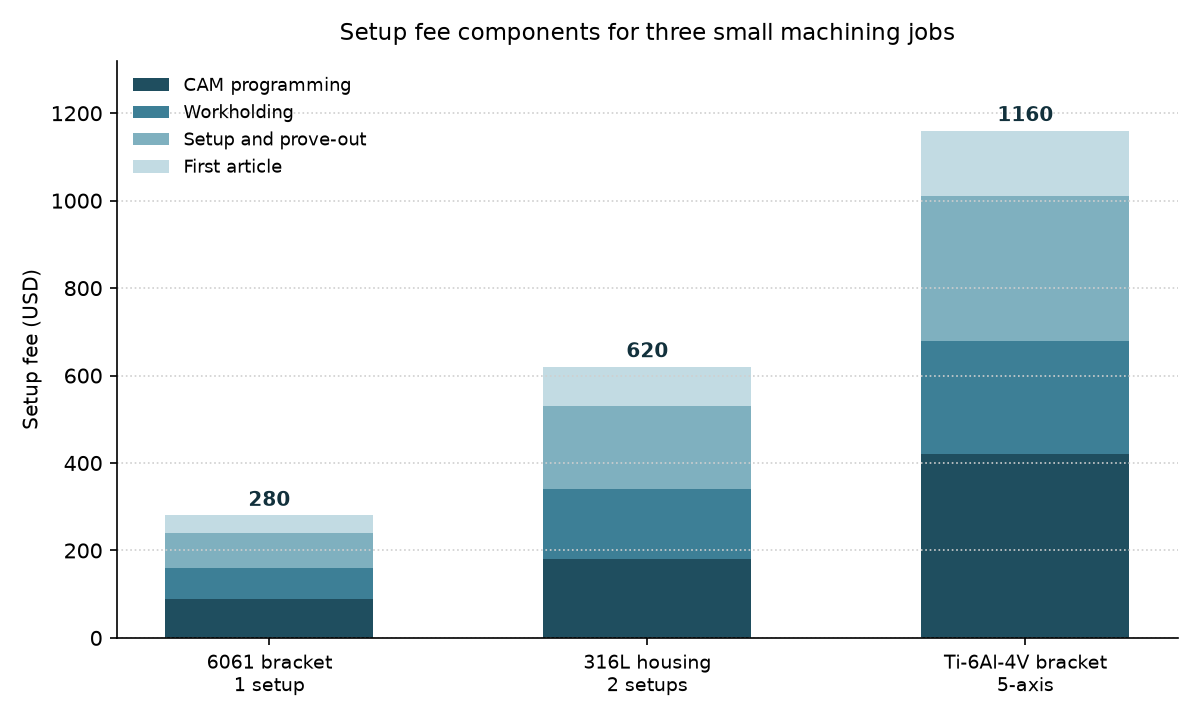
| Job | Programming | Workholding | Setup and prove-out | First article | Total setup |
|---|---|---|---|---|---|
| 6061-T6 bracket, one setup, vise work | $90 | $70 | $80 | $40 | $280 |
| 316L sensor housing, two setups, soft jaws | $180 | $160 | $190 | $90 | $620 |
| Ti-6Al-4V bracket, five-axis contouring | $420 | $260 | $330 | $150 | $1,160 |
The jump from $280 to $620 is not padding. It is a second setup plus a material that work hardens the moment a cutter dwells. 316L stainless punishes dull tools and slow feeds more than free-cutting grades, and that housing had a deep pocket needing a long-reach cutter.
The titanium row pays for five-axis programming time and slow cutting. We run Ti-6Al-4V near 60 m/min with carbide where 6061 runs at 300 m/min, and tool life is worse than the speed ratio suggests. A setup fee that looks high on titanium usually is not.
Fair versus padded setup fee
Every shop I respect can split its setup into hours and a rate. If I quote $620, I can tell you it is 8.3 hours at $75 per hour and show you which operation each block belongs to. A shop that will not break it out has not costed the job, or does not want you to see the arithmetic.
Watch for double counting. I have reviewed competitor quotes where CAM programming sat on its own line at $250 while the setup line said $600 with programming included. Ask for the breakdown in writing and it tends to vanish on the second revision.
Standard cutters are consumables and belong inside the hourly machine rate. A line called special tooling is legitimate when it means a form cutter or a reamer ground for your part. It is not legitimate when it means a 10 mm carbide end mill.
Treat "setup included" as a pricing decision rather than a discount. Money does not disappear. A shop that absorbs $280 recovers it somewhere, usually in unit price or a minimum order quantity. Compare the total at the quantity you will actually order, the exercise we walk through in how to read a CNC quote without missing hidden fees.
Quantity and cost per part
Setup is a fixed cost, so how much it hurts depends on how many parts share it. Take the 6061 bracket: $280 setup, $8.40 per piece to machine. At ten pieces you pay $36.40 per part. At fifty you pay $14.00. At five hundred you pay $8.96, and the setup contribution has dropped to fifty-six cents.
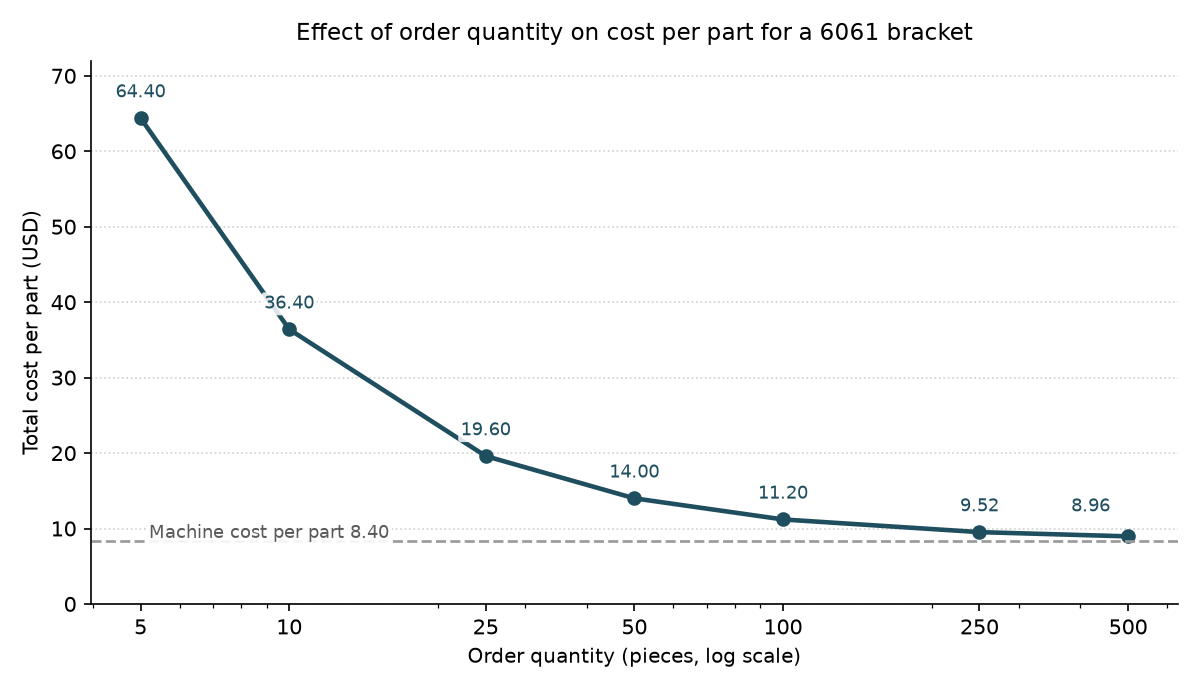
This is the number that usually changes a buyer's mind. Moving from ten pieces to fifty takes the total invoice from $364 to $700. You spend 1.9 times as much money and get five times as many parts. If the bracket goes into a product you will build for three years, that trade is easy.
Where does setup stop mattering? On this job the setup share falls to about 10 percent of base machining cost near 330 pieces. Past that point, arguing about setup wastes more time than it saves. Argue about cycle time and material yield instead. Above a few thousand parts a year the question flips completely, and the crossover arithmetic sits in how to pick the right process for tight tolerance metal brackets.
When a high setup fee is fair
Some setups are expensive because the part is hard, not because the shop is slow.
Thin-wall titanium is the clearest case. A 1.2 mm wall in Ti-6Al-4V deflects under cutter pressure, so the setup includes stepped roughing, stress relieving between operations, and finish passes at low radial engagement. Add five-axis access and the CAM work alone reaches twelve hours. Two of those drivers are in your control, covered in how to reduce features that force 5-axis machining and in what makes titanium parts more expensive than stainless steel.
Hardened tool steel belongs in this group. A die section in M2 tool steel at 62 HRC cannot be milled annealed and heat treated afterwards if the tolerance stack will not survive distortion. It gets ground, which means wheel dressing, extra setups, and removal rates a fraction of aluminum's.
Tight geometric control adds time to the prove-out loop. A true position callout of 0.02 mm at MMC needs probing routines and a coordinate system strategy that survives part rotation. If your drawing piles positional tolerances onto faces you never assemble against, you are paying for someone else's caution. Our CNC machining tolerances guide goes into where that money buys something.
Documentation is the last fair driver. A PPAP Level 3 package with dimensional results on every characteristic, a process flow, and a control plan pulls a quality engineer off your job for most of a day. That is real labor. The full list of what to request is in our PPAP submission checklist, and our automotive programs follow the same rules.
Questions before you negotiate
Six questions, in the order I would ask them:
- How many hours are in this setup, and what hourly rate are you applying?
- Is CAM programming inside that number or billed on a separate line?
- What workholding am I buying, and do I own it if I move the job?
- What happens to the fee if I revise the drawing after first article approval?
- Will I pay setup again if I reorder in nine months, and do you keep the fixture that long?
- Can you quote ten, fifty, and two hundred and fifty pieces on one sheet?
The fifth one matters more than buyers expect. Most shops store soft jaws and programs for twelve to eighteen months and re-run without a second setup charge, because pulling a fixture off the shelf costs forty minutes. Some will not. Ask rather than assume.
If your answer to the sixth question shows setup still dominating at 250 pieces, the geometry may be wrong for machining at that volume. Routes such as metal injection molding, powder metallurgy, and investment casting spread tooling cost across long runs, which is why some brackets never belong on a mill at all. Small gears are their own story, since gear hobbing setup is priced per arbor and cutter grind rather than per CAM hour. Medical programs follow the same pattern.
Our how we work page lays out the sequence from quote to shipment, and the quality page covers certificates and inspection scope. The FAQ answers the logistics questions we hear most. For the drawing side of the same problem, see how to prepare CAD drawings for a CNC quote.
Frequently asked questions
What is a fair setup fee for a small machining job?
Between 180 and 650 dollars for a one to fifty piece order on a three-axis mill or turning center, assuming standard workholding and a documented first article. Under 150 dollars usually means programming was left out and will appear elsewhere on the invoice. Over 700 dollars on a simple prismatic part needs a written explanation.
Is free CNC setup really free?
No. The shop recovers it in unit price, in a minimum order quantity, or in a shorter payment term. Compare the invoice total at the quantity you will actually order. Zero setup at 11.50 dollars per part beats 280 dollars setup at 8.40 per part only below about 90 pieces.
How much does CNC programming cost per hour?
Rates in southern China run 45 to 75 dollars per hour for three-axis work and 90 to 140 dollars for five-axis, with programming billed at or slightly above the machine rate. A simple bracket needs two to three hours. A contoured five-axis part needs eight to twelve.
Do I pay the setup fee again on a reorder?
Usually not, if you reorder within twelve to eighteen months and the drawing has not changed. The program and soft jaws stay on the shelf, and reloading them takes under an hour. Confirm this in writing before the first order, because some shops bill a fresh setup after six months of inactivity.
Does the setup fee include first article inspection?
It should include a basic dimensional check on the first piece, which is part of releasing the machine to run. A full CMM layout with a written report, or an AS9102 or PPAP Level 3 package, is separate work and should be quoted as its own line so you can compare shops on the same scope.
One last thing I tell buyers: ask for the hours. A $280 setup built from 3.7 honest hours and a $620 setup built from 8.3 honest hours are the same kind of number, and both are negotiable where the padding is. What is not negotiable is the physics. Programming a contoured titanium bracket takes the time it takes, and anyone quoting it at $180 has either not read the drawing or plans to recover the difference somewhere you will not look.
Need Precision Metal Parts for Your Project?
Yujiaxin Tech specializes in MIM, CNC Machining, Powder Metallurgy, Investment Casting, and Gear Hobbing. Get a free quote within 24 hours.