E-Cigarette and Vape Metal Parts
Metal Structural Parts
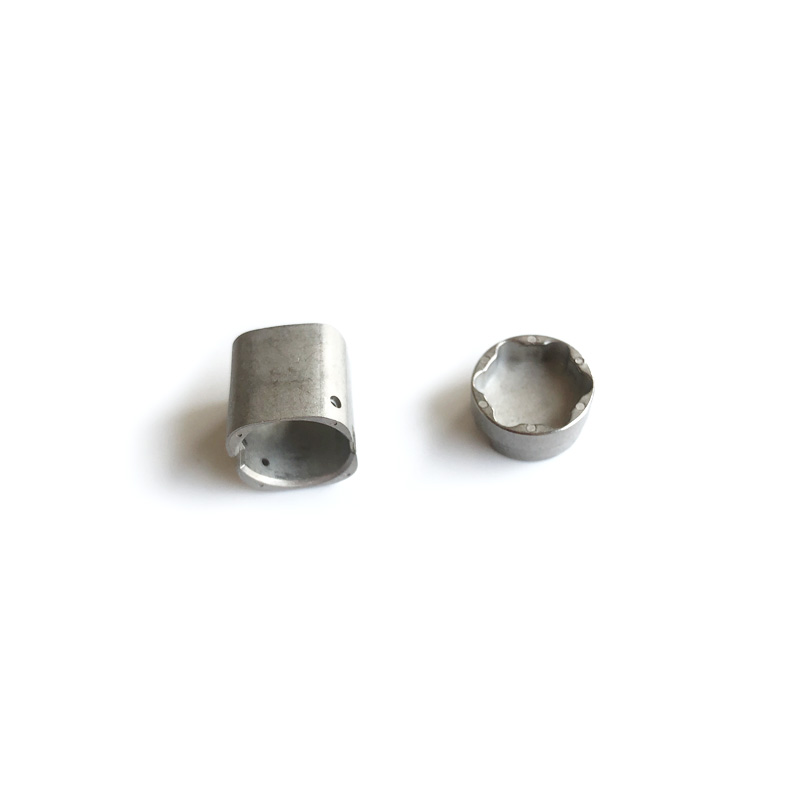
E-cigarette metal parts and vape components moulded by MIM in 316L, 304L and 17-4PH, from 0.5 to 15 g with 0.35 mm walls, atomizer bases, pod shells, airflow rings and hinges.
| Category | Metal Structural Parts |
| Materials | Stainless 316L, Stainless 304L, 17-4PH, Ti-6Al-4V |
| Industries | Consumer Electronics, Vape Hardware, Portable Devices |
Send your drawing or 3D model — engineering review and quotation within 24 hours.
Overview
Parts for e-cigarette and vape hardware are small, thin walled and bought in large batches. An atomizer base has to hold a thread, a centre pin bore, an air inlet and a sealing land in a body not much larger than a fingernail. A pod shell has to stay straight at 0.5 mm wall while it takes a window cutout and a gasket step at both ends. Those are the conditions where metal injection molding earns its place.
We mold e-cigarette metal parts and vape components by MIM in 316L, 304L and 17-4PH, from 0.5 g to 15 g per part. This page describes component manufacturing only. We do not make or sell finished devices, and we make no health or safety claim about any end product.
What we mold for e-cigarette and vape hardware
The drawings that reach us fall into seven groups. Most programs start with one or two of them and expand once the tool is running.
- Atomizer base and 510 connector, with the thread, centre pin bore, air inlet and the flat that seats the gasket
- Pod and cartridge shells at 0.5 to 0.7 mm wall, with a window cutout and a sealing step at each end
- Airflow control rings with an arc slot, a detent bump and a laser marked scale
- Fire buttons and bezels, where the cap is 0.4 mm and the underside carries a dome seat
- Mouthpiece inserts and drip tip bases, which need a clean internal surface because they sit near the vapour path
- Flip top hinges and latches, usually in 17-4PH because the spring leg carries load through thousands of cycles
- Battery tube end caps and contacts, where the wall is thin but the thread and the vent path both have to be there
Why metal injection molding suits these parts
For an e-cigarette atomizer base or a vape pod shell, the geometry is a closed 3D form with internal ribs, a gasket groove and often a stepped bore. Deep drawing cannot produce the internal features, and a stamped assembly needs a seam on a surface the user will touch. Die cast zinc handles the shape but leaves porosity that appears once the part is polished.
MIM puts every internal feature into the tool cavity, so the rib, the groove and the boss arrive in the same shot as the outer skin. There is no draft requirement on the visible wall, which is what allows a pod shell to be drawn almost vertical. Sintered density lands at 97 to 99 percent of theoretical, so a polished surface holds without the small pits that reject a die casting.
The commercial case is volume. One mould cycles every 15 to 25 seconds and carries 4 to 32 cavities, so a 200,000 piece order is a few weeks of press time rather than a year. Our metal injection molding service page covers feedstock, debinding and furnace detail.
Alloys and finishes
Three grades cover almost every program in this family. Density values are for the sintered condition and they matter because they set how well the surface will take a polish.
| Grade | Density after sintering | Character | Where it is used |
|---|---|---|---|
| 316L | 7.85 to 7.95 g/cm3 | Molybdenum addition, resists chloride attack from hand contact | Atomizer base, pod shell, connector, default choice |
| 304L | 7.80 to 7.88 g/cm3 | Lower alloy cost, adequate for dry internal parts | Internal brackets, airflow rings |
| 17-4PH (H1150) | 7.65 to 7.75 g/cm3 | Precipitation hardened, 930 to 1000 MPa tensile | Hinges, latches, snap features that flex |
| Ti-6Al-4V | 4.35 to 4.42 g/cm3 | 40 percent lighter, harder to polish, higher cost | Lightweight bodies and higher value lines |
Finishing decides the visual grade. Mirror polish to Ra 0.05 or 0.1 mm gives the bright stainless look, bead blasting gives a satin surface that hides fingerprints, and PVD in black, gunmetal or gold sits over a polished base. Passivation follows polishing on 316L to restore the chromium oxide layer the abrasives removed. Data sheets sit on the 316L stainless steel page and the 17-4PH page.
Capability
Numbers below are what we quote against for e-cigarette and vape components. A design outside them is reviewed rather than refused, but the review usually changes the tooling plan or the wall section.
| Part weight | 0.5 to 15 g, with most parts between 1 and 6 g |
|---|---|
| Wall thickness | 0.35 mm minimum, 0.50 to 0.90 mm typical |
| As sintered tolerance | plus or minus 0.3 percent above 10 mm, plus or minus 0.05 mm on small features |
| Minimum hole | 0.3 mm diameter through, depth to 3x diameter |
| Moulded thread | M1.6 to M4 coarse, with a rotating core or split insert; finer pitches are cut after sintering |
| Surface roughness | Ra 0.8 to 1.6 as sintered, Ra 0.05 to 0.2 after polishing |
| Cavities per tool | 4 to 32, balanced layout for weight repeatability |
| Lot size | 20,000 to 2,000,000 pieces per year |
| Tooling lead time | 20 to 30 working days, first article to follow |
Design rules for e-cigarette parts
Five drawing decisions cause most of the scrap in these parts. Settling them at review stage is far cheaper than fixing them at polishing.
- Keep the wall uniform at 0.5 to 0.9 mm, because an isolated thick mass cools last and pulls porosity into the section that carries the cosmetics
- Place the gate away from the sealing land and away from the thread start, so the gate scar cannot affect either function
- Give the o ring groove a drafted lead in and hold the land flatness, since sealing depends on the land more than on the groove depth
- Avoid a closed internal volume that traps binder during debinding, or add a drain path that is removed in a later step
- Radius every edge to at least 0.15 mm, because a sharp sintered edge chips during tumbling and shows as a bright line after PVD
Threads deserve their own decision. On an e-cigarette connector, a moulded coarse thread works when the core can rotate or split, and it removes a machining setup. Where the thread start position, the concentricity to the pin bore or the pitch diameter tolerance matter to the assembly, cutting the thread after sintering is the more predictable route and we usually recommend it.
The production chain
- Feedstock mixing, with the powder to binder ratio fixed per grade and lot
- Moulding with in process weight and dimension checks on the first shots
- Debinding, first by catalytic or solvent route and then thermally
- Sintering at 1,350 to 1,400 degrees Celsius in vacuum or hydrogen, with a charted cycle
- Tumbling and grinding to remove the gate scar and blend the parting line
- Machining where the drawing calls for a cut thread, a reamed bore or a flat
- Cleaning, passivation, then PVD or bead blasting
- Final inspection, cleanliness check and packing
Cleanliness and residue control
This is the part of the process that separates a supplier who understands the application from one who does not. A vape part can be dimensionally correct and still fail because residual binder outgasses inside a sealed pod, or because a machining lubricant stayed on a surface that sits near the vapour path.
We control it in three places. Debinding is verified by weight loss against the theoretical binder content, with thermogravimetric analysis available on request. Cleaning after machining uses an alkaline wash, a DI water ultrasonic rinse and a DI final rinse, with conductivity logged per batch. Any lubricant used on a wetted surface is recorded, and cutting operations on those surfaces run on a segregated line so a general purpose coolant cannot migrate onto them.
Where a customer has an extractables or leachables protocol, we prepare the sample per their method and send it to a third party laboratory, then report the results as received. We do not certify the end product and we do not issue a compliance statement on the customer's behalf. The brand owner holds that responsibility, and we supply the manufacturing data behind it. The quality page lists the inspection equipment on site.
Documentation and traceability
Each lot of e-cigarette metal parts carries the powder batch, the moulding date, the sintering cycle, the cleaning batch and the finishing batch. A complaint about colour, fit or residue on a delivered carton can therefore be traced to the specific operation that caused it.
- 3.1 material certificate with the heat and powder batch number
- Dimensional report against the ballooned drawing, plus CMM data on the stated critical characteristics
- Cleanliness report with the conductivity log and, where agreed, third party test results
- RoHS and REACH declarations issued against the material certificates rather than against the finished device
Where metal injection molding stops paying off
The route has edges, and naming them early avoids a wasted quarter.
- Programs under about 20,000 pieces a year are better served by machining from bar, because the tool is never amortised
- Parts that need a thread held to a tight pitch diameter and a fixed start angle are usually bought as a moulded boss plus a cut thread
- Bodies above roughly 90 mm at high volume belong on a die cast or stamped route, where per piece cost drops below what feedstock and sintering allow
- Prototype quantities are faster and cheaper as machined parts, with the MIM tool built in parallel once the design freezes
What to send for a quotation
Seven items let us quote without a round of questions, and they also let us flag a moulding risk before the tool is cut.
- A 3D model in STEP plus a 2D drawing with the cosmetic surfaces classified
- The alloy and the finish, with the target Ra for each surface
- Wall thickness and the critical characteristics that set the assembly
- Annual volume, release size and the number of colour or finish variants
- Whether the thread is to be moulded or cut, and the tolerance behind that decision
- The sealing method and the surfaces that touch the vapour path
- Any cleaning, extractables or documentation protocol the program must follow
Send the files through the contact page and an engineer will review the wall sections before a price is issued. The electronics industry page lists the other small metal parts we run for this sector, and the stainless steel earbud housing page shows a comparable thin wall shell with the same polishing and colour matching discipline.
Frequently asked questions
Can you mould the 510 thread instead of cutting it?
Yes, up to about M4 coarse, provided the tool can carry a rotating core or a split insert. Most programs still choose to mould a boss and cut the thread, because the start angle, the pitch diameter and the concentricity to the centre pin bore are all easier to hold on a lathe. The decision is worth taking at drawing review rather than after the tool is cut.
How do you prove the binder has been fully removed?
Debinding is checked by weight loss against the theoretical binder fraction for the lot, and the furnace cycle is charted. Where a customer needs more, we run thermogravimetric analysis on a sample and report the residual mass. A part that still carries binder usually shows it as discolouration after sintering or as outgassing in a sealed assembly.
Do you supply complete devices or only components?
Components only. We mould and finish metal parts to a drawing, and we do not assemble, fill or sell finished devices. That boundary keeps the regulatory responsibility with the brand owner, who holds the product registration in the markets they serve.
What is the minimum order for a new part in this family?
We quote from about 20,000 pieces a year upward, and below that the tool cost dominates the piece price. A trial batch can be run from the same tool once it exists, so a pilot run does not need a second tool. Prototype quantities are usually faster as machined parts while the design is still moving.
More in Metal Structural Parts
Custom Machined Enclosure Parts
Custom machined enclosure parts built to your drawing in 6061 aluminium, 304 and 316L stainless,...
View Details →
Stainless Steel Earbud Housings
Stainless steel earbud housings moulded by MIM in 316L, 304L and 17-4PH, 0.35 mm walls, mirror...
View Details →
Automotive Metal Structural Parts
Automotive structural parts made by precision casting in carbon steel, 4140 and stainless, from...
View Details →