A buyer sent me a drawing last month: a brass pin, 2.5 mm diameter, 18 mm long, with a chamfer and one small flat. Annual volume: 400,000 pieces. He asked for a CNC machining quote. I quoted it as a stamped part instead and the price fell by more than half. That conversation happens weekly, and it always traces back to the same skipped question: which process actually suits this pin at this volume?
Connector pins look simple, which is exactly why process selection goes wrong. The same drawing can be made five different ways, and the cost curves cross more than once between 10,000 and 1,000,000 pieces per year. I have sold pins into connector assemblies since the late 1990s, and I have watched buyers overspend on machining and underspend on tooling. Here is how I sort a pin request into the right lane.
- What high volume means for connector pins
- Progressive die stamping: the default above 150,000 pieces
- Screw machined pins for prototypes and large diameters
- Metal injection molding for pins a die cannot stamp
- Powder metallurgy for plain round pins
- Plating decides contact resistance, not the base process
- Cost per part and break-even volumes
- How I decide between the four processes
- Common questions about high volume connector pins
What high volume means for connector pins
"High volume" means different things in different shops, so I fix bands before quoting. Below 10,000 pieces per year, nobody should be talking about dies. Between 10,000 and 150,000, the decision is genuinely close and worth real math. Above 150,000, a progressive die usually wins on cost and consistency. Above 500,000, the argument is mostly over unless the geometry refuses to stamp.
The money scales faster than people expect. At 400,000 pins a year, one cent per part is 4,000 dollars per year. A buyer who avoids a 12,000 dollar die can spend that saving twice over before the first quarter closes. That arithmetic, not shop folklore, should drive the choice.
Progressive die stamping: the default above 150,000 pieces
Most connector pins you have ever touched came off a progressive die. Strip stock feeds through stations that pierce, form, chamfer and cut the pin off in one pass. A two-out die on a 60 ton press turns out 25,000 to 50,000 pins per shift, and the per part price sits in a different universe from machining. Strip stock for contacts is usually brass C26000, phosphor bronze C51000, or 316L stainless steel in corrosive service.
The upfront cost is the die. A simple two-out progressive die for a 2.5 mm pin runs 8,000 to 18,000 dollars depending on the number of forming stations. Steel tooling needs a regrind every 2 to 5 million strokes; carbide sections run far longer, which is why I spec carbide on anything above a million pieces a year. Our die sections for hard strip stock are cut from M2 tool steel and heat treated to 60 to 62 HRC.
What stamping holds: hole to hole positions around ±0.05 mm, chamfers formed consistently, and burr height under 0.05 mm with well maintained tooling. That burr number matters. A burr over 0.05 mm scratches plating off the mating partner, and the connector starts failing intermittently in the field months later, where it is expensive. When a customer's pin needs tighter control than that, the machining lane on our CNC machining page is the better fit.
Screw machined pins for prototypes and large diameters
Below roughly 150,000 pieces, an automatic lathe is usually the honest answer. Setup costs about 250 dollars, there is no die to amortize, and a Swiss lathe holds ±0.01 mm on diameter with a surface finish near Ra 0.8. For a 2.5 mm pin the machined price lands around 0.08 to 0.15 dollars per piece depending on volume.
Machining also wins when the pin refuses to be a stamping part. Diameters over 6 mm get clumsy in strip stock. Threads, undercuts and sharp shoulders belong on a lathe. And when the program is young and the drawing still changes, I push every customer toward machining first. I have watched more than one buyer cut a progressive die for a part that got redesigned a month later, and the die became a very expensive paperweight.
Metal injection molding for pins a die cannot stamp
Some pins are not stampable. A headed pin with an asymmetric flange, a pin bent 30 degrees in two planes, a pin with a cross hole: a progressive die cannot form those in one pass, and machining them at volume is slow and expensive. This is where metal injection molding earns its keep.
MIM tooling for a pin runs 12,000 to 20,000 dollars, and the molded part costs 0.04 to 0.08 dollars once the tool is paid for. Sintered density reaches 96 to 98 percent of wrought stock, and a 20 mm feature holds about ±0.05 mm after sintering, ±0.025 mm with a sizing operation. The break-even against screw machining lands near 230,000 pieces. For a deeper walkthrough, I wrote a separate piece on how MIM tooling amortization shows up in part pricing.
One caution: MIM never beats stamping on a pin that stamping can make. The die is cheaper and faster to build. I quote MIM when geometry forces it, not when a spreadsheet narrowly favors it.
Powder metallurgy for plain round pins
When the pin is a plain round or stepped cylinder with no re-entrant features, conventional powder metallurgy is the cheapest route I know at very large volumes. A compaction tool costs 20,000 to 30,000 dollars, the press runs 40 to 80 strokes a minute, and per part cost drops to 0.02 to 0.03 dollars. Tool inserts hold up for 300,000 to 500,000 strokes between repairs.
The trade-off is porosity. Sintered parts carry 8 to 12 percent residual porosity, and on an electrical pin that matters twice: pores wick plating solution during finishing, which can add 20 to 30 percent to the plating bill, and the cross section conducts less current than wrought stock. For structural pins that is fine. For current carrying contacts I still prefer wrought strip or bar, and the related trade-offs appear in my comparison of powder metallurgy against CNC machining and of sintered versus machined stainless steel components.
Plating decides contact resistance, not the base process
The base process gets the attention, but on a connector pin the plating spec often moves total cost more than the process choice. Tin over a nickel barrier is the standard for most signal pins. Gold goes on anything that cycles, vibrates or lives in humidity.
Typical plating cost per pin at volume: bright tin about 0.008 dollars, matte tin 0.010, electroless nickel 0.020, selective gold on the mating tip only 0.030, a full coverage 0.05 μm gold flash 0.045, and full 0.76 μm gold over nickel 0.12. The selective option is the one I push hardest. Putting 0.76 μm of gold only where the pins actually touch cuts the gold bill by about 75 percent compared with plating the whole pin, and the contact resistance at the interface is identical.
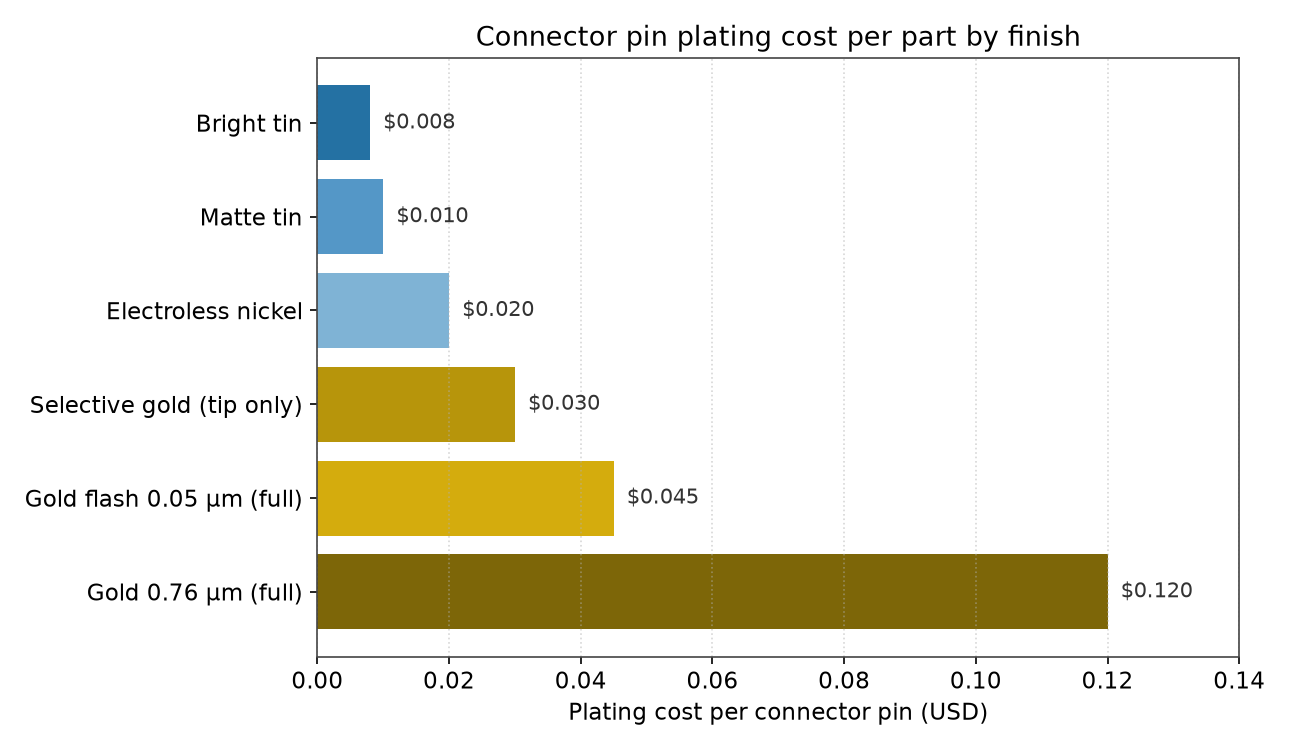
The corrosion stack matters too: 0.76 μm of gold sits over at least 1.3 μm of nickel, and the nickel is what actually blocks diffusion of the base metal. Skip the nickel and the gold develops pinholes within months. I covered the options in a piece on plating options that protect steel parts from rust.
Cost per part and break-even volumes
Put real numbers on it. For a 2.5 mm brass pin, using our own quoting data: progressive stamping carries about 800 dollars of setup plus a 12,000 dollar die and runs 0.028 dollars per part. Screw machining carries 250 dollars of setup at 0.11 dollars per part. MIM carries a 14,000 dollar tool at 0.05 dollars per part.
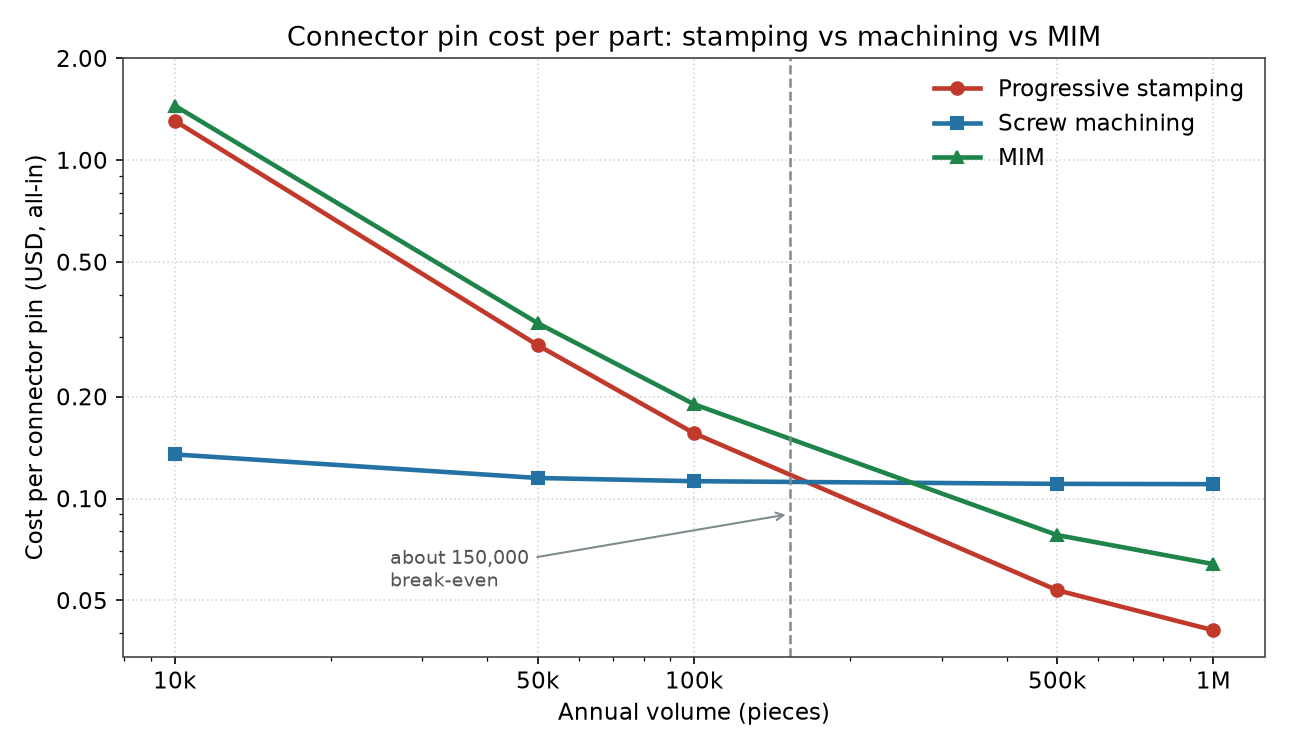
Read the crossover points off the chart. Screw machining wins below roughly 150,000 pieces. Above that the stamped pin pulls away and never looks back: 0.16 dollars at 100,000, 0.05 at 500,000, 0.04 at a million. MIM sits between the two for a plain pin and only wins when geometry takes stamping off the table. The same logic holds whether the pin feeds an automotive ECU or a consumer device like those on our electronics industry page.
One more variable buyers forget: volume is rarely flat. If the forecast is 100,000 the first year and 600,000 the second, I quote machining for year one with a written plan to cut the die at launch. A die bought six months early on a shaky forecast is the most common way I see tooling money wasted. For pressure testing a volume forecast before committing, the questions on our FAQ page are a decent start.
How I decide between the four processes
My sequence is short. First, can a strip stamp it? If yes and volume clears 150,000 a year, stamping is the answer and I stop there. Second, does the pin need turned features like threads or shoulders, or is the program still changing? Machining it is. Third, does the geometry need 3D forming a die cannot do? That is the MIM lane. Fourth, is it a plain round pin at enormous volume with no current carrying duty? Powder metallurgy.
I trust stamping most at the volumes it was built for. The first 5,000 pieces off a new die deserve inspection, because that is when a worn punch or a misaligned station shows up, but after a clean first article the process is boring in the best way. What I do not trust is a stamping quote on a pin whose print still says the 3D model is for reference only. Freeze the drawing first. Our how we work page walks through the quoting and first article steps our factory uses.
Common questions about high volume connector pins
What is the cheapest process for connector pins above 500,000 pieces per year?
Progressive stamping. At 500,000 pieces the all-in cost of a stamped 2.5 mm brass pin lands near 0.05 dollars each including die amortization, roughly half the machined price.
What is the progressive die life expectancy for connector pins?
Steel tooling needs a regrind every 2 to 5 million strokes. Carbide sections run longer. At 400,000 pins a year, one die usually outlasts the program.
What gold plating thickness do connector pins need?
0.05 μm gold flash protects shelf stock. Mating contacts need 0.76 μm gold over at least 1.3 μm of nickel. Tip only selective plating cuts the gold cost by about 75 percent.
Can MIM hold connector pin tolerances?
Yes, about ±0.05 mm on a 20 mm feature after sintering and ±0.025 mm with a sizing operation. The catch is cost: if stamping can make the pin, it makes it cheaper.
What break-even volume justifies a progressive die?
For a 2.5 mm pin against screw machining, around 150,000 pieces with our numbers. The crossover moves with pin size, material and plating, so run the math per part.
Need Precision Metal Parts for Your Project?
Yujiaxin Tech specializes in MIM, CNC Machining, Powder Metallurgy, Investment Casting, and Gear Hobbing. Get a free quote within 24 hours.