Small Module Multi-Start Worms
Mechanical Components
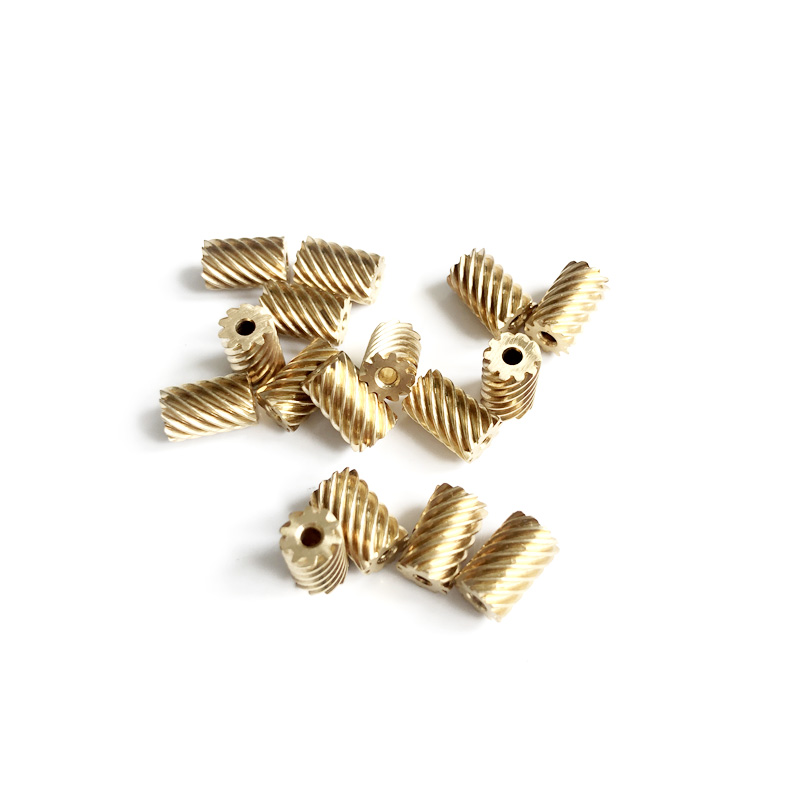
Small module multi-start worm shafts machined on CNC turning and whirling centres, module 0.2 mm to 1.5 mm, two to six starts, alloy or stainless steel, milled or ground to grade 6, with matched worm wheels on request.
| Category | Mechanical Components |
| Materials | 42CrMo4, 20CrMnTi, 8620, 4140, 17-4PH, Stainless 303, Stainless 316L, Brass C36000 |
| Industries | Automotive, Industrial Equipment, Robotics, Medical Devices, Instrumentation |
Send your drawing or 3D model — engineering review and quotation within 24 hours.
Yujiaxin Tech machines small module multi-start worms from bar stock, turning the journals and datums first and then cutting the whorl on a CNC whorl milling centre, with profile grinding added where the accuracy grade calls for it. A multi-start worm puts a steep lead angle and a short ratio onto a worm shaft that may be under 6 mm across the thread, so the geometry has to be cut rather than formed. We hold module 0.2 mm to 1.5 mm, two to six starts, in alloy and stainless steel, from prototype to production lots.
What makes a worm small module and multi start
Module is a size index rather than a dimension you can check with a caliper. On a worm it is the axial pitch divided by pi, and small module in our shop means 0.2 mm to 1.5 mm. A module 0.5 worm on a 10 mm reference diameter carries a thread depth of about 1.1 mm, so the whole whorl sits inside a shaft you could lose on a bench.
Starts are the number of independent helices wound onto the same shaft. A single start worm advances one axial pitch per revolution. A four start worm advances four pitches in the same revolution, so the same shaft drives the wheel four times faster at the same centre distance. Lead angle follows from those two numbers: tan of the lead angle equals the number of starts multiplied by the module, divided by the reference diameter.
That single relationship explains most of the behaviour of a multi-start worm. More starts mean a steeper lead angle, a shorter ratio for the same wheel, and less sliding loss in the mesh. They also mean the drive stops holding itself, which is the trade most designers run into after the first prototype.
What the number of starts changes
The table is calculated for a module 0.5 worm on an 8 mm reference diameter against a 40 tooth wheel. It is a useful check before a drawing exists.
| Starts | Ratio at 40 teeth | Lead angle | Efficiency |
|---|---|---|---|
| 1 | 40:1 | 3.6 degrees | 40 to 55% |
| 2 | 20:1 | 7.1 degrees | 60 to 75% |
| 3 | 13.3:1 | 10.6 degrees | 70 to 80% |
| 4 | 10:1 | 14.0 degrees | 75 to 85% |
| 6 | 6.7:1 | 20.6 degrees | 78 to 87% |
Efficiency rises steeply between one and four starts and then flattens, as the sliding angle between the flanks moves away from the friction angle. Holding behaviour is judged at light load, and it is the first property to disappear as starts are added. This is why miniature gearmotors that need 10:1 to 20:1 in a single stage use a two, three or four start worm instead of a chain of spur stages. Fewer stages means fewer bearings, less backlash stack up and a shorter housing.
The cost is holding torque. Once the lead angle passes roughly 4 to 5 degrees the mesh can be back driven, so a mechanism that must stay put with the motor unpowered needs a brake, a friction element or a single start worm. We quote the lead angle, not a brake rating, and the difference matters on a sloped load.
Geometry and tolerances we hold
| Parameter | Range or value |
|---|---|
| Axial module | 0.2 mm to 1.5 mm |
| Number of starts | 2 to 6, single start on request |
| Reference diameter | 2 mm to 25 mm |
| Lead angle | 5 to 30 degrees |
| Pressure angle | 20 degrees standard, 14.5 degrees on request |
| Hand of helix | Right hand or left hand |
| Accuracy grade | GB/T 10089 grade 6 to 8 |
| Lead deviation, grade 6 at module 0.5 | 0.008 mm |
| Profile deviation, grade 6 | 0.006 mm |
| Radial runout of thread to datum | 0.005 mm |
| Flank finish | Ra 0.2 to 0.4 um ground, Ra 0.8 um milled |
| Thread hardness | 45 to 62 HRC, material dependent |
| Shaft features | Journals, flats, keyways, cross holes, tapped ends, D cuts |
| Inspection | Profile, lead, pitch, runout, double flank roll |
Grade 7 covers most miniature gearmotor work. Grade 6 is worth paying for when the worm runs against a wheel that is already ground or when backlash has to be held across a temperature swing, and it costs more because the steep lead angle of a four or six start worm makes the grinding pass slower than on a single start shaft.
How the whorl is cut
Sequence matters more than the machine. We CNC turn the journals, the datums and the centre holes in one setup wherever the shaft allows, because every later measurement refers back to those surfaces. The whorl is then cut on a four or five axis CNC centre, either by whirling with a rotating cutter ring or by milling the helix with a disc cutter, and the part goes to heat treatment before any grinding pass.
- Whirling suits a multi-start worm because the cutter follows the helix continuously and each start is indexed by the control, not by a division plate
- Disc milling leaves a longer scallop and is the cheaper route when the flank is not ground afterwards
- CNC profile grinding after hardening uses a dressable wheel, and a steep lead angle needs a smaller wheel or a single rib wheel to clear the opposite flank
- No dedicated hob is needed, so changing from two starts to four is a program change rather than a tooling purchase
That point decides the commercial case for a small module multi-start worm at low volume. A formed or rolled process needs tooling that only pays back at quantity, while a cut whorl lets a design change starts, lead angle or hand between builds without a new tool. For prototype and bridge quantities we mill and leave the flank unground at grade 8, then move to ground flanks once the design is fixed and the annual volume justifies the extra pass.
Materials and heat treatment
| Material | Condition | Hardness | Where it fits |
|---|---|---|---|
| 42CrMo4 / SCM440 | Through hardened and tempered | 28 to 32 HRC | General gearmotor worms, good core toughness under shock |
| 20CrMnTi | Case carburised | 58 to 62 HRC, case 0.3 to 0.5 mm | Higher load at small module, ground flanks after hardening |
| 8620 / 4140 | Case or through hardened | 60 HRC case, 28 to 32 HRC core | Drawings written to US material equivalents |
| 17-4PH | H900 | 40 to 44 HRC | Corrosion resistance with usable strength, no post heat treat distortion |
| 303 stainless | Not hardened | As supplied | Light duty and wash down areas, pair with a dissimilar wheel |
| 316L stainless | Not hardened | As supplied | Laboratory and food machinery, low load only |
| Brass C36000 | Not hardened | As supplied | Instruments and low torque mechanisms, quiet running |
Hardening is where a thin multi-start whorl is most at risk. The ridge between helices is narrower than on a single start shaft at the same module, so a case depth that would be routine on a 2 mm module worm shaft can leave the ridge brittle. We set case depth against the measured ridge width rather than against the shaft diameter, and we straighten between hardening and grinding so the runout callout on a small module multi-start worm survives the last operation.
Inspection and documentation
Every small module multi-start worm is checked on a CNC gear measuring centre for profile, lead and pitch deviation, with the datum taken from the turned journals. Lead angle is cross checked over pins, which catches a program error that a lead scan can sometimes mask on a short thread.
A double flank roll against a master wheel gives a functional check of tooth thickness and runout in one pass, and it correlates with the noise heard in a finished gearbox. Each lot ships with a material certificate, a dimensional report and the measured values against the drawing callouts.
We hold ISO 9001 and GJB 9001C-2017. All worms are supplied as components for OEM assembly, not as finished gearboxes or machinery, and the declared accuracy grade refers to the part as measured at the datums on the drawing.
Where multi-start worms do the work
These applications share one condition: a short gearbox and one stage carrying the whole ratio. That is the case a small module multi-start worm answers best, and it is where a spur stage stack becomes too long for the housing.
- Miniature gearmotors needing 10:1 to 20:1 reduction in a single stage
- Robot and humanoid actuator joints where the output should be back drivable by hand
- Automotive seat, mirror, latch, tailgate and grille shutter actuators
- Laboratory and peristaltic pumps where smooth low speed dosing matters
- HVAC damper and small valve actuators with a spring return
- Power tool and garden equipment transmissions at high input speed
- Camera pan and tilt heads, gimbal drives and optical stages
- Instrument mechanisms such as chart drives, tuners and fine adjustment screws
Design points that decide whether it works
Most failures we are asked to diagnose come from the surrounding assembly rather than from the small module multi-start worm itself.
- Axial location of the worm. Preload with a wave washer or a pair of angular contact bearings. A worm that floats axially will run quietly on a bench and howl in the housing
- Wheel tooth count. With four or more starts keep the wheel at 30 teeth or above, otherwise the wheel teeth undercut and come to a point
- Ridge width at the root. Each extra start thins the ridge, and below about 0.25 mm a six start module 0.2 worm becomes a grinding problem rather than a design choice
- Hand of the helix. The worm and wheel hands must be a matched pair, so a worm quoted without the wheel hand is a guess and the thrust direction may reverse
- Lubrication. A steep lead angle raises sliding velocity, which means a grease channel or an oil bath rather than dry running above light load
- Thrust capacity. Both shafts carry axial load in a worm mesh, so the bearing stack has to be settled before the housing is drawn
What to send for a quotation
A drawing is the fastest route. When there is no drawing yet, the following is enough for a firm reply.
- Module, or the measured diameter over the thread if the module is unknown
- Number of starts and the ratio, or the wheel tooth count
- Hand of the helix, and the required output direction
- Reference diameter and the overall shaft envelope
- Journal, keyway, flat and thread details at both ends
- Material, hardness and accuracy grade
- Input speed, output torque, duty cycle and ambient temperature
- Quantity for the first lot and the expected annual volume
Send those eight items and we reply with a price and a drawing for approval within 24 hours, quoted as a CNC machined worm shaft to the grade you specify. First article samples are available before a production order, and where the original drawing is missing we measure the sample, rebuild the geometry and send the drawing back for sign off before any metal is cut.
FAQ
What is the practical difference between a single start and a multi-start worm?
Three things move together: ratio, lead angle and efficiency. One start gives a high ratio, a shallow lead angle and a drive that usually holds position. Two to six starts give a shorter ratio, a steeper lead angle and better efficiency, but the mesh can be back driven.
Can a small module multi-start worm be self-locking?
Only at a very low lead angle, which defeats the purpose of adding starts. Above roughly 4 to 5 degrees of lead angle the mesh will usually run backwards under load, so a mechanism that must hold position needs a brake or a separate locking element.
What is the smallest module you can cut with four or more starts?
Module 0.2 with four starts is possible, and we review it before quoting because the ridge between helices gets thin. In production, module 0.3 and above is the comfortable range for a four or six start worm in hardened steel.
Do you supply the matching worm wheel as well?
Yes, and buying the pair together is the safer route. Lead angle, centre distance and backlash belong to the pair, so a worm and a wheel quoted separately can end up with slightly different reference dimensions. We machine both to one assembly number when the application allows it.
Related pages
For a small module multi-start worm, see the full mechanical components range, compare our high precision worm gear and worm wheel pairs and miniature precision gears, review the CNC machining capability behind this work and our quality and inspection process, read the automotive applications, or send a drawing for a quotation.
More in Mechanical Components
Micro Bevel Gears
Micro bevel gears from module 0.2 to 1.5 mm produced by metal injection molding in 17-4PH, 316L...
View Details →
Powder Metallurgy Gears
Powder metallurgy gears pressed and sintered in iron copper carbon steel and stainless steel,...
View Details →
High Precision Worm Gear and Worm Wheel
High precision worm gear and worm wheel pairs in bronze, hardened steel and stainless steel,...
View Details →