Buyers ask me about lead time more often than they ask about price. A powder metallurgy production run has a schedule that looks strange the first time you see it. The first order runs 8 to 10 weeks from purchase order to shipment. A repeat order with an existing tool runs 4 to 5 weeks. The difference is almost entirely the tool, and once you understand where the weeks go, planning around the schedule becomes a routine part of sourcing. I have quoted sintered parts since 1998 and I still open every new inquiry with the same two numbers.
Contents:
- What the lead time actually covers
- The tool build drives the schedule
- Inside a production batch, stage by stage
- Why sintering runs on a batch schedule
- Typical lead times by project type
- What adds weeks to the schedule
- How to shorten the schedule without adding risk
- Questions buyers ask about powder metallurgy lead times
What the lead time actually covers
When I quote lead time, I mean calendar weeks from a released purchase order to parts leaving our dock. That window covers five things in sequence: queue and planning, tool work, first articles, the production batch itself, and final inspection with packing. It does not include ocean freight, which adds its own weeks depending on the destination.
Machining works differently. Send a drawing to our CNC machining team and you can hold parts in hand inside two weeks for simple work. Powder metallurgy cannot match that because nothing physical starts until the compaction tool exists. The trade is simple: you accept weeks up front to buy a cost per part that machining cannot reach at volume. If annual volumes sit below roughly ten thousand units, the tool does not pay for itself and the schedule argument disappears with it. I covered that crossover in detail in my article on why powder metallurgy beats CNC above ten thousand units.
The same tool-first logic applies to our metal injection molding and investment casting services. All three processes sell you a tool, then sell you cheap parts.
The tool build drives the schedule
The tool is the schedule. Tool design takes 1 to 2 weeks. Building a single cavity die set takes another 4 to 6 weeks, longer if the part needs multiple levels, core rods for through holes, or tight concentricity between punch and die. We cut die inserts from carbide or hardened tool steel and grind punch sets from grades like M2 tool steel, chosen because a punch running 300,000 cycles cannot hold size if it wears past a few microns.
Once the tool is assembled we run T1 samples, usually 50 pieces. Those go through full first article inspection on a CMM against the drawing, not against a photo. I have watched buyers approve a T1 from images to save a week, and it has always cost them more later. The approval loop is where schedules slip, and it slips on the buyer side as often as on ours. A signed FAI report releases the tool for production. An unsigned one parks it, along with your delivery date.
One more thing worth saying. The tool build clock stops if the drawing changes. A dimension edit that takes ten minutes to make can put the die insert back at the grinder for a week. The same mold-first logic is why mold making takes longer than production in MIM, and buyers who internalize that point stop asking why the press is idle.
Inside a production batch, stage by stage
Once the tool is approved, the batch itself is predictable. Here is what 13 working days on the shop floor looks like for a typical 316L stainless steel run.
Powder blending and QC take 3 days. We mix the base powder with lubricant and confirm chemistry and flow against the blend record. Compaction takes 2 days on the press, running 20 to 40 strokes per minute depending on part height. Debinding takes 2 days in the thermal delube furnace, slow on purpose, because a part that cracks there never sees the sinter furnace. Sintering is 1 day of furnace time, a 20 to 24 hour cycle near 1120 C for 316L. Parts shrink during sintering, which is why sizing and secondary operations take 3 days: we repress critical dimensions back to tolerance, holding plus or minus 0.025 mm where the drawing demands it and letting ISO 2768-m govern the rest. Final inspection and packing close the last 2 days.
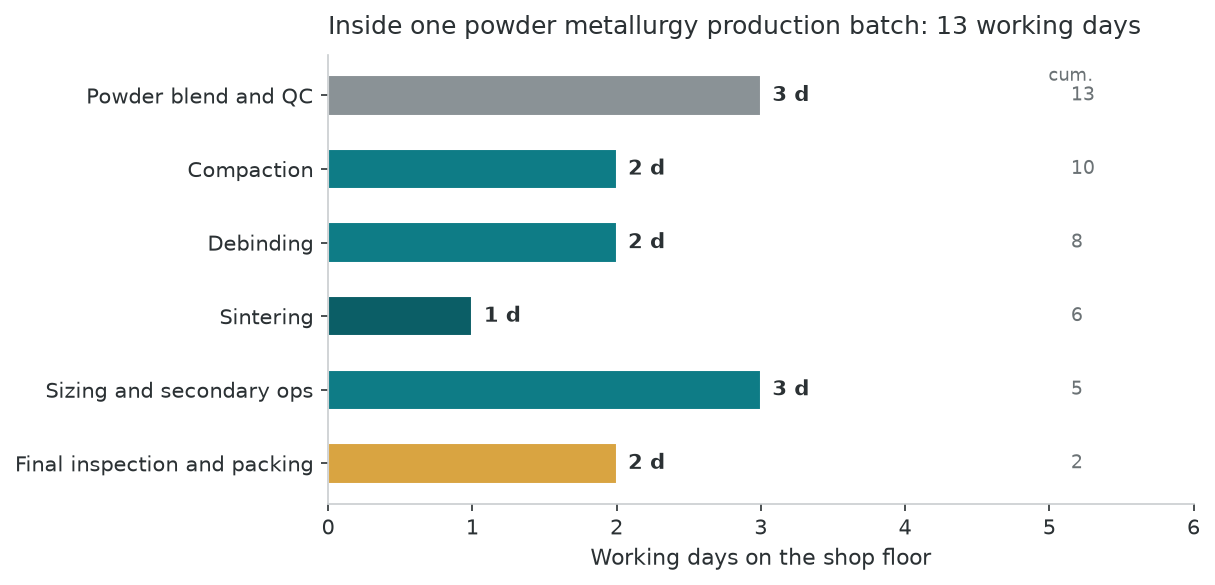
That is 13 working days, roughly two and a half calendar weeks. The gap between that and the 4 to 5 weeks I quote for a repeat order is queue time ahead of your batch, plus freight booking.
Why sintering runs on a batch schedule
Sinter furnaces do not run on demand. They run campaigns, usually one or two per week per furnace. A full furnace load spreads gas and power cost across more parts and keeps the cost per part honest. Mixing materials in one campaign invites contamination, so 316L campaigns do not carry carbon steels. Your parts wait for the next compatible campaign, and that wait is most of the queue time I mentioned above.
Buyers sometimes ask for a dedicated run. I can do it, and I charge for it, typically 15 to 20 percent on that batch, because the furnace burns a full cycle for half a load. For most orders the better advice is to plan around the campaign calendar rather than pay to escape it.
Typical lead times by project type
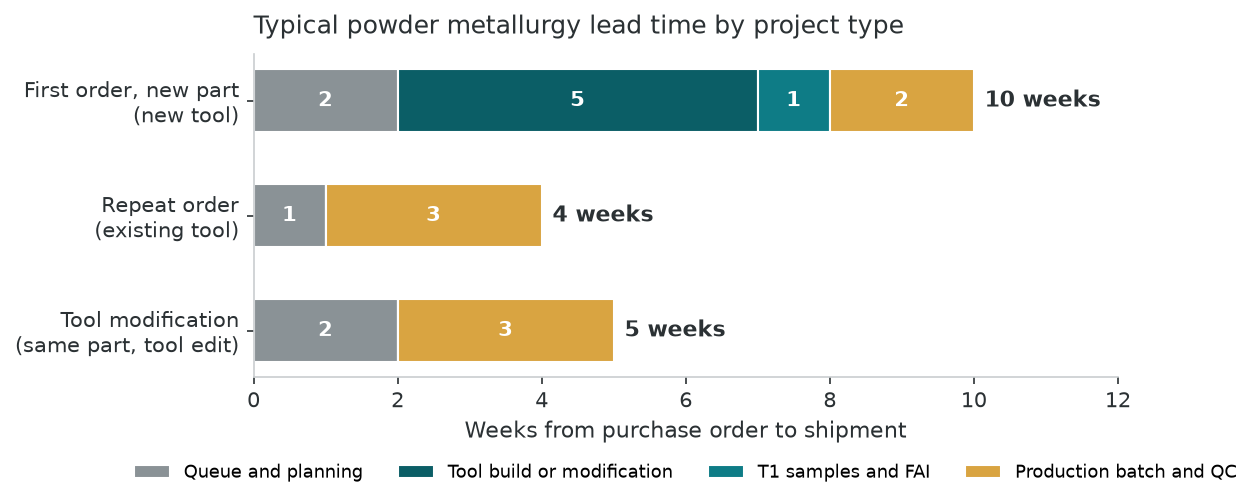
Pulling it together, here are the three schedules I quote most often.
| Project type | Typical total | Where the weeks go |
|---|---|---|
| First order, new part | 8 to 10 weeks | 2 queue, 5 tool build, 1 T1 and FAI, 2 production batch and QC |
| Repeat order, existing tool | 4 to 5 weeks | 1 queue, 3 batch and QC, plus freight booking |
| Tool modification, same part | 5 weeks | 2 tool edit, 1 T1 and FAI, 2 production batch |
The first order carries the tool. After that you are buying furnace capacity, and the schedule compresses by more than half.
Two caveats worth flagging. If the program needs PPAP documentation under IATF 16949, as most automotive programs do, add 1 to 2 weeks for the level 3 package and the measurement studies. That documentation rides with the FAI, but it is real work, and treating it as free produces late submissions. For industrial machinery components the same logic applies to any customer-specific quality agreement you signed at contract review.
What adds weeks to the schedule
A few things stretch these numbers. Outside secondary operations, mainly heat treatment and plating, add 1 to 2 weeks because the parts leave our floor and wait in someone else's queue. Special powder blends that we do not hold in stock add procurement time. Drawing changes after tool start restart the tool clock, as I said earlier. And the quiet one: approval delays on first articles. I have seen first articles sit unsigned for three weeks while a committee discussed a tolerance nobody had questioned at the quote stage. The parts were fine. The calendar was not.
How to shorten the schedule without adding risk
Four moves actually work.
- Freeze the drawing before the tool starts. This habit saves more weeks than anything else on this page, and our how we work process starts with it for a reason.
- Request the T1 sample and first article inspection inside the original purchase order, not after it.
- Keep standard tolerances wherever function allows, and spend tight tolerances only on the two or three dimensions that locate the assembly.
- Plan repeat orders against the sinter campaign calendar instead of requesting dedicated runs.
If an order is already late, read my notes on how to expedite without rush penalties. The short version: paying for a campaign slot works, paying a general rush fee usually does not. If you want the same breakdown for another process, my article on realistic investment casting lead times in China walks through the casting side, and the design choices that raise or lower tooling cost get their own treatment in the article on cost-reducing design changes in powder metallurgy.
More scheduling questions, including freight and payment terms, are answered on our FAQ page.
Questions buyers ask about powder metallurgy lead times
How long does a powder metallurgy production run take with an existing tool?
Typically 4 to 5 weeks from purchase order to shipment. That covers about 1 week of queue for the next compatible sinter campaign, 13 working days on the shop floor, and freight booking. First orders take longer because the compaction tool must be built and approved first.
Why does the first powder metallurgy order take 8 to 10 weeks?
Tool design and build dominate. Design takes 1 to 2 weeks, a single cavity die set takes 4 to 6 weeks to build, then 50-piece T1 samples, first article inspection, and the first production batch follow. The tool build clock stops if the drawing changes, which is the most common cause of delay.
What is the fastest way to shorten a powder metallurgy production lead time?
Freeze the drawing before tool start, book first article inspection with the original order, and plan repeat orders around the sinter campaign calendar. Dedicated furnace runs are possible at a 15 to 20 percent premium, but scheduling around campaigns is usually the cheaper move.
How does powder metallurgy lead time compare with CNC machining?
CNC machining delivers simple parts in days to two weeks with no tool, while powder metallurgy needs 8 to 10 weeks up front. Above roughly ten thousand units a year the powder metallurgy cost per part wins by a wide margin, which is the trade the schedule is buying.
Does expedited powder metallurgy production cost more?
Yes, when it requires a dedicated sinter campaign. Expect roughly 15 to 20 percent on that batch because the furnace runs a full cycle for a partial load. Scheduling into an existing compatible campaign normally carries no premium.
Need Precision Metal Parts for Your Project?
Yujiaxin Tech specializes in MIM, CNC Machining, Powder Metallurgy, Investment Casting, and Gear Hobbing. Get a free quote within 24 hours.