Most sensor housings that fail in the field do not fail because the electronics were wrong. They fail at the joint where metal meets glass, epoxy, or rubber. A seal that survives a 30 minute dunk in the test tank can still leak helium at 3 × 10⁻⁵ and fog a camera module eight months into a coastal install.
I have quoted sealed housings since the late 1990s, first for pressure transmitters, then for lidar cans and implant feedthroughs. The buying mistakes repeat. Buyers write "hermetic" on a drawing without a leak rate. They test with compressed air and call it proof.
This guide covers what belongs on the RFQ, which sealing route holds which leak rate, and where the money goes. The figures come from our test logs and published MIL-STD-883 practice.
What hermetic actually means on a datasheet
Hermetic is not a yes or no property. It is a leak rate, measured by a stated method, with an accept and reject limit. A drawing that says "hermetic" and stops there tells you nothing inspectable. Rates are quoted in atm cc/s, and the span between a decent O-ring and a welded can covers six orders of magnitude.
Last spring a customer sent me an IP68 sensor that had passed immersion at 1 m for 30 minutes, then failed helium at 1.4 × 10⁻⁵. Water at 1 m puts about 0.1 bar across the joint, and a moulded gasket with a 0.3 mm scratch holds that easily. Helium at one atmosphere finds the scratch in seconds.
Leak rate targets worth writing into the RFQ
Targets, not standards. A good supplier will argue with them.
| Application | Target leak rate (atm cc/s He) | Typical test |
|---|---|---|
| Industrial pressure sensor | 1 × 10⁻⁵ | bubble or batch helium |
| Automotive underhood | 1 × 10⁻⁶ | helium fine leak |
| Lidar and camera cans | 1 × 10⁻⁸ | helium, per part |
| Implant feedthrough | 1 × 10⁻⁹ | helium, per part |
MIL-STD-883 Method 1014 condition A1 is the reference most buyers cite. Its fine leak reject limit is 5 × 10⁻⁸ atm cc/s of helium on a mass spectrometer, after a fixed dwell in a pressurized bomb. Condition C covers gross leaks by bubble immersion. Cite the method, the bomb pressure, the dwell, and whether every part is tested. A supplier who quotes a leak rate without a method is quoting a feeling.
Four sealing routes and where each one leaks
The chart below is the one I sketch on whiteboards most often.
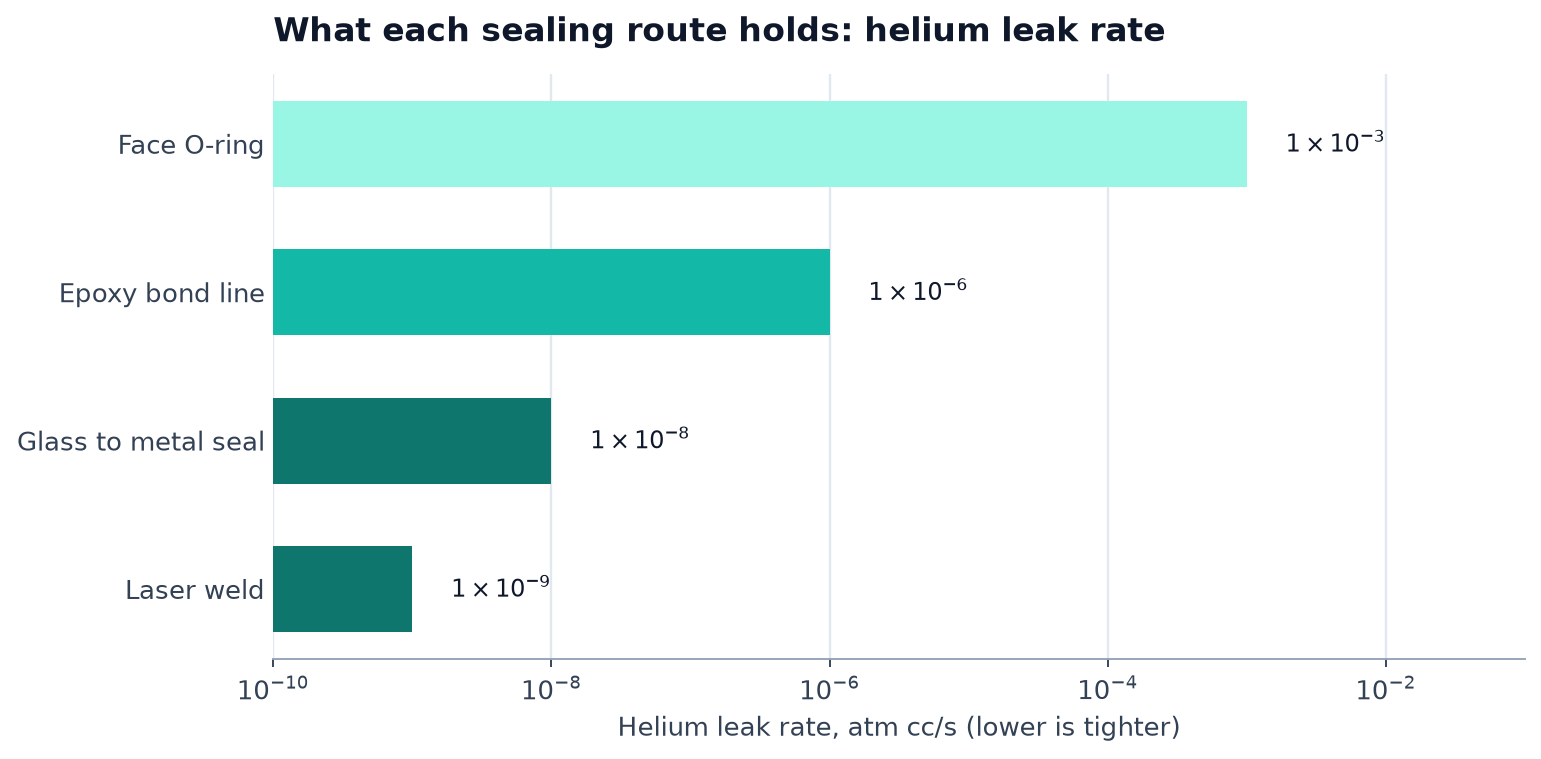
A face O-ring in a machined groove holds around 1 × 10⁻³ atm cc/s of helium. An epoxy bond line gets to 1 × 10⁻⁶. A glass-to-metal seal reaches 1 × 10⁻⁸. A laser weld closes at 1 × 10⁻⁹ or better.
Each route fails in its own way. O-rings fail by compression set and by a scratch across the sealing face, which is why I ask for 0.4 to 0.8 µm Ra there. Epoxy fails at the interface after thermal cycling or outgasses onto the sensor window. Glass-to-metal beads crack after a thermal shock. Welds fail on porosity, and most weld porosity traces back to plating.
An epoxy-only joint on a housing that sees 125 °C is a warranty claim in slow motion. I watched 4,000 units come back with a 22% field failure rate.
Material and CTE choices that decide the seal
Seals fail at interfaces, and interfaces fail on thermal expansion mismatch. Four numbers matter here.
- Kovar expands at 4.6 to 5.2 ppm/°C and matches 7052 borosilicate glass at 4.6, which is why it dominates feedthrough pins.
- 94% alumina runs 7.2 to 8.0 ppm/°C and pairs with Kovar pins in a compression seal.
- 316L stainless runs 16 to 17 ppm/°C. No glass matches it, so it needs an epoxy joint or a weld, never a matched glass seal.
- Ti-6Al-4V sits at 8.6 ppm/°C, close to alumina and light enough to cool fast, which makes it tempting and treacherous at once.
That last line is the trap. A titanium-to-alumina braze looks fine on paper, then a 165 °C reflow swing chips the ceramic at the fillet. Shield the seal or move it out of the hot zone.
Plating is the other decision buyers get wrong. Zinc or nickel on the weld land boils under the arc and leaves a pore behind. Weld first and plate after, or buy a pre-plated ring and weld to bare 316L; more on plating choices for steel parts.
Which process makes the housing
Metal injection molding suits 316L bodies with undercuts, bosses, and a sealing face that would take four setups on a lathe. Above roughly 5,000 pieces a year it is usually the cheapest route. Sintered density runs 96 to 98% of theoretical, and the remaining porosity can leak. Vacuum impregnation closes porosity down to about 0.2 mm; impregnation is a patch, not a hermetic design. See how to catch porosity before parts ship.
CNC machining stays the right answer for prototypes and runs under a few hundred pieces. A sealing face at 0.4 µm Ra needs a separate finishing pass and a flatness check, usually 0.05 mm across the joint. Cutting that face in the same op as the bore is how you get an unexplained leak.
Ceramic injection molding covers alumina bodies and feedthrough insulators that must hold 1 × 10⁻⁹ at 400 °C. Sintered alumina at 96 to 99.5% density is the only route I trust there without a metal seal.
Test methods that catch a bad seal
A leak test that runs before thermal cycling tells you little about a rooftop cabinet part. Run 100 cycles from -40 to +125 °C to IEC 60068-2-14 first, then test. Failures cluster after cycling, when the epoxy interface finally moves.
For fine leak, a helium mass spectrometer set to a 5 × 10⁻⁸ reject limit is the workhorse. Cost runs about 0.55 USD per part in a batch tray and 1.40 USD with a dedicated fixture and dwell. Gross leaks come out in bubble immersion, and welds get dye penetrant first. Verify inspection reports before you sign them off.
First pass seal yield on a new assembly runs 88 to 93%. With a tuned fixture and a settled cure it moves to 96 to 99%. The difference is scrap at 12 USD a housing, so ask for the yield number inside the quote.
Cost per sealed housing and the break-even point
Take one 316L housing, 40 mm across, one feedthrough. Assume 18,000 USD for a single cavity MIM tool, and 27,000 USD with a glass-to-metal seal fixture.
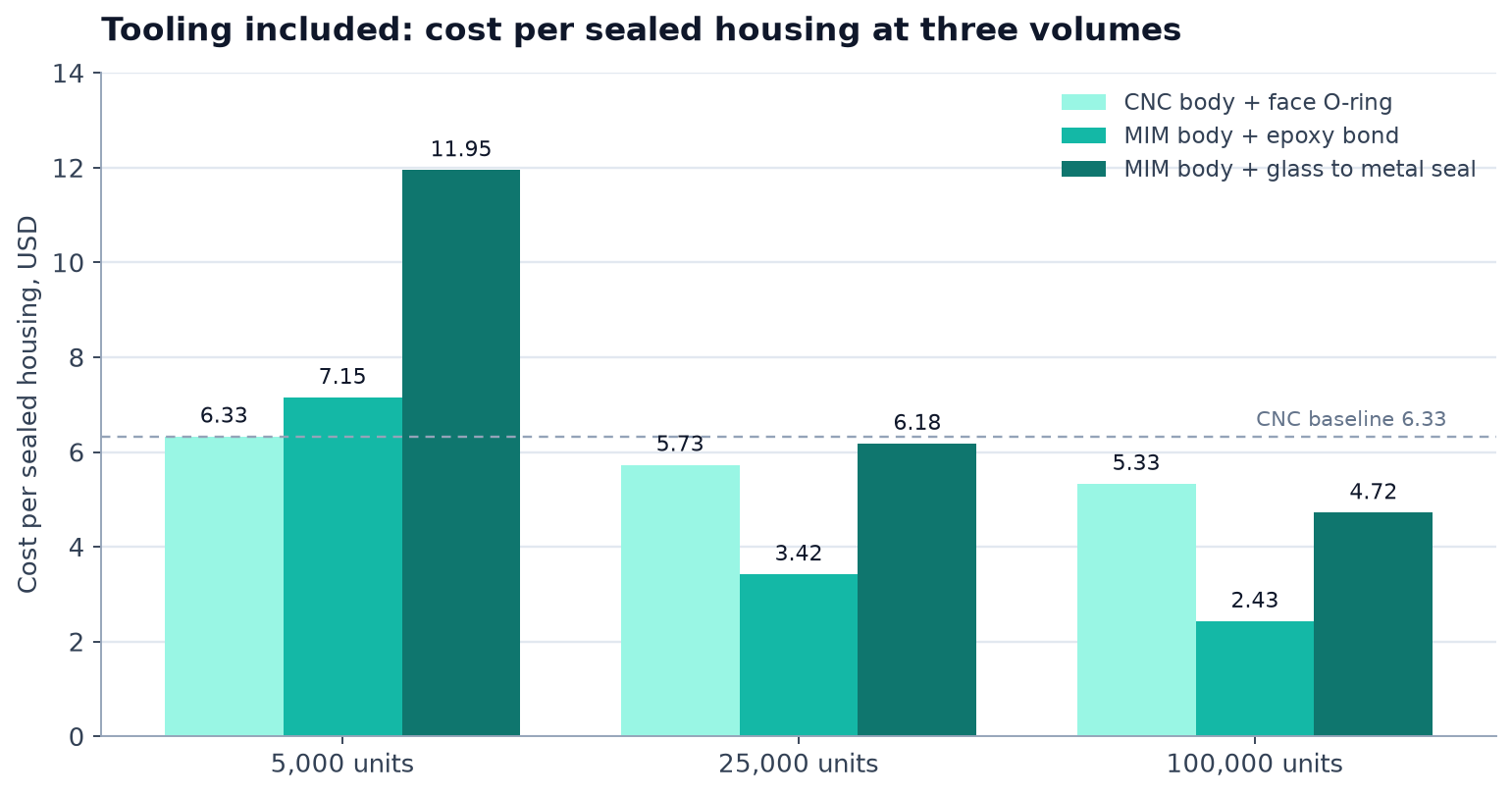
CNC with a face O-ring lands at 6.33 USD per housing at 5,000 pieces, 5.73 at 25,000, and 5.33 at 100,000. No tooling.
MIM with an epoxy bond lands at 7.15, 3.42, and 2.43 USD at the same three volumes. The crossover against CNC sits near 6,500 pieces, right where most sensor programs sit.
MIM with a glass-to-metal seal runs 11.95, 6.18, and 4.72. It runs about twice the epoxy route, and it is the only one of the three I would put on an implant or a 400 °C feedthrough.
If a supplier quotes 3.20 USD for a hermetic MIM housing at 5,000 pieces, ask what was excluded. Seal hardware, helium test, and yield loss are the usual missing lines.
What to ask before you send the drawing
Six questions, in the order I ask them.
- What leak rate, by which method, on every part or a lot sample?
- Which seal routes are allowed, and is the sealing face flat to 0.05 mm?
- Is the housing plated before or after welding?
- Who owns the seal fixture, and is it in the tooling quote?
- What was the first pass seal yield on the last three lots?
- What does the first article package cover for the seal itself?
A supplier who answers all six with numbers is worth a second meeting. One who answers three and drifts is not. Our how we work page walks through quoting and first article steps, and the quality page lists the certificates.
Housing work for electronics programs usually lands at 1 × 10⁻⁸ or tighter; medical programs go to 1 × 10⁻⁹ with documentation on top. The FAQ below covers the rest. Coastal 316L raises a grade question; see 316L versus 304 for marine use.
Frequently asked questions
What leak rate counts as hermetic for a sensor housing?
For most sensor housings, 5 × 10⁻⁸ atm cc/s of helium, tested to MIL-STD-883 Method 1014 condition A1, is the working definition. Implant feedthroughs often need 1 × 10⁻⁹. Anything looser than 1 × 10⁻⁵ is an ingress rating, not hermeticity.
How much does a helium leak test cost per part?
About 0.55 USD per part in a batch tray and 1.40 USD with a dedicated fixture and dwell. On a 5,000 piece order, per part testing adds roughly 4,250 USD.
Does an IP68 rating mean the housing is hermetic?
No. IP68 is an ingress rating under IEC 60529, and the depth and duration are set by the manufacturer. A housing can pass IP68 at 1.5 m for 30 minutes and still leak helium at 1 × 10⁻⁵.
Can a MIM housing be made hermetic?
Yes, with conditions. Sintered density needs to reach 96 to 98% of theoretical, and residual porosity needs vacuum impregnation. I would not run an impregnated MIM body above 125 °C, because the resin degrades and the leak returns.
How long does it take to qualify a new sealed housing?
Six to eight weeks for the mold, three to four for the seal fixture, two to first article, and about three for thermal cycling plus leak test. Ten to fourteen weeks total. A supplier promising six is quoting a different part.
Need Precision Metal Parts for Your Project?
Yujiaxin Tech specializes in MIM, CNC Machining, Powder Metallurgy, Investment Casting, and Gear Hobbing. Get a free quote within 24 hours.